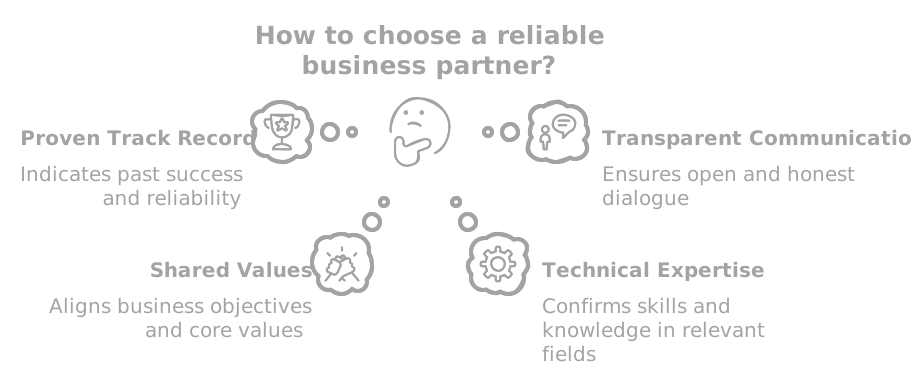
Choosing a partner, commercial, technical, or strategic, is one of the decisions that most shapes a business’s direction. Whether you are building custom software, launching a web application, or expanding into a new market, the right collaborator can make or break the outcome. It isn’t only about technical capability, but about character: how they behave when things get hard, when a deadline slips, or when an estimate turns out to be wrong. The hard part is that almost everyone looks reliable in a sales pitch. Reliability only reveals itself in how a partner acts under pressure, over time, when no one is watching. A dependable ally is recognized by a handful of traits you can actually observe:
- Transparency from day one: they speak plainly about costs, timelines, and risks.
- A track record that backs it up: verifiable history and references you can call.
- Steady, honest communication: they tell you early, even the uncomfortable parts.
- Aligned values and steadiness under pressure: they hold when there’s tension.
- A long-term mindset: they invest in the relationship, not just the next invoice.
Transparency from day one
A reliable partner doesn’t hide the uncomfortable parts. They speak plainly about costs, timelines, risks, and the limits of what they can deliver. That early honesty can feel awkward, because it punctures the easy optimism of a kickoff meeting, but it is one of the most valuable signals you will get. The way a partner handles inconvenient truths before you sign tells you almost everything about how they will handle them once the work is underway and the stakes are higher.
Be especially wary of anyone who only promises and never qualifies. A partner who claims every feature is simple, every deadline is comfortable, and every risk is negligible is not being confident; they are managing your expectations downward until reality arrives. Genuine experts are usually the ones willing to say “this part is harder than it looks” or “we should test this assumption before committing.” That nuance is a feature, not a weakness.
Transparency also shows up in the small operational details, long before any crisis:
- Clear pricing: a reliable partner explains what is included, what costs extra, and how change requests are handled, with no surprises buried in the fine print.
- Honest scoping: they distinguish between what they can commit to now and what depends on assumptions still to be validated.
- Named risks: instead of pretending the plan is perfect, they tell you where it could break and what the contingency is.
- Visible process: you can see how decisions get made, who is responsible for what, and how progress is tracked.
“Whoever is careless with the truth in small matters cannot be trusted with important matters.” This observation, attributed to Albert Einstein, captures why early transparency matters so much: the way a partner treats small truths predicts how they will treat the big ones.
A track record that backs the words
References and past work say more than any polished pitch deck. A verifiable history, clients willing to vouch for them, and projects that held up over time are difficult to fake. Anyone can describe their ideal process; far fewer can point to a body of work that proves they actually follow it. Relevant experience reduces uncertainty in a way that enthusiasm simply can’t, because it replaces what a partner says they will do with evidence of what they have already done.
The key word is relevant. A long résumé in a different domain is reassuring but not decisive. What you want is proof that the partner has solved problems close to yours: similar scale, similar complexity, similar constraints. A team that has shipped and maintained software in production understands a different set of realities than one that has only built demos, and that difference tends to surface at the worst possible moment if you skip the diligence.
When you evaluate a partner’s history, look past the highlight reel and check the substance:
- Reachable references: ask to speak with two or three past clients directly, and pay attention to how willingly the partner connects you.
- Work that aged well: projects that are still running and still maintained say more than launches that quietly disappeared.
- Retention as a signal: partners who keep clients for years usually earn that loyalty through consistent delivery, not lock-in.
- Honest war stories: a credible partner can describe a project that went sideways and what they learned, rather than claiming an unbroken record of perfection.
“Trust is built with consistency.” This line from author Lincoln Chafee is a useful filter: one impressive result can be luck, but a pattern of dependable results is character.
Steady, honest communication
The quality of a partnership shows up in the everyday far more than in the contract. Timely replies, updates you did not have to chase, and a willingness to deliver bad news early are the daily texture of a relationship that works. A good partner prefers a hard conversation today over an expensive surprise tomorrow, because they understand that problems rarely get cheaper or smaller by being delayed. Communication is the nervous system of any serious collaboration: when it is healthy, small issues get corrected quickly; when it is poor, they compound silently until they become emergencies.
Research consistently links communication to outcomes. The Project Management Institute has reported that ineffective communication is a primary contributor to project failure, meaning that a meaningful share of failed initiatives can be traced not to missing skills but to messages that were never clearly sent or received. That is encouraging, because communication is something you can assess before you commit, simply by paying attention to how a prospective partner behaves during the courtship.
Strong communicators tend to share a recognizable set of habits:
- Open channels: regular check-ins and shared updates, rather than a black box that goes quiet between milestones.
- Real feedback loops: they invite your input and actually adjust, instead of treating feedback as a formality.
- Composure in a crisis: when something breaks, they communicate the plan and the fix clearly instead of going dark.
- Right medium, right moment: they know when a quick message will do and when a problem deserves a real conversation.
“The single biggest problem in communication is the illusion that it has taken place.” Playwright George Bernard Shaw’s warning is exactly why you should test communication directly: assume nothing has been understood until it has been confirmed.
Aligned values and steadiness under pressure
Easy agreements get tested in hard moments. A reliable partner shares your view of what actually matters, quality, ethics, the long term, and holds steady when there is tension, a slipping deadline, or an unexpected obstacle. Shared values are not a soft, feel-good extra; they are the thing that decides which way a partner leans when there is a genuine conflict between speed and quality, or between their short-term gain and your long-term interest. When values line up, those moments resolve quietly. When they don’t, every difficult decision becomes a negotiation.
Steadiness under pressure is the trait you most want and least get to observe in advance, so look for proxies. How does the partner talk about past clients who were difficult? Do they take ownership of mistakes, or is there always an external party to blame? Adaptability matters here too: in fast-moving fields, a dependable partner can adjust the plan when circumstances change without using that change as an excuse to quietly drop quality or commitments. Firmness and flexibility are not opposites; the best partners hold firm on principles and stay flexible on tactics.
A few signals help you read values and resilience before a crisis forces the issue:
- Aligned mission: their definition of a good outcome resembles yours, not just on price but on quality and on how the work gets done.
- Ethics under load: they hold their standards when cutting a corner would be faster, cheaper, or easier to hide.
- Ownership of mistakes: they name errors plainly and focus on the fix, instead of constructing a story where nothing was their fault.
- Calm under stress: pressure makes them more communicative and more deliberate, not more evasive.
“Alone we can do so little; together we can do so much.” Helen Keller’s words are a reminder that a real partnership is judged not by the easy stretches but by how much the two of you can carry together when it gets heavy.
Building a long-term relationship
The traits above are not a one-time checklist you run before signing and then forget. The strongest partnerships are relationships that get more valuable over time, as the partner learns your business, anticipates your needs, and earns the kind of trust that lets you move faster together. Studies on organizational performance repeatedly find that strategic partnerships and effective collaboration improve results, but those gains accrue to the relationships that are actively maintained, not to the ones treated as a single transaction and then neglected.
Maintaining that relationship is a two-way responsibility. The best partners invest in it through regular engagement, honest feedback in both directions, and a shared commitment to navigating problems together rather than assigning blame. They celebrate the wins, they own their part of the setbacks, and they keep one eye on where you are heading next so the work compounds instead of restarting with every project. That long-term orientation is, in the end, what separates a vendor you hire from a partner you build with.
In short
A reliable partner is recognized by how they act, not by how they present: transparency about the hard parts, a track record you can verify, steady and honest communication, aligned values that hold under pressure, and a genuine commitment to the long term. None of these traits show up in a logo or a slogan; you find them by asking direct questions, calling references, and watching how a prospective partner behaves before there is any contract to enforce. At LabWeb we try to be that kind of ally: clear about timelines, honest about risks, communicative when it would be easier to go quiet, and committed to building software and relationships that last. If you are looking for a partner who acts like one when it counts, that is exactly the standard we hold ourselves to.