
We fortify your future
Whether you're looking to:
Our team of experts is here to bring your vision to life.
Exceptional Solutions Designed for You
Explore a suite of state-of-the-art cybersecurity solutions tailored to meet the unique challenges of today’s digital landscape. From robust laptops and mobile threat protection to comprehensive data protection and identity management, our offerings ensure maximum security at every level. Designed with advanced encryption, zero-trust architecture, and multi-layered defenses, our solutions empower organizations to maintain data integrity, secure communications, and safeguard against emerging threats. Discover how our exceptional solutions can elevate your security posture and protect your most valuable assets.
Durable and Secure Laptops
Our security laptops undergo rigorous military-standard testing, offering durability in extreme conditions with built-in tamper detection. They ensure reliable protection even in harsh environments, maintaining high standards of performance.
They ensure anonymous browsing, leaving no trace of activities behind for maximum privacy. This feature guarantees the confidentiality of users' actions for both business and personal use.
With secure operating systems, encrypted storage, and custom hardware, these laptops are designed for uncompromising security. Enhanced measures ensure that critical data is kept safe from unauthorized access.
Mobile Threat Protection
Our mobile devices are designed to guard against spyware, malware, and advanced threats, including Pegasus, to protect user privacy. They provide comprehensive threat detection for full protection on the go.
Built with tamper detection and rugged durability, they offer secure communication and resilience in harsh environments. Users can communicate confidently without the risk of interception.
Features include encrypted voice and video calls, blocking risky network features like SMS and MMS for robust mobile security. This adds a significant layer of defense against potential breaches.
Multi-Layered Security
Our multi-layered protection solution safeguards devices and data with overlapping layers of security to address evolving threats. This layered approach ensures that threats are met with a broad spectrum of defenses.
It integrates threat detection, data encryption, and network monitoring for comprehensive defense. Such integration strengthens the organization's overall security posture.
Each layer works together to mitigate risks, ensuring a secure environment for sensitive information. The design helps prevent potential data loss or breaches effectively.
Zero Trust Architecture
Our zero-trust solution enforces strict access controls, verifying every request to ensure security from inside and outside the network. This ensures that each user and device is authenticated at every step.
It operates on the principle of least privilege, minimizing exposure to threats by limiting access to only essential data and applications. This minimizes potential vulnerabilities and maintains system integrity.
With continuous monitoring, this approach ensures a secure, trustless environment that adapts to potential vulnerabilities. It supports proactive risk management and threat response.
Advanced Threat Detection
Our threat analysis solution detects vulnerabilities like zero-day exploits and zero-click attacks to preemptively secure systems. This early detection reduces response times and mitigates potential impacts.
It offers policy control and comprehensive data encryption, protecting against emerging and persistent threats. This layered approach boosts an organization's overall resilience.
By proactively identifying risks, this solution empowers organizations to respond quickly and minimize potential damage. Preparedness ensures business continuity and reduced downtime.
Protected Networks
Our secure networking solution ensures data integrity through encrypted connections and stringent access controls. This approach secures communications both internally and externally.
It minimizes exposure by managing secure communication channels and blocking unauthorized network access. This helps maintain the confidentiality and safety of transmitted data.
With this solution, sensitive data and communications remain protected, reducing the risk of interception and attacks. This creates a safer communication ecosystem for businesses.
Advanced Identity Verification
Our identity management solution securely authenticates users, ensuring that only authorized personnel access sensitive systems. This prevents unauthorized parties from compromising critical assets.
With multi-factor authentication and biometric options, it strengthens security and enhances access control. These features are vital for meeting stringent security standards.
This solution supports compliance requirements and reduces the risk of unauthorized access to valuable data. This guarantees adherence to industry regulations and internal policies.
Robust Data Security Measures
Our data protection solution secures sensitive information with encryption and data masking for enhanced confidentiality. This ensures that data remains protected at every stage.
It includes real-time monitoring and intrusion detection to prevent data breaches and unauthorized access. This enables swift detection and response to any threats.
Designed to meet strict data security regulations, this solution ensures information integrity and reduces compliance risks. Businesses can trust that their data is safeguarded.
Advanced Encryption for Safety
Our encryption tools protect data at rest and in transit, safeguarding it against unauthorized access and breaches. This ensures the highest level of data privacy and confidentiality.
With support for industry-standard encryption protocols, our solution enhances data security across all channels. It effectively maintains protection during all stages of data handling.
These tools provide essential protection for sensitive information, ensuring compliance and peace of mind. Organizations can maintain trust by securing their data assets.
How Mexico's Software Industry Is Adapting to Cybersecurity Concerns
Cybersecurity is no longer just a concern for large corporations. As more Mexican companies digitize their operations, the country’s software development industry has had to mature fast to protect data, meet regulations, and earn the trust of local and international clients. Threats evolve at an unprecedented pace, and with them the demand to defend every application from the design stage rather than as a last-minute patch. That pressure has reshaped how software gets built in Mexico, and it is worth understanding how the shift is unfolding, because it marks the difference between a provider that reacts to problems and one that prevents them.
The change is visible on four fronts that advance in parallel:
- From a cost to a business priority.
- Standards and compliance as a differentiator.
- Specialized security talent.
- A security culture that involves the whole team.
From a cost to a business priority
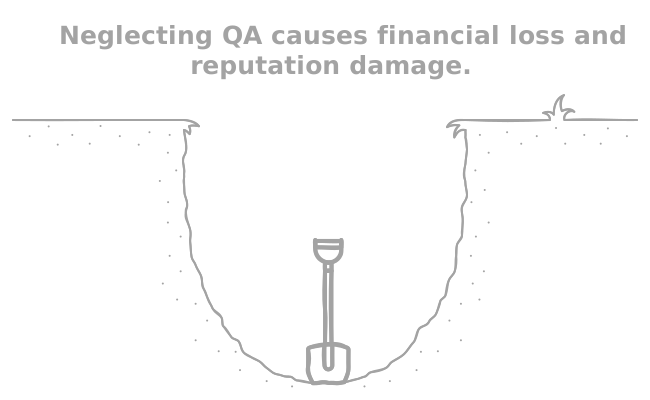
For years, security was handled at the end of a project, almost like a formality before launch. Today, Mexican companies build it in from the design stage: threat modeling, code reviews, and penetration testing are part of the development cycle, not an afterthought. The shift reflects a simple, hard-to-argue reality: a breach costs far more, in money and reputation, than preventing one in time.
That calculation became unavoidable once teams started measuring the true cost of an incident. Fixing a vulnerability found in production is far more expensive than catching it during design, and that is before counting regulatory fines, lost customers, and the brand damage that usually follows a leak. So investment in security stopped looking like an expense that eats into margin and started being understood as insurance that protects the entire business.
On top of that logic sits a number no serious team can ignore: a large share of attacks targets small and midsize companies, precisely the ones that historically skipped the basics for lack of time or budget. In a country where the digital economy grows faster than risk awareness does, that gap is exactly the opening attackers exploit. Closing it does not require huge budgets, just early decisions and steady discipline.
The practices that support this preventive approach are already part of the daily work of serious teams:
- Regular vulnerability assessments. Reviewing systems routinely surfaces weak points before someone exploits them, and early detection prevents costly breaches.
- Threat modeling. Anticipating how an adversary might attack helps teams design countermeasures from the start instead of improvising them under pressure.
- Penetration testing. Simulating real attacks against the application reveals flaws that normal development cycles do not always catch.
“Security is not a product, but a process.” Bruce Schneier, one of the world’s most respected cryptographers, said it, and it captures the underlying shift: protecting software is an ongoing practice, not a box you check once.
The takeaway is direct: when security is considered from day one, it stops being a brake and becomes a solid foundation the product can grow on without surprises. And a product that grows without surprises is, almost always, a product that scales better.
Standards and compliance as a differentiator
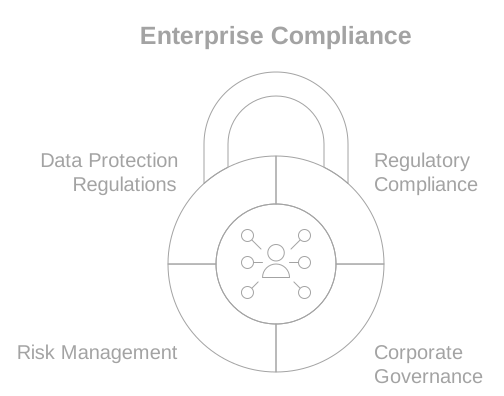
Frameworks like ISO 27001, SOC 2, and data-protection requirements, including Mexico’s Federal Law on the Protection of Personal Data Held by Private Parties (LFPDPPP), have become part of teams’ everyday language. For many Mexican providers, demonstrating compliance is now as much of a selling point as price or speed, especially when working with clients in the United States and Europe, where security due diligence is mandatory.
Compliance has stopped being a formality and turned into a key that opens markets. A company that can show certifications, clear data-handling policies, and auditable controls unlocks doors that used to be closed to providers from the region. In large contracts, the absence of those credentials often disqualifies a candidate before the technical proposal is even discussed, so investing in compliance became a commercial decision, not just a legal one.

Compliance also forces a team to put its own house in order. To get certified, you have to document how you handle data, who can access what, and how you respond to an incident, and that exercise usually surfaces gaps no one had looked at head-on. The result is twofold: the company becomes more sellable and, along the way, more secure, because the same policies that reassure an auditor are the ones that slow down an attacker.
In practice, compliance translates into concrete habits that teams fold into their operations:
- Sensitive data mapping. Knowing what information is collected, where it lives, and who can touch it is the first step to protecting it and to responding to an audit.
- Encryption at rest and in transit. Safeguarding data both when stored and when moving across the network reduces the impact of unauthorized access.
- Traceability and logging. Keeping records of who did what and when makes it possible to spot anomalies and to demonstrate diligence to regulators and clients.
According to the OWASP Top Ten project, a large share of applications remain vulnerable to known flaws, which confirms that compliance only protects when it turns into real technical practice.
The message for the sector is clear: compliance done right is not bureaucracy, it is tangible proof that a company takes seriously the data entrusted to it.
Specialized security talent
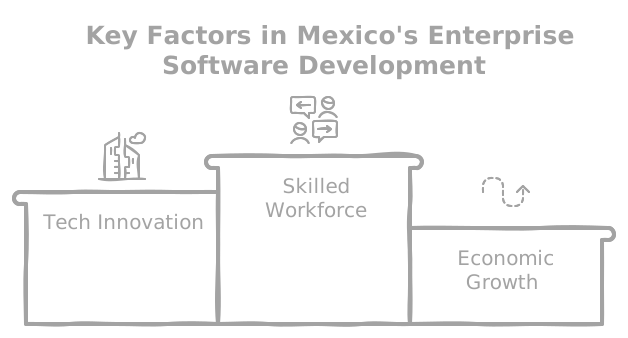
Demand has driven the growth of specialized roles, from security engineers to incident-response teams, along with a growing ecosystem of certifications and communities. That talent lets companies not just react to threats but design resilient software from the start. The difference between a team that fights fires and one that prevents them almost always comes down to the depth of its security knowledge.
Training has become the central lever of this transformation. Recognized certifications, such as CISSP or Certified Ethical Hacker, give developers a common framework for talking about risks and controls, while hands-on threat-modeling workshops put them in front of real attack scenarios before they happen in production. A significant share of successful incidents exploits already known vulnerabilities, so closing that knowledge gap has an immediate effect on any organization’s security.
What is interesting is that this talent does not form in classrooms alone. Security communities, capture-the-flag competitions, and forums where engineers share findings create a learning loop that moves faster than any curriculum. In Mexico, that informal fabric grows year after year, and it is precisely what lets a developer move from writing code that works to writing code that holds up.
Building that secure workforce combines several pieces:
- Secure coding training. Regular sessions on secure coding techniques help developers adopt a security-first mindset across the whole lifecycle.
- Recognized certifications. Credentials like CISSP or CEH deepen a developer’s command of security protocols and vulnerability management.
- Practice with simulated attacks. Penetration exercises and controlled labs let teams learn from real threats without exposing production data.
“The future belongs to those who prepare for it today.” The line, attributed to Malcolm X, captures the spirit of security training: preparing today is what secures a more resilient tomorrow.
That talent is also what makes the nearshore model from Mexico so attractive: teams that understand security, share a time zone with the United States, and can plug into demanding projects without lowering standards. When a company wants to build custom software that is also defensible, finding the right people stops being a detail and becomes an advantage.
A security culture, not just tools
The deepest adaptation isn’t technological but cultural: ongoing training, least-privilege principles, and the idea that security is the whole team’s responsibility, not one department’s. That mindset is what turns compliance into real protection, because no tool helps if the people using it do not understand why it matters.
The approach that best embodies this culture is DevSecOps: integrating security into every stage of development, from planning through deployment, instead of treating it as a final review. When security is shared across roles, it stops being one isolated team’s bottleneck and becomes a natural part of the workflow. Add continuous monitoring, which makes it possible to detect anomalous behavior and respond to incidents in real time, before they escalate.
This culture matters even more with the cloud and automation. When infrastructure is deployed with a few lines of code, a single misconfiguration can expose an entire database in minutes, so security has to travel inside the same tools developers already use. That is why mature teams treat secure configuration, encryption, and secrets management as part of the product, not as an optional step at the end.
Building that culture comes down to everyday decisions more than big announcements:
- Least-privilege principle. Giving each person and each service only the permissions they need limits the damage if a credential is ever compromised.
- Security as a shared responsibility. When designers, developers, and operations own security together, flaws are caught earlier and fixed faster.
- Continuous learning. Reviewing past incidents without hunting for someone to blame turns every mistake into a lesson that strengthens the whole team.
“The best way to predict the future is to create it.” The idea, popularized by Peter Drucker, sums up how teams that design their security deliberately shape a more resilient future instead of merely reacting to it.
The underlying lesson is that technology changes fast, but culture is what sustains security over time. A team that internalizes these habits protects its products even against threats that do not exist yet.
In short
Mexico’s software industry has gone from seeing cybersecurity as a requirement to treating it as a competitive advantage. The change rests on four pillars that reinforce one another: prevention from the design stage, compliance as a differentiator, specialized talent, and a shared security culture. Where there used to be last-minute patches, there are now processes, standards, and teams ready to build software that holds up and scales without opening the door to needless risk.
At LabWeb we build security and compliance in from the architecture, not as an add-on, so your product protects your users’ data and your business’s reputation as it scales. If you are looking for a partner that understands security and quality go hand in hand, we are exactly that kind of team.
Full-Cycle Cybersecurity Expertise
Discover our comprehensive cybersecurity services, from analysis to ongoing support, designed to protect your digital infrastructure. Our step-by-step approach ensures tailored, resilient, and secure solutions.
Strategic Requirement Analysis
We analyze your attack surface and compliance requirements before any tool. Security starts by understanding risk.
We map critical assets, sensitive data, and threat vectors. Scope is defined by what must be protected.
We set clear security, compliance (ISO 27001, SOC 2), and incident-response criteria.
Innovative Discovery & Design
We design a layered security architecture with least-privilege principles. Defense is planned before building.
We threat-model the real flows to anticipate failures. Preventing costs less than reacting.
We validate key controls, authentication, encryption, segmentation, in the design.
Robust Alpha Development
We build with secure development practices: code review, secrets management, controlled dependencies. Security is part of the code.
We integrate monitoring, logging, and detection early. What isn't observed isn't protected.
We iterate, hardening the system as new findings appear.
Comprehensive Testing
We test with penetration testing, vulnerability analysis, and incident drills. We attack the system before a third party does.
We validate encryption, access controls, and failure resilience in real scenarios. Defense is demonstrated.
Every vulnerability is documented, fixed, and re-verified with traceability.
Strategic Product Updates
We evolve defenses as threats change and new vulnerabilities appear. Security is never finished.
We prioritize patches and improvements by risk and impact. The critical is handled first.
Each update maintains compliance and reduces the attack surface.
Seamless Deployment & Integration
We plan a deployment that opens no gaps: hardened configuration and pre-checks. Go-live is controlled.
We integrate with your systems and migrate with encryption and verification. Nothing is exposed without validation.
After deployment we run security checks in the real environment.
Continuous Support & Maintenance
We provide continuous monitoring and incident response to protect you after launch. The threat doesn't rest.
Proactive maintenance applies patches and hardens defenses before an attacker acts.
We resolve incidents with clear, traceable processes, sustaining your security posture.
Let's Get In Touch!
Send us a message, and we'll promptly discuss your project with you.
What's Next?
- We start by signing an NDA to ensure your ideas are protected.
- Then, our team will analyze your requirements.
- You get a detailed project outline.
- We bring your project to life, so you can focus on growing your business.
© 2019–2026 LabWeb · Laboratorio Internacional Web S.A. de C.V. · All rights reserved.