
Good software doesn’t happen by accident, it’s the result of a process. At LabWeb we work full-cycle, walking your project from the first conversation to long after launch, because that’s where it’s decided whether technology drives you forward or holds you back. Most projects that fail don’t fail for lack of technical talent, they fail by skipping steps: writing code before understanding the problem, shipping without really testing, or vanishing the day after going live. These are the phases we use to turn an idea into a reliable product, and why each one matters.
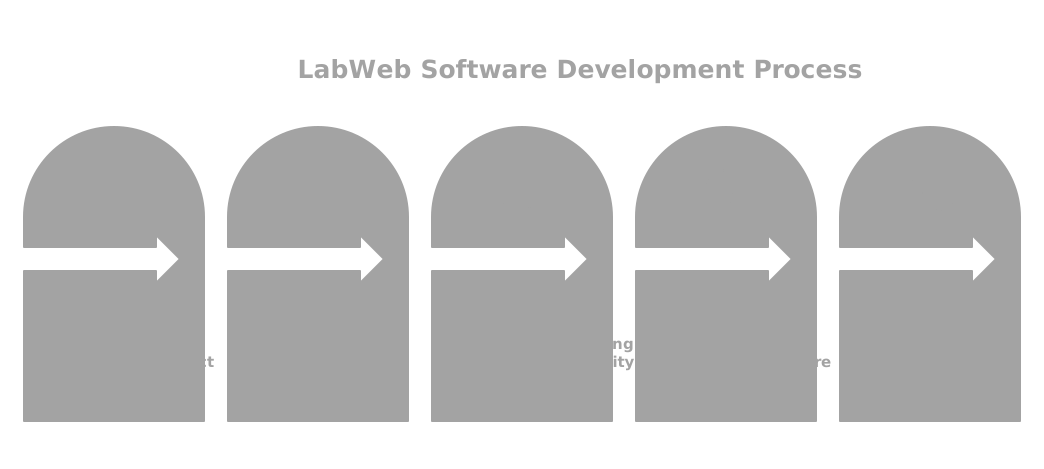
Before going into detail, here is the full journey at a glance:
- Requirement analysis and planning.
- Discovery and design.
- Development and testing.
- Deployment, integration, and migration.
- Evolution and ongoing support.
Requirement analysis and planning
It all starts with understanding the problem before writing a single line of code. We define goals, scope, and priorities, and map a route with clear milestones. This phase looks like the least “technical” one, but it saves the most money: aligning what the business needs with what the technology allows is exactly what prevents costly surprises later. A requirement misunderstood at the start multiplies into wasted hours across the rest of the project.
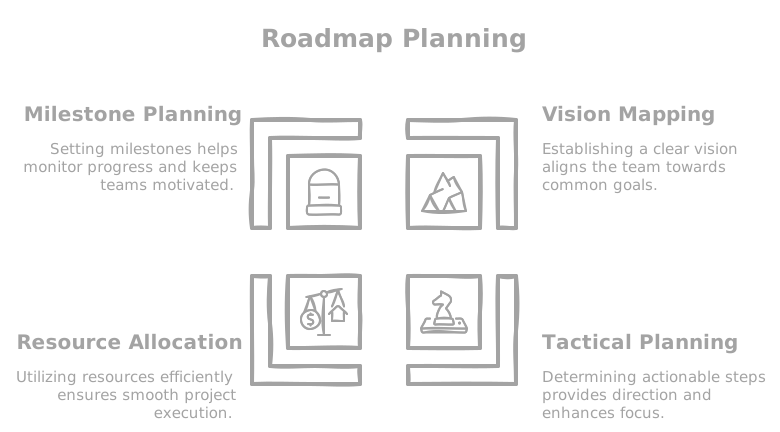
This isn’t about documenting for the sake of it, it’s about making hard decisions early, while they are still cheap. What goes into the first version and what can wait? What assumptions are we making about users, and how will we test them? Honest planning admits what isn’t known yet and leaves room to discover it, instead of faking certainty and paying for it down the line.
- Goals before features. We start from the business outcome you’re after, not a list of screens, so every feature exists for a reason.
- Scoped, phased delivery. Defining what stays out is as important as defining what stays in: a realistic scope protects the budget and the schedule.
- Risks in plain sight. We identify the fragile points (integrations, data, external dependencies) from the start, so we can tackle them before they become emergencies.
- Clear success criteria. We agree on how we’ll measure that the project worked, giving future decisions an objective reference point.
“If I had an hour to solve a problem, I’d spend fifty-five minutes thinking about the problem and five minutes thinking about solutions.” The line, often attributed to Albert Einstein, captures why we begin by understanding before we build.
Discovery and design
With the direction set, we dig into users and real workflows. Design isn’t just aesthetics: it’s architecture, experience, and the decisions that make a product easy to use and to maintain. This is where we translate business goals into something concrete that people can see, touch, and criticize before it truly exists. Validating prototypes early lets us fix on paper what would be expensive to fix in production.

Discovery is also the moment to challenge assumptions. Clients often arrive with a solution already in mind, and our job is to understand the problem behind it so we can propose, perhaps, a better path. A prototype a real user can walk through reveals in minutes what a thousand meetings cannot: where they get confused, where they give up, what they expected to find and didn’t. That early feedback is one of the most profitable investments in the whole cycle.
- User research. We talk to the people who will use the product, so we design from real needs rather than internal guesses.
- Architecture from day one. We think through the technical structure alongside the experience, so the design is buildable and scalability isn’t a patch bolted on later.
- Clickable prototypes. We test ideas with interactive mockups before writing code, while changing course still costs little.
- Designed to maintain. Consistent decisions and a clear component system make the product cheaper to evolve over time.
“Design is not just what it looks like and feels like. Design is how it works.” Steve Jobs said it, and it captures why, for us, experience and engineering are the same conversation.
Development and testing
We build in short cycles, with deliverables you can see and comment on. Each increment is tested (functionality, performance, security) so quality isn’t a final step but part of the journey. Working this way, with constant feedback, lets us adapt when priorities shift without losing the thread. A product that’s shown every few weeks is a product that never drifts too far from what the client actually wanted.
We treat testing as part of development, not as a stage that gets cut when the schedule tightens. Automated tests act as a safety net: every change is checked against hundreds of verifications, so moving fast doesn’t mean moving blind. And security is built into the code, not sprayed on at the end, because a slip here can cost far more than any feature someone tried to rush. It’s the same care we bring to cybersecurity on every project.
- Short, visible iterations. We deliver in increments you can review early, so we correct course with real information instead of guesswork.
- Quality built in. Automated tests travel with every change, so bugs are caught as they’re introduced, when they’re cheap to fix.
- Security by design. We address data protection and good practices from the architecture, not as a last-minute touch-up.
- Code made to last. We write for the next developer who reads it, because clear software is software you can maintain and grow.
“Quality is not an act, it is a habit.” The idea, drawn from Aristotle, describes exactly how we see testing: something everyday, not a final exam.
Deployment, integration, and migration
The launch is planned to minimize disruption. We handle integration with your existing systems and data migration with thorough checks, so deployment day is a controlled formality rather than a leap into the dark. A good launch stands out precisely because it barely shows: users keep working and, suddenly, things simply work better.
The tricky part is almost never turning the new system on, it’s living alongside the old one. Legacy data is rarely as clean as everyone hopes, integrations with other tools hold surprises, and there’s always an edge case nobody had considered. That’s why we rehearse the deployment, prepare a rollback plan, and migrate with checks that confirm, record by record, that nothing was lost along the way. The goal is that if something goes wrong, we can go back in minutes rather than days.
- Rehearsed deployment. We test the launch process in staging environments so the real day holds no surprises.
- Careful integration. We connect the product to your current systems while respecting what already works, instead of forcing you to replace everything at once.
- Verified migration. We move data with controls that confirm its integrity, because one lost record can be worth more than many hours of development.
- Rollback plan. We always prepare a safe exit, so any hiccup is handled calmly rather than as a crisis.
Evolution and ongoing support
The work doesn’t end at production, that’s where the product’s real life begins. We maintain it, monitor performance, and evolve features based on real usage and new needs. A partner who stays after launch is the difference between a project that ages and one that keeps improving. Software isn’t a deliverable you hand over and forget; it’s closer to a living organism that needs attention to stay healthy.
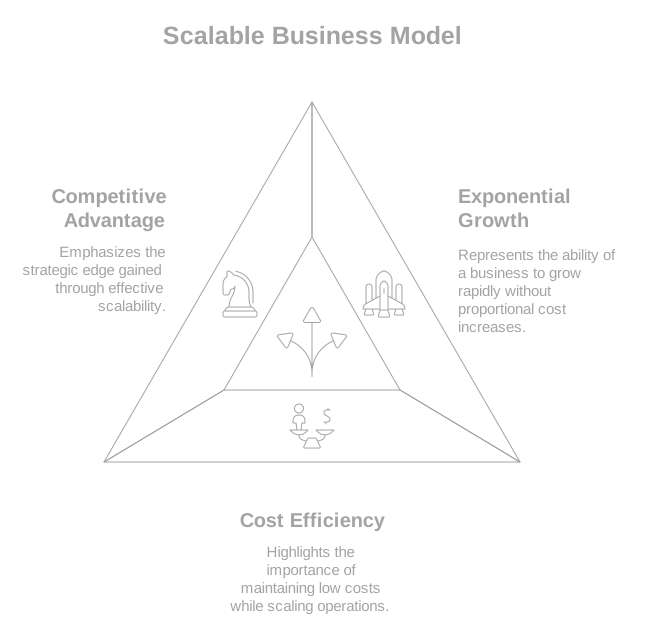
Once it’s running, real data starts telling the true story. Which features get used and which don’t? Where do users get stuck? What traffic spike puts the infrastructure to the test? That information guides the product’s evolution with facts, not opinions. And maintenance isn’t only putting out fires: it’s applying security updates, watching performance, and preparing the ground for the system to grow as the business does. Thinking about scalability ahead of time is what spares you from rebuilding under pressure.
- Constant monitoring. We watch behavior in production to catch problems before the user notices them.
- Data-driven improvement. We prioritize changes based on real usage, so every update solves something that genuinely matters.
- Preventive maintenance. We handle updates, security, and performance regularly, so small problems don’t grow into large ones.
- Ready to scale. We support the product’s growth without having to rebuild it, because the architecture already accounted for that future.
“The only constant is change.” The maxim, traced back to Heraclitus, explains why for us support isn’t the end of the project but its most mature form.
In short
Full-cycle isn’t bureaucracy: it’s how you deliver well the first time and sustain quality over time. Each phase exists to reduce risk and raise the odds that your idea not only reaches production but thrives there. Skipping steps almost always costs more than working through them, the bill just arrives later, and with interest.
At LabWeb we operate as an extension of your team at every phase, from the first conversation to the support that keeps your product alive. Whether it’s custom software, a web application, or a system that needs to grow with your business, we’re with you so your idea reaches production solidly and keeps improving long after launch. If you’re looking for a partner who won’t disappear the day after the system turns on, let’s talk.