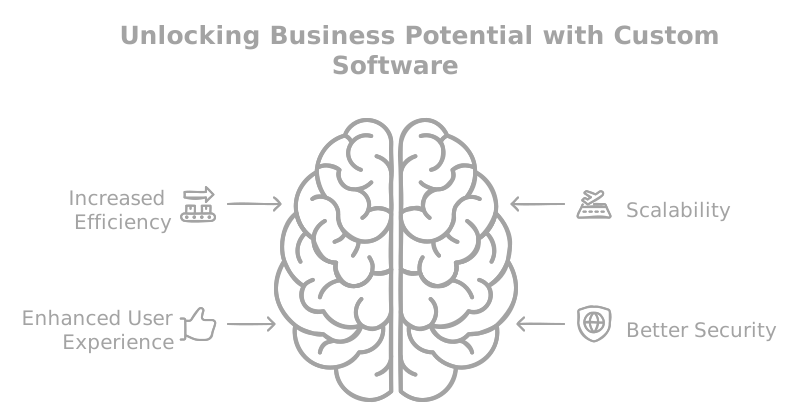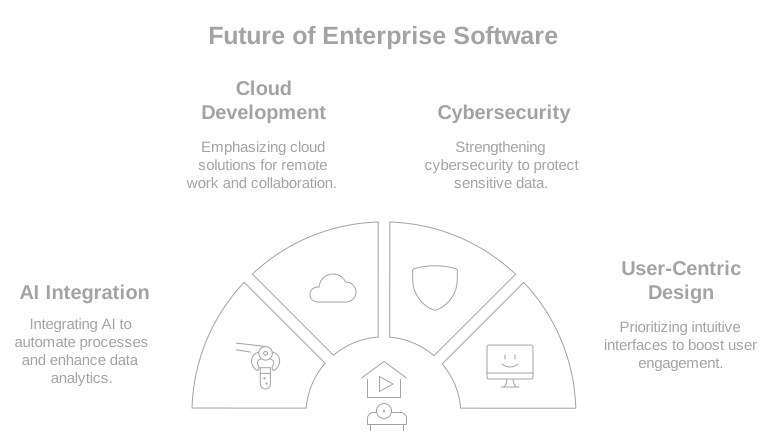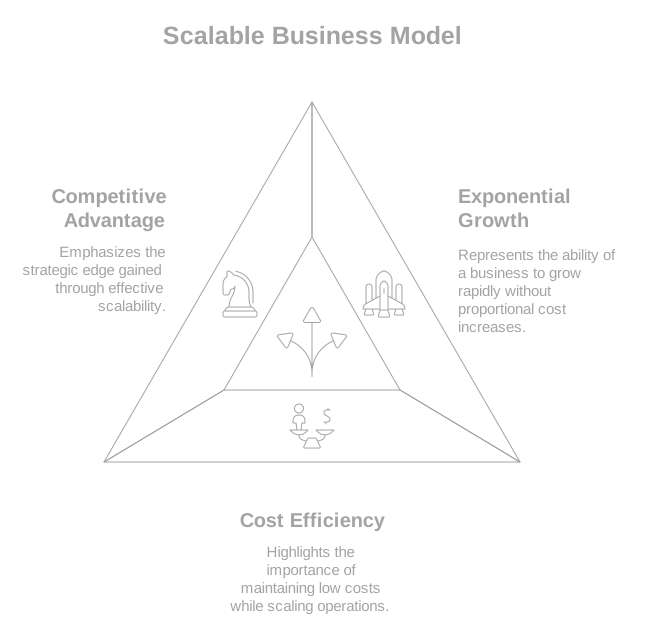
Growing and scaling aren’t the same thing. A business grows when it sells more; it scales when it can serve far more without its costs rising at the same pace. The difference sounds subtle, but it is the line that separates companies that consolidate from those that collapse just when everything seemed to be going well. Measuring that capacity before you accelerate avoids the classic mistake of doubling revenue and, with it, doubling the chaos. The good news is that scalability isn’t a mystery: it can be observed, measured, and improved with concrete numbers.
Before you hit the gas, it helps to be clear about the signals that separate a scalable model from one that is merely growing through sheer effort. These are the ones that matter most:
- Margins that improve as volume grows.
- Repeatable processes that don’t depend on indispensable people.
- Technology and automation that hold the operation together.
- Clear metrics for customer acquisition and retention.
- Technical and financial maturity to absorb a jump in demand.
Margins that improve with volume
The first sign of a scalable model is that each additional sale costs proportionally less to serve. If your margins hold or improve as you grow, the model has room to leverage; if they compress, you’re growing at the expense of profitability. It’s the difference between a business that gains strength with every new customer and one that drowns in its own costs precisely when it sells the most.
The key is separating fixed costs from variable ones. A truly scalable model spreads its fixed costs across more customers while keeping variable costs under control. Software is the perfect example: building a platform costs the same whether a hundred or a hundred thousand people use it, and that tipping point is what turns volume into real profitability instead of constant pressure.
To understand whether your margins are keeping pace with growth, it’s worth watching a few indicators closely:
- Contribution margin: how much each sale leaves once variable costs are deducted. If that margin rises with volume, you’re on the right track; if it falls, there’s a leak worth fixing before you scale.
- Marginal cost per customer: what it costs to serve one more customer. In a scalable model, that figure trends downward as the operation matures.
- Break-even point: the volume at which the business starts turning a profit. The sooner you reach it, the more room you have to reinvest in growth.
“If you can’t measure it, you can’t manage it.” The line often attributed to Peter Drucker captures why margins are the first thermometer of any model that aims to scale.
Repeatable processes, not heroes
A business that depends on indispensable people or heroic efforts doesn’t scale, it burns out. Repeatability (documented processes, clear roles, standardized decisions) lets you add volume without reinventing operations each time. The key question is whether you could deliver ten times more without ten times more improvisation. If the answer depends on one particular person never getting sick or taking a vacation, the model isn’t ready yet.
Companies that scale well turn their knowledge into systems. What once lived in the founder’s head ends up written into playbooks, templates, and workflows that anyone on the team can follow. Slack, for instance, started as an internal communication tool for a video game studio and grew into a global collaboration platform precisely because it standardized the experience and made it repeatable for millions of teams.
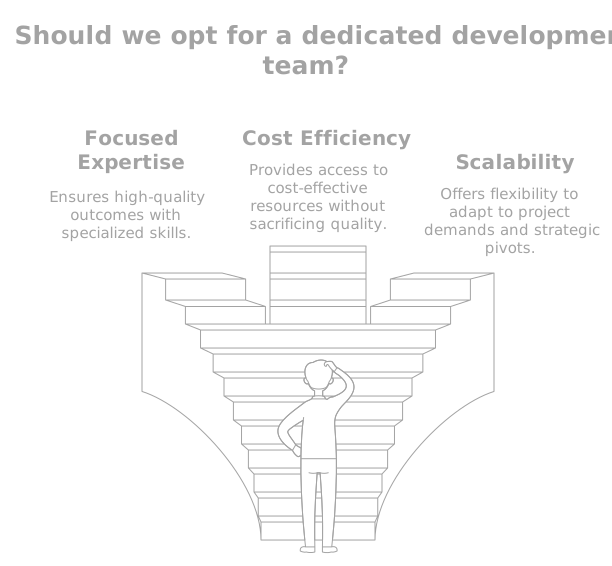
Making operations repeatable doesn’t mean making them rigid; it means removing the dependency on improvisation. A few elements make the difference:
- Living documentation: written processes that get updated alongside the operation, not manuals nobody opens again after the first day.
- Clear roles and responsibilities: everyone knows what they decide and what they deliver, which prevents bottlenecks from forming around specific people.
- Standardized decisions: defined criteria for common cases, so the team resolves things quickly without escalating everything upward.
- Fast onboarding: a new hire becoming productive in weeks rather than months is one of the strongest signs that a model is truly repeatable.
Technology and automation as leverage
Software is what keeps effort from rising in lockstep with demand. Automating repetitive tasks, integrating systems, and removing manual work turns growth into something sustainable rather than exhausting. Where you put in more hours today, you should be able to put in better technology tomorrow. Swapping hours for systems is, at its core, the central mechanic of any business that genuinely scales.
Cloud infrastructure rewrote the rules. Growing used to mean buying servers and praying you didn’t fall short or overspend. Today, platforms that scale on demand let you absorb traffic spikes without massive upfront investment. Zoom is an emblematic case: it went from ten million daily participants to more than three hundred million in a matter of months during 2020, and it could only do so because its technology was built to grow without rewriting everything from scratch.
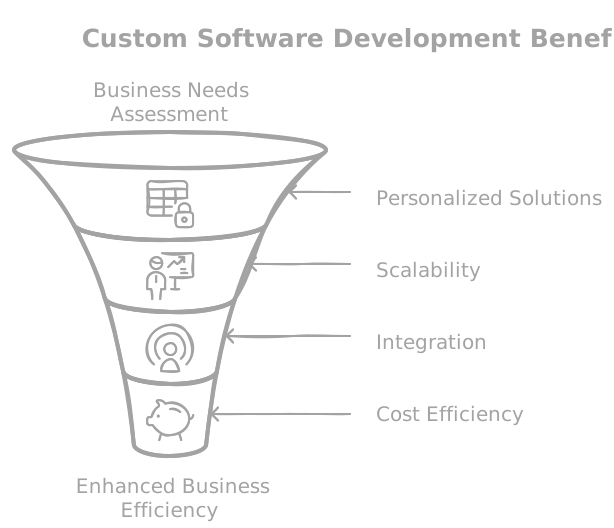
Technology leverage shows up when the operation grows faster than the team holding it together. These are the fronts where it pays off most:
- Automating repetitive tasks: any manual process repeated many times is a candidate for automation, freeing the team for the work that genuinely requires human judgment.
- System integration: when tools talk to each other, information flows without re-entry or errors, and the operation stops depending on fragile spreadsheets.
- Elastic infrastructure: the cloud lets you pay for what you use and scale in minutes, not months, when demand calls for it.
- Custom software: when your key processes are your edge, a solution built for you scales better than forcing generic tools that never quite fit.
“The only way to scale is to get more people using your product.” Stewart Butterfield, founder of Slack, put it that way, and behind that idea sits a technical truth: only what is built to scale actually scales.
Metrics that reveal whether the model holds
Measuring scalability without numbers is like driving at night without headlights. A handful of metrics reveal, better than any gut feeling, whether the model is ready to grow or still hides leaks that will widen with volume. Watching them regularly turns scalability from a hunch into an informed decision.
The relationship between what it costs to win a customer and what that customer leaves behind over time is probably the most revealing indicator. If lifetime value comfortably exceeds acquisition cost, every new sale strengthens the business; if the ratio flips, scaling only accelerates the losses. Retention, in turn, is a quiet multiplier: according to a classic analysis published in Harvard Business Review, increasing customer retention by just five percent can lift profits very significantly.
These are the metrics worth keeping in plain sight at all times:
- LTV/CAC ratio: customer lifetime value divided by the cost of acquiring them. A healthy ratio, around three to one, indicates the model has room to scale profitably.
- Retention rate: what percentage of customers stays over time. High retention makes growth cheaper, because growing by retaining costs far less than growing by replacing.
- Revenue growth rate: how fast billing increases. Sustained growth, not an isolated spike, is the signal of a model that truly scales.
- Unit economics: the profitability of a single transaction or a single customer. If the basic unit isn’t profitable, multiplying it only multiplies the problem.
Maturity to grow without breaking
Scaling is also a stress test: can your infrastructure, support, and finances handle a jump in demand? Assessing that maturity (technical and operational) before you hit the gas keeps success from becoming the source of the next crisis. Better to find the bottlenecks in the analysis than in the middle of peak season, when every hour counts and mistakes are paid for dearly in front of customers.
Financial maturity matters as much as technical maturity. Healthy cash flow and a margin that doesn’t collapse under pressure are what let you sustain growth without running out of oxygen halfway there. It’s no coincidence that a significant share of failed ventures fall because of liquidity problems or because they tried to scale before validating that real demand existed. Growing on fragile foundations is the fastest way to turn a good streak into a downfall.
Before accelerating, it’s worth running an honest diagnosis on several fronts:
- Technical capacity: can your platform handle ten times the users without degrading? Load testing reveals the limits before frustrated customers do.
- Operational resilience: can your support and logistics absorb the volume without quality collapsing? Scaling service poorly costs customers who take years to win back.
- Financial health: do you have the cash flow to fund growth without choking? Growth consumes capital before it generates it, and underestimating that is a common error.
- Market fit: is there real, sustained demand, or are you scaling a fragile validation? Confirming product-market fit before investing in scale saves expensive disappointments.
“Success usually comes to those who are too busy to be looking for it.” Henry David Thoreau’s reflection fits well here: scalability is built in the daily operation, not chased like a stroke of luck.
In short
A scalable model keeps margins healthy, repeats processes without friction, uses technology as leverage, and leans on clear metrics for acquisition, retention, and maturity. Measuring those signals before you accelerate is what turns growth into a decision rather than a leap into the dark. Scalability isn’t improvised: it is designed, measured, and sustained with systems built to grow.
At LabWeb we build the software that sustains that growth: automated, integrated, and ready for more volume. If your model already shows the right signals and only the supporting technology is missing, we’re exactly the kind of partner that makes scalability concrete, so scaling is a decision, not a risk.