Enterprise software is undergoing a deep transformation: the rigid, monolithic platforms of the past decade are giving way to systems that are smarter, more modular, and more connected. This shift isn’t just about adopting new technology, it’s about rethinking how an organization operates from end to end. Over the next five years, several forces will redefine how companies build, buy, and use their management systems. Understanding where that evolution is heading helps you make better technology decisions today, before the gap with those who already moved becomes hard to close.
Here are the trends worth watching:
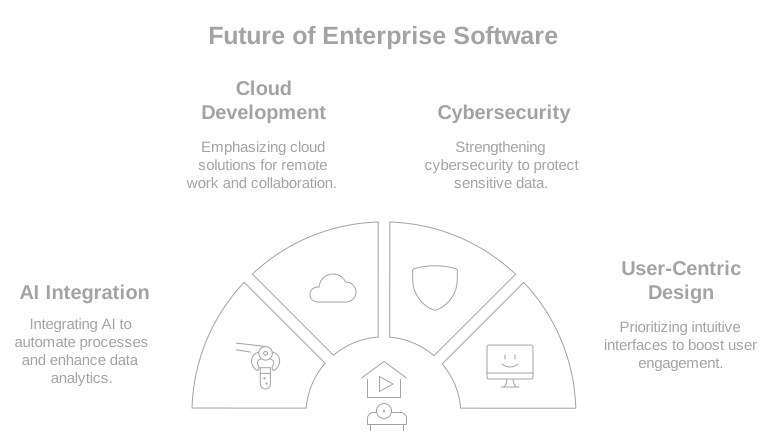
- AI woven into the workflow.
- The cloud as a starting point, not an exception.
- Cybersecurity as a foundation of design.
- Business intelligence for data-driven decisions.
- Custom software that fits the business, not the other way around.
AI woven into the workflow
Artificial intelligence is moving from an isolated feature to a layer that runs across enterprise software. Instead of separate screens and reports nobody reads, we’ll see assistance, prediction, and automation embedded directly into processes: prioritizing tasks, suggesting the next step, flagging a problem before it blows up. The value isn’t in AI for its own sake, but in how it reduces friction in people’s daily work and frees up time for what actually matters.
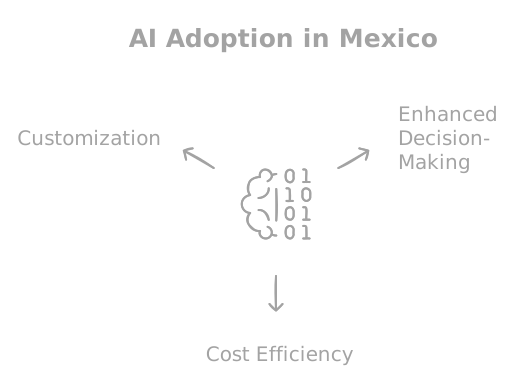
That integration changes the nature of business software. A system that merely stores information becomes one that interprets it: spotting patterns across thousands of operations, flagging anomalies in real time, and proposing decisions that once required a dedicated analyst. Automation stops being a fragile script and becomes a native capability of the platform, one that learns from usage and improves over time.
What sets a strong enterprise AI implementation apart shows up on several fronts:
- Faster, data-backed decisions. Organizations that ground their decisions in advanced analytics react ahead of competitors, because they replace pure intuition with evidence.
- Automation of the repetitive. Manual, error-prone tasks (reconciliations, classifications, data entry) get delegated to the system, cutting cost and mistakes at once.
- Assistance in context. AI appears inside the process, not in a separate tool, so teams use it without switching screens or habits.
- Continuous improvement. The model sharpens with every interaction, so the software grows more useful the more it’s used.
“We are not just shifting from a world that is information poor to one that is information rich: the challenge is turning that information into decisions.” The idea, popularized by author John Naisbitt, still captures the real challenge of enterprise AI.
The key point is that AI doesn’t replace human judgment, it amplifies it. The companies that adopt it thoughtfully, focused on real problems rather than the hype of the moment, will be the ones that turn data into a lasting advantage.
The cloud as a starting point
Cloud-native is now the standard, not the exception: elasticity, continuous deployment, and availability as a baseline. Modern enterprise software is built to scale without forcing the business to invest upfront in physical infrastructure. For a growing organization, that flexibility is exactly what allows it to meet demand without overspending when things go well or carrying fixed costs when they cool off.
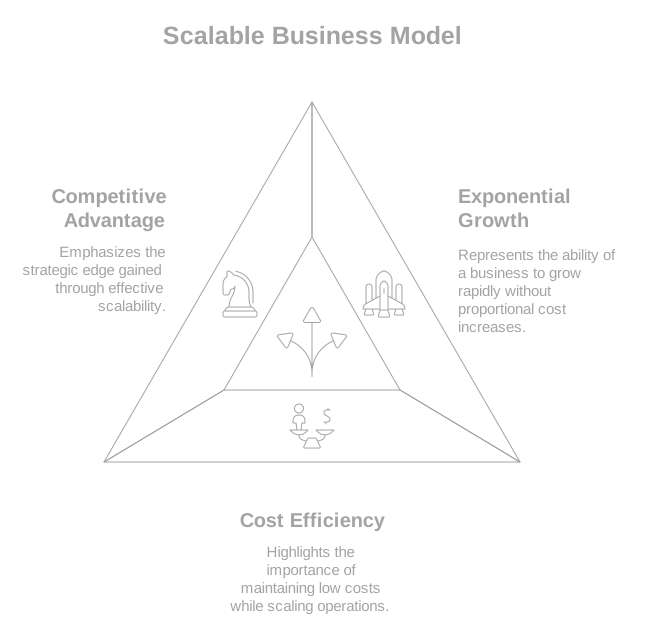
The cloud also redefines the economics of software. The pay-as-you-go model turns large upfront outlays into predictable operating costs, and that democratizes access to capabilities once reserved for big corporations. A mid-sized company can now run on the same class of infrastructure as a multinational, and pay only for what it consumes.
The concrete advantages of a cloud-native approach are felt day to day:
- Real scalability. Resources grow and shrink with demand, with no one having to buy servers or plan months ahead.
- Costs under control. Pay-as-you-go schemes remove the upfront investment and align spending with the actual use of the business.
- Access from anywhere. Remote and hybrid teams work on the same applications no matter where they are, sustaining collaboration and productivity.
- Continuity through the unexpected. Backups and disaster recovery come built in, so a failure stops being a catastrophe.
“The cloud is not just a technology: it is a new way of conducting business.” Marc Benioff, founder of Salesforce, said it, and it sums up why the cloud went from a technical option to a strategic decision.
Alongside the cloud, APIs become the connective tissue that links internal tools, external services, and data. A well-integrated ecosystem matters more than any single application, because value emerges from how information flows between systems. Betting on an open, composable architecture today avoids the dreaded lock-in to a single vendor and gives the business control over its own technological evolution.
Cybersecurity as a foundation
As systems connect more, the risk surface grows, and security shifts from an add-on to a design requirement. The enterprise software of the future assumes strong identity, encryption, and compliance from the architecture, not as a patch applied at the end. Far from slowing innovation, that solid foundation is exactly what allows new technologies to be adopted with confidence, because risk is managed from the system’s first stroke.
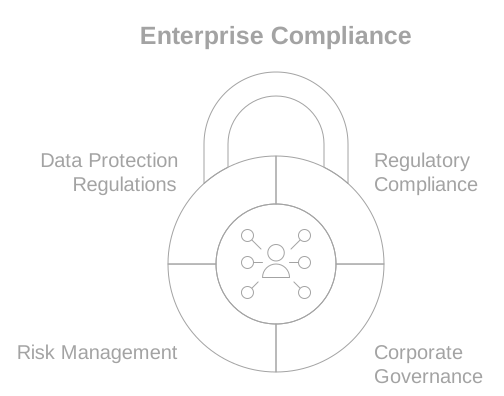
The cost of getting it wrong is high and very concrete. A single data breach can mean losses in the millions, regulatory penalties, and reputational damage that takes years to repair. That’s why cybersecurity stops being the sole responsibility of the IT team and becomes a shared culture: the weakest link is usually human error, not technology, so training the team matters as much as encryption.
A mature security posture rests on several practices that reinforce one another:
- Data protection by design. Encryption, access controls, and periodic audits are built in from the start, not bolted on afterward.
- A secure development lifecycle. Vulnerabilities are identified and fixed while the software is being built, not once it’s already in production.
- Early threat detection. Real-time monitoring, supported by AI, makes it possible to respond to an incident before it escalates.
- A clear response plan. Knowing exactly what to do in the event of a breach reduces the damage and speeds up recovery.
“In an interconnected world, cybersecurity is everyone’s responsibility.” The phrase, repeated across the industry, captures why security can no longer be delegated entirely to a single team.
Building on secure foundations doesn’t just protect the company’s assets: it also earns the trust of customers and partners. In a market where reputation is staked on data protection, treating security as an investment rather than an expense becomes a real competitive advantage.
Business intelligence for data-driven decisions
In an environment flooded with information, business intelligence tools stop being a luxury and become indispensable. Their job is simple to state and hard to master: turning raw data into actionable decisions. Organizations that pull it off transform mountains of records into an advantage, while those stuck in scattered spreadsheets end up deciding blind.
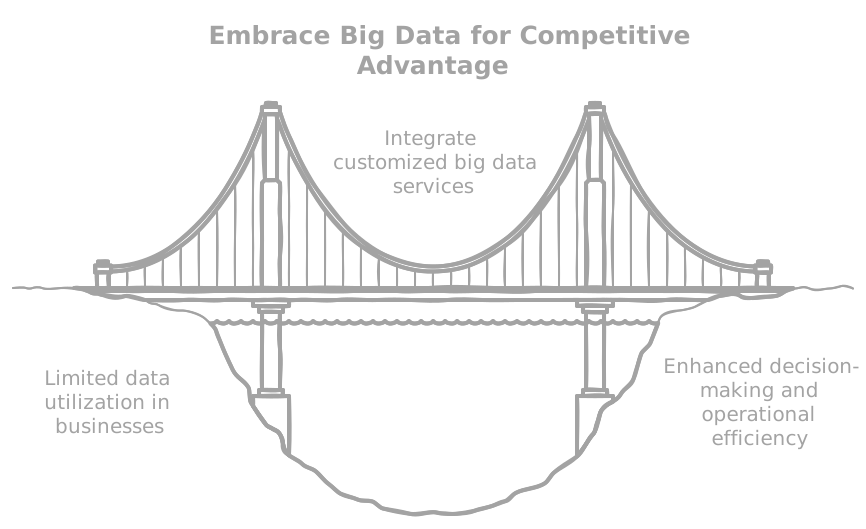
The new generation of these tools does more than show reports of the past. Predictive analytics and machine learning make it possible to anticipate trends, optimize inventory, and spot opportunities ahead of the competition. And modern visualization brings those findings to non-technical people: interactive dashboards that any manager can read without relying on IT for every query.
What makes business intelligence genuinely useful comes down to a few principles:
- Advanced analytics. Predictive models project scenarios and reduce the uncertainty of important decisions.
- Clear visualization. Dashboards translate complex data into information anyone can interpret at a glance.
- Self-service. Users generate their own reports without overloading the technical team, which democratizes access to data.
- Integration with existing systems. Connecting business intelligence to the rest of the software gives a single, coherent view of the whole operation.
“Without data, you’re just another person with an opinion.” The line from W. Edwards Deming, a pioneer of quality management, captures why a data culture became a requirement rather than an ornament.
The challenge isn’t technological, it’s cultural. The best analytics platform is useless if the organization doesn’t cultivate data literacy and the habit of questioning decisions with evidence. The companies that make that habit part of their everyday work will be the ones that draw real advantage from their information, as analyses in the specialized press such as Forbes consistently point out.
Custom software that fits the business
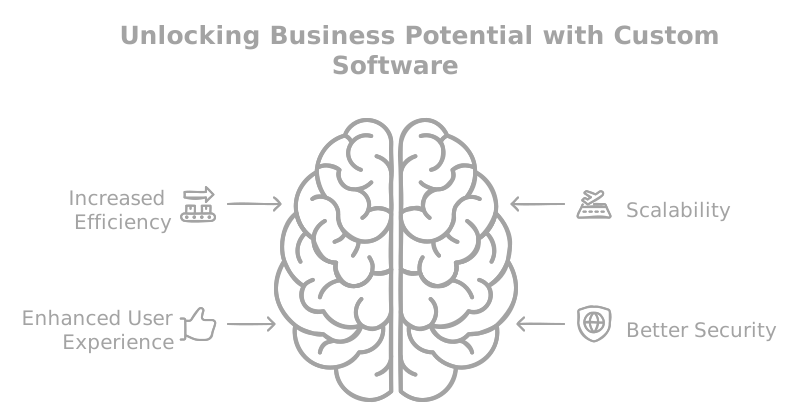
Against closed suites that impose their own way of working, demand is growing for custom software that adapts to the business, not the other way around. Unlike a generic one-size-fits-all solution, a custom application is designed around the organization’s real goals and workflows. That precision is exactly what turns software into a competitive advantage rather than a necessary evil the team puts up with reluctantly.
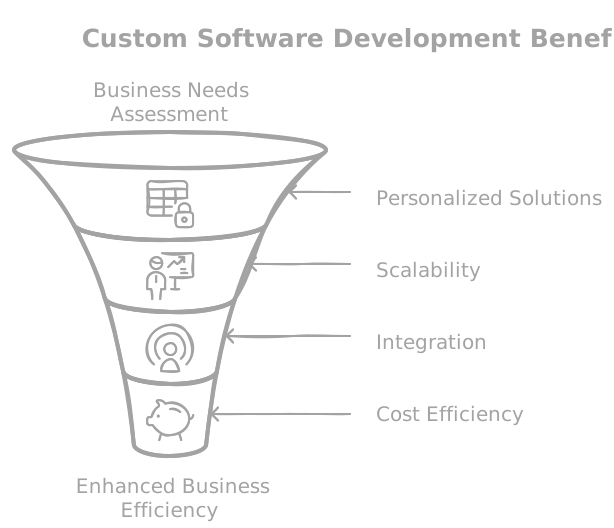
The case for customization grows stronger as a company scales. A purpose-built system grows with the business, adds new features without rewriting everything, and integrates with the tools already in use. It also lets you build security and compliance exactly around your own vulnerabilities, instead of settling for whatever the vendor decided to offer everyone alike.
The reasons to invest in custom development stand on their own:
- Scalability without artificial limits. The solution grows with the company, free of the ceilings imposed by packaged products.
- Real integration. The software is designed to talk to existing systems and keep data flowing without friction.
- Tailored security. Controls are matched to the concrete risks of the business and its compliance requirements.
- An experience built for your team. An interface designed for the people who use it improves adoption and cuts training time.
“Custom software is no longer a luxury: it’s becoming an essential part of operational excellence.” The idea, echoed by industry analysts, reflects a deep shift in how companies think about their technology.
Building custom doesn’t mean reinventing everything from scratch, but choosing wisely which pieces deserve a tailored fit and which can be solved with proven components. Organizations that strike that balance, leaning on modular architectures and teams that understand their business, are the ones that end up with technology that drives growth instead of holding it back.
In short
Enterprise software is moving toward the intelligent, the modular, and the connected, with cybersecurity underpinning all of it and data as the compass. AI in the workflow, the cloud as the standard, security by design, business intelligence, and custom software aren’t isolated trends: they’re pieces of a single movement toward systems that fit the business rather than the reverse. The companies that move with intention today will be the ones leading tomorrow.
At LabWeb we build systems aligned with these trends: cloud-native, integration-ready, secure, and designed to fit each business. If you want your technology to become a platform for growth rather than inherited baggage, we’re exactly the kind of partner that turns these ideas into product.