Artificial intelligence has gone from a distant promise to an everyday working tool. In Mexico, that shift is happening fast: more teams are integrating language models, computer vision, and automation into products that are already in production, not in labs. The country’s digital landscape is going through a deep transformation, driven by how quickly this technology is being adopted across sectors as different as banking, healthcare, retail, and manufacturing. The question is no longer whether to use AI, but how to use it well.
Before going into detail, it helps to sum up the forces moving this wave:
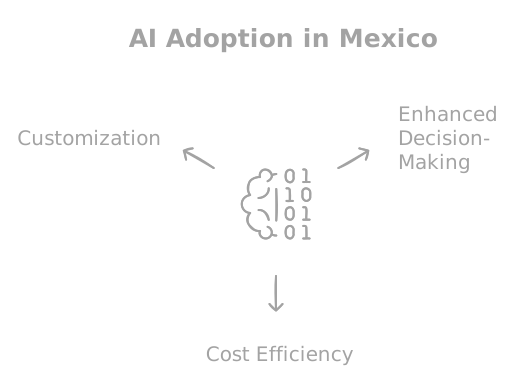
- Better decisions. Predictive models help anticipate demand, risk, and customer behavior.
- Cost efficiency. Automating repetitive tasks frees up the team’s time for higher-value problems.
- Tailored solutions. Well-built AI software adapts to the business instead of forcing the business to adapt to a generic tool.
Talent growing with the ecosystem
Mexico combines a solid base of engineers with a new generation trained specifically in machine learning and data science. Universities, bootcamps, and technical communities are feeding a market that once depended on talent from abroad. That talent also tends to have experience working with international clients, which makes adopting global best practices easier without losing local context. Cities like Guadalajara, nicknamed the “Mexican Silicon Valley”, concentrate a density of engineers that draws both local companies and foreign firms looking to set up operations in the region.
What stands out is not just the number of professionals, but the speed at which that talent is reorienting toward AI. A large share of today’s technology graduates aims to specialize in machine learning, natural language processing, or data engineering. That critical mass is exactly what an ecosystem needs to move from experimenting to producing at scale.
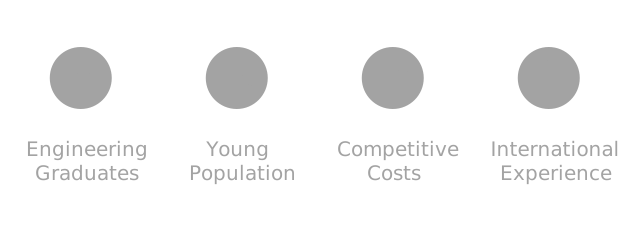
The pieces behind this talent advantage are concrete:
- Serious technical training. University programs and communities of practice that produce profiles able to compete on demanding projects.
- International experience. Many teams already work with companies in the United States and Europe, so they know high standards and global ways of working.
- A culture of continuous learning. Hackathons, study groups, and open projects keep talent current in a field that changes every few months.
“AI is probably the most important thing humanity has ever worked on.” The line is from Elon Musk, and it captures the conviction with which this new generation of engineers is joining the field.
From pilots to real use cases
AI in Mexico already solves concrete problems: automated customer support, fraud detection, inventory optimization, and document analysis at scale. The difference from past years is that these projects are no longer isolated experiments, they are part of operations that generate measurable value. The conversation has moved from “what could AI do?” to “how do we put it to work today?”.
Healthcare is a good example: predictive models help anticipate how a patient will evolve and prioritize resources more precisely. In banking, real-time fraud detection has gone from a luxury to an operational standard. And in retail, recommendation engines and demand forecasting fine-tune inventory and shopping experiences that once relied on intuition. When several industries adopt the same technology at the same time, the effect compounds.
A few trends clearly mark the direction of this development:
- More investment in AI startups. Capital aimed at artificial intelligence ventures across Latin America has grown strongly in recent years, and Mexico is among the main recipients.
- A focus on custom solutions. Companies have learned that generic software rarely solves their specific challenges, so demand for tailor-made development keeps rising.
- Machine learning integration. More and more teams use their own data to optimize processes, in line with a global shift toward evidence-based decisions.
- Embedded smart technology. Traditional systems are paired with AI layers to gain efficiency without having to rebuild everything from scratch.
Factors driving the growth
Several factors are pushing AI software development in Mexico at the same time, creating fertile ground for innovation. The first is the pressure for efficiency and productivity: in an increasingly automated global market, companies look for intelligent solutions that cut costs without sacrificing quality. What used to be a nice-to-have is now seen as a competitive necessity.
The second factor is talent, which we already covered, combined with an institutional environment that is starting to support technology adoption. Startup support programs, ties between universities and businesses, and incentives for research are creating the conditions for local solutions to compete at an international scale. It is not a finished shift, but the direction is clear.
The underlying drivers can be summed up like this:
- Need for productivity. Automation stops being optional once competitors are already using it to operate faster and cheaper.
- Talent availability. A growing base of specialized engineers lowers the friction of starting ambitious projects.
- Data-driven decisions. Access to more and better data makes predictive analytics viable in real operations, not just in slide decks.
- Emerging institutional support. Public and private programs that connect research with industry widen the room to innovate.
According to McKinsey & Company, companies that implement AI successfully tend to improve their operating margins in measurable ways, a hard incentive to ignore for any leadership team weighing where to invest.
The role of firms and consulting
As the country speeds up its entry into artificial intelligence, development firms and consulting services play a decisive role. They are not mere vendors: they act as strategic partners that help navigate the complexity of digital transformation. Their value lies in translating an abstract technology into solutions that fit each company’s concrete processes and goals.
Beyond the technical side, these firms bring judgment. They help identify where automation makes sense, which processes to optimize first, and how to measure the real impact of each initiative. That guidance avoids one of the most expensive mistakes in AI projects: investing in flashy technology that never actually touches the business.
The contribution of a good development partner shows up on several fronts:
- Tailored solutions. Teams that build for each company’s specific requirements instead of pushing a one-size-fits-all product.
- Sector expertise. From healthcare to finance and logistics, domain knowledge makes every solution relevant and applicable.
- Training and support. Hands-on guidance so internal teams truly leverage the systems, not just receive them and disappear.
- Future-proof strategies. Architectures designed with scalability and maintenance in mind, so today’s investment keeps paying off tomorrow.
Consulting also helps address two issues that keep growing in importance: cybersecurity and sound data governance. Integrating AI without neglecting information protection is exactly what separates a solid project from one that creates risk.
Future prospects
The prospects for AI software development in Mexico are not only promising, they span very different industries. The next step will be specialization: teams focused on specific sectors, like healthcare, fintech, and manufacturing, that train and fine-tune models for niche problems. That depth by industry is what makes solutions genuinely hard to replicate.
We will also see clear progress in capabilities like natural language processing, which already improves customer service through increasingly useful assistants and chatbots. On top of that, sustained interest from local and international investors signals confidence in what the country can build within the AI domain.
The moves worth watching closely are several:
- Broader enterprise adoption. More companies integrate AI into their business model, not as a pilot, but as a central part of operations.
- AI-powered innovation. New products and services that use custom models to stand out, from personalized retail to intelligent logistics.
- Sector-specific applications. Predictive analytics in healthcare, fraud detection in finance, and predictive maintenance in manufacturing, each tuned to its context.
- The push from startups. An entrepreneurial ecosystem that keeps growing and brings agility and appetite for risk.
As AI becomes a critical part of systems, the conversation about governance, data privacy, and responsible use gains weight too. Technical maturity will inevitably bring ethical maturity: the companies that prioritize transparency and responsible data handling will build the trust that sustains long-term success.
The challenges still ahead
The picture is encouraging, but not free of obstacles. The first is the skills gap: although the number of technology graduates keeps rising, there is still a distance between what is taught in classrooms and what a field that changes every few months demands. Many profiles arrive with solid foundations but without practical experience in advanced concepts, which can delay projects.
Added to this is the need for greater investment in long-term research and development. Much of the capital goes to immediate applications, which is natural, but deep innovation requires patience and sustained funding. In parallel, the regulatory frameworks around privacy and data use are still maturing: companies must innovate and comply at the same time, a balance that is not always easy.
The main challenges can be organized like this:
- Skills gap. Closing the distance between academic training and real market needs remains a priority.
- Research investment. Favoring only immediate returns can slow the innovation that delivers lasting advantages.
- Maturing regulation. Designing clear data protection policies is necessary and still a work in progress.
- Perceptions about AI. Doubts about job displacement can stall investment if they are not addressed honestly.
- Integration with legacy systems. Modernizing old platforms is often more complex than starting from scratch.
None of these challenges is insurmountable. On the contrary, they open room for collaboration among universities, government, and the private sector.
“The greatest danger in times of turbulence is not the turbulence; it is to act with yesterday’s logic.” Peter Drucker said it, and it sums up the attitude this moment demands: adapt instead of resisting change.
In short
Mexico is moving from adopting AI to building with it, driven by talent, nearshore demand, and use cases that already deliver results. The trends point toward more investment, more specialization by industry, and growing attention to data governance and security. The challenges exist, but they look more like opportunities for collaboration than like impassable barriers.
At LabWeb we integrate artificial intelligence into custom software, focused on real business problems rather than flashy demos. If you are looking for a partner that understands both the technology and your context, and that builds with scaling and protecting what matters in mind, that is exactly the kind of work we do from here.