
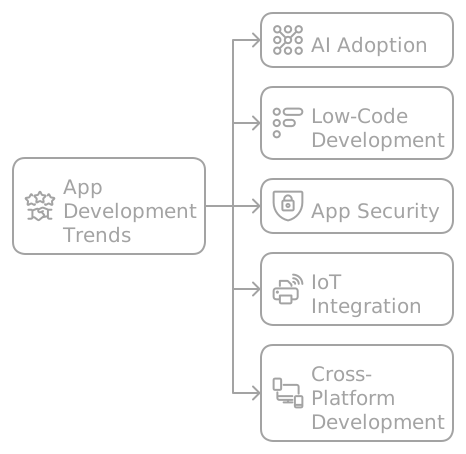
The landscape of app development is evolving at a lightning pace, and if you think you can just sit back and let the world change around you, think again. The question is no longer whether to adopt new technologies but rather how quickly you can do so. As mobile apps continue to dominate the digital space, understanding these emerging trends can be the difference between leading your category and falling behind. Here are five trends shaping the future of this vibrant industry.
The five trends you can’t ignore:
- Artificial intelligence inside the app: recommendations, smart search, and personalization that solve real user problems.
- Mature cross-platform: a single codebase that reaches iOS and Android at lower cost and higher speed.
- Augmented and virtual reality: immersive experiences that transform how people interact with the product.
- Progressive web apps: the best of web and mobile, with no downloads or installations.
- Security by design: protecting user data stops being an extra and becomes the foundation of trust.
Embracing these trends in mobile application design and custom software development isn’t about following fashion for its own sake: it’s how businesses not only survive but thrive in an increasingly competitive market. As renowned software engineer Robert C. Martin, author of Clean Code, put it:
“The only way to go fast is to go well.”
Artificial intelligence and machine learning
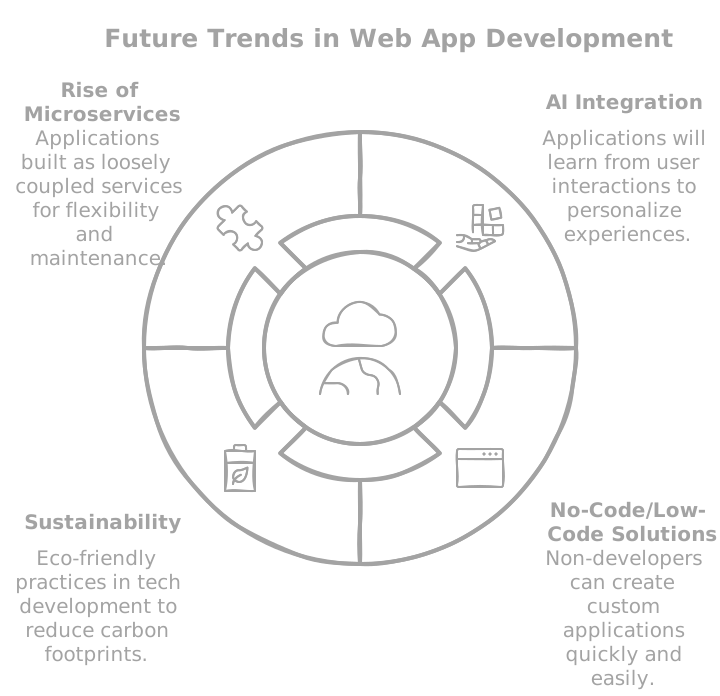
One of the most transformative trends in app development is the integration of artificial intelligence (AI) and machine learning (ML). These aren’t just buzzwords: they represent a fundamental shift in how applications operate, delivering richer experiences and smarter functionality. AI has gone from an exotic feature to part of the product itself, and done well it isn’t about “adding AI” but about solving concrete user problems better.
The key is to use it where it delivers measurable value, not as decoration. Studies from firms such as McKinsey indicate that organizations integrating AI in a serious way can meaningfully improve their results, which makes harnessing its potential almost imperative in both iOS and Android development. What matters is understanding where each capability fits before investing in it.
Here’s what you need to keep in mind about AI and ML in the realm of applications:
- Personalized experiences: through advanced algorithms, AI analyzes user behavior to deliver tailored content. Spotify’s recommendation engine, for example, builds custom playlists from listening habits and turns a generic interaction into an individual experience.
- Predictive analysis: machine learning lets apps anticipate user actions. E-commerce platforms like Amazon use predictive analytics not only to recommend products but to manage inventory, a crucial function as online shopping keeps soaring.
- Natural language processing: NLP allows apps to understand people conversationally, beyond rigid commands. Assistants like Google Assistant show how integrated this technology already is in daily life.
- Chatbots for customer service: virtual assistants improve user interaction while reducing operational costs, a significant shift in how companies handle inquiries.
By bringing AI into custom software development, teams not only build smarter applications, they also automate backend processes. As tech visionary Kai-Fu Lee aptly states:
“Artificial intelligence is the new electricity.”
This perspective underscores the need to adopt AI in mobile application design: an evolution that is essential to staying relevant and competitive in today’s digital landscape.
The rise of cross-platform development
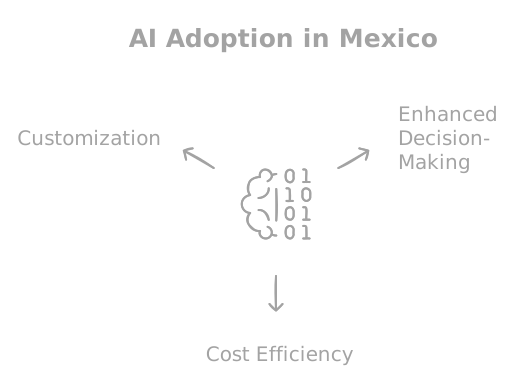
As we move toward the future of app development, one trend companies cannot afford to ignore is cross-platform development. In an environment where users demand seamless experiences across multiple devices, adopting this approach is no longer optional but essential. Cross-platform development lets you build applications that run smoothly on both iOS and Android, broadening reach and maximizing user engagement.
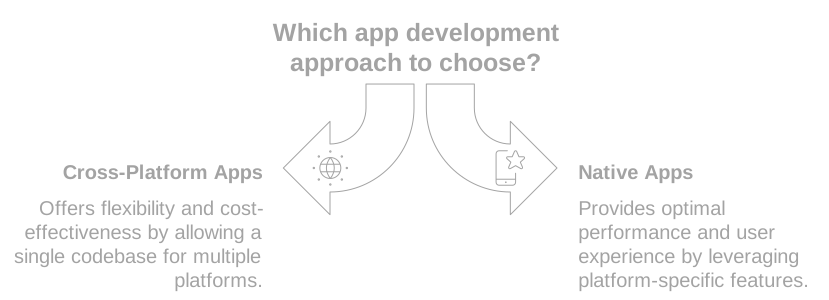
Cross-platform frameworks have matured to the point of competing head-on with native in many cases. Popular tools such as React Native and Flutter let developers maintain high performance while accessing native device features. This lowers development costs, speeds up launches, and is especially valuable for startups that need to validate their ideas quickly with a minimum viable product.
These concrete advantages are worth keeping in mind:
- Cost efficiency: building a single application that works across multiple platforms significantly reduces spending, since it avoids creating and maintaining two separate codebases.
- Faster time to market: with a shared codebase across iOS and Android, the development process accelerates, which is decisive for anyone trying to arrive ahead of the competition.
- Consistent user experience: cross-platform apps offer uniformity in updates and features, so users get a similar experience regardless of their device.
- Broader audience reach: since many people use more than one device, reaching several platforms at once is key to not leaving users out.
That said, cross-platform development requires choosing the right tools and testing thoroughly. Performance issues can arise if the application isn’t optimized properly for each system, so rigorous testing across different devices is indispensable during the prototyping phase. As Steve Jobs famously stated:
“Design is not just what it looks like and feels like. Design is how it works.”
That line captures the essence of good cross-platform development: building applications that not only function well but also connect with users. The ability to serve diverse needs while optimizing resources is what paves the way to success.
Augmented reality and virtual reality
Another trend gaining incredible momentum is the integration of augmented reality (AR) and virtual reality (VR) into applications. These immersive technologies aren’t merely enhancing the user experience: they are changing the way people interact with the digital world. Demand for applications that leverage these capabilities grows year after year, and entire sectors are starting to reorganize how they work around them.
AR and VR open up possibilities that once felt like science fiction, from trying on clothes virtually to training professionals in simulated environments without risk. The interesting part is that their usefulness no longer stops at entertainment: education, healthcare, and retail are finding very concrete applications that improve real outcomes.
Here’s how these technologies are reshaping the development landscape:
- Greater user engagement: by offering interactive experiences, AR and VR keep users engaged longer than traditional apps. IKEA’s Place app, for example, lets users visualize furniture in their homes before buying and reduces purchase hesitation.
- Training and simulation: industries such as healthcare and aviation use VR for training because it provides safe environments to practice without real-world consequences. Several studies show that staff trained with VR focus better than in a traditional classroom.
- Gamification: adding game-like elements through AR makes routine tasks enjoyable. Pokémon Go is the classic example: it blends the real-world environment with game elements and racked up hundreds of millions of downloads.
- E-commerce innovation: retailers adopt AR features to enhance the experience, from virtual fitting rooms to makeup try-ons, which reduces returns and builds confidence at checkout.
Betting on these technologies also brings business benefits: integrating immersive experiences can meaningfully lift conversion rates, a fact no team aiming to grow should overlook. The potential of AR and VR extends far beyond entertainment; participating actively in this trend can position your application not as a mere tool but as an experience that genuinely connects with user needs.
The emergence of progressive web apps
As the sector keeps innovating, one trend advancing rapidly is the evolution of progressive web apps (PWAs). They combine the best of web and mobile and are designed to deliver an app-like experience directly through the browser. This means no downloads and no installations, which makes them highly accessible and convenient for users.
PWAs can considerably increase engagement rates, according to industry data, which demonstrates their potential to reshape how people relate to digital content. Their appeal lies in reducing the barrier to entry: users try the product with no friction and, if they like it, keep it on their home screen like any other application. For a deeper look at the technical detail, the resources at MDN Web Docs are a reliable reference.
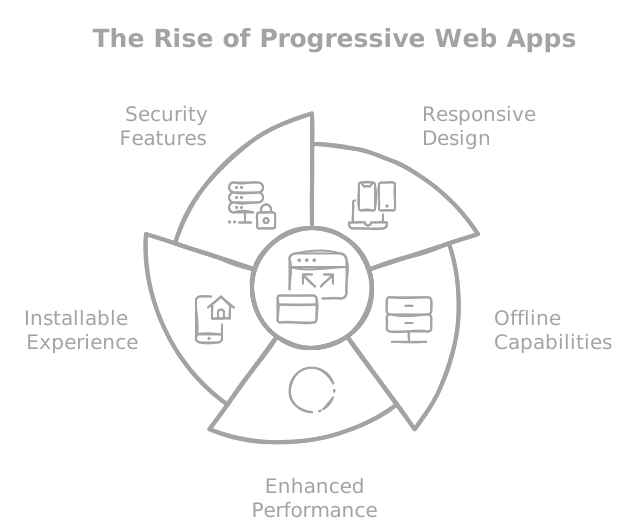
These are the features that make PWAs a game-changer:
- Responsive design: PWAs adapt seamlessly across devices and screen sizes, ensuring a consistent experience on phone, tablet, or desktop.
- Offline capabilities: thanks to service workers, PWAs can run offline or on limited connections, perfect for those moments on public transit or in areas with poor signal.
- Improved load times: fast-loading applications are essential for retaining interest, since users abandon a site that takes too long. PWAs dramatically improve performance through caching and efficient resource management.
- Engaging experience: with features like push notifications and home-screen installation, PWAs offer an experience close to native apps, which invites users to return.
Real-world examples confirm their effectiveness: companies such as Twitter and Pinterest adopted this technology and reported clear improvements in performance and in the time users spend on their platforms. Incorporating progressive web apps isn’t just following a trend: it’s about raising user satisfaction and engagement. By recognizing their importance within the digital ecosystem, teams can build solutions that not only meet but exceed expectations, an invaluable asset as we move forward in this dynamic space.
An increased focus on security
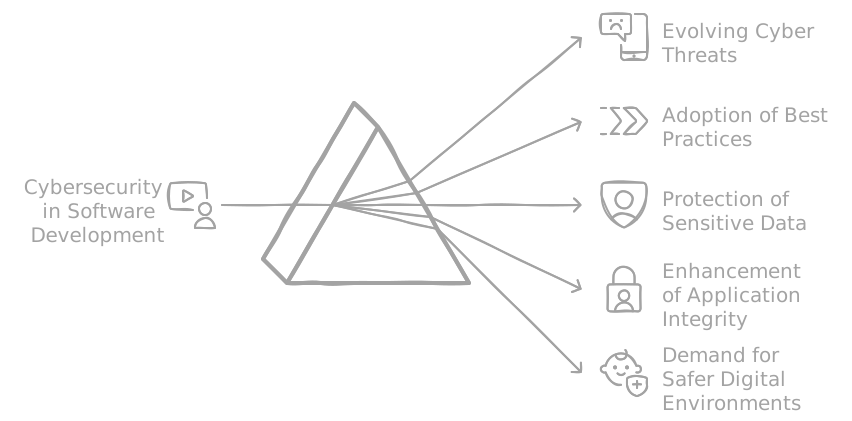
In the ever-evolving world of app development, security has moved from an afterthought to a fundamental pillar of design. As mobile applications seep into every corner of our lives, the stakes have never been higher. With threats growing more sophisticated, companies must prioritize robust security measures throughout their development process. Concern over mobile application risks is widespread across the industry, and it serves as a wake-up call: security isn’t an add-on, it’s integral to user trust.
Privacy, moreover, has shifted from a mere legal requirement to a differentiator: users choose apps that respect their data, and platforms demand it. This turns cybersecurity into a business conversation, not just a technical one, and forces protection to be built in from the first line of code rather than patched on at the end.
These are the factors driving that increased focus on security:
- Data privacy regulations: frameworks like Europe’s GDPR and local data-protection laws require companies to be careful about how they handle information. With considerable fines for non-compliance, neglecting security puts both user trust and financial stability at risk.
- Authentication mechanisms: adding multi-factor authentication dramatically improves the security of a mobile app and blocks the vast majority of automated attacks, so it’s worth considering from the development phases.
- Regular security audits: running reviews throughout the lifecycle helps catch vulnerabilities before anyone can exploit them, a practice that should be woven into agile methodologies.
- Secure coding practices: adopting secure coding standards is key to mitigating attacks such as SQL injection or cross-site scripting, and educating teams on best practices greatly reduces the risk surface.
As we navigate this landscape full of threats, it’s worth remembering the words of security expert Bruce Schneier:
“Security is not a product, but a process.”
This idea underscores the need for continuous vigilance in security strategies, a point on which leaders across every sector agree. In such a competitive environment, prioritizing security in custom software development isn’t just about compliance: it’s about building credibility and long-term relationships with users. A product’s scalability, in the end, also depends on it being trustworthy.
In short
The future of app development is as exciting as it is demanding. By staying on top of these emerging trends (AI integration, cross-platform capabilities, augmented and virtual reality, progressive web apps, and stronger security), your business stays well positioned in an industry that changes at high speed. Those who adapt quickly are, without a doubt, the ones who end up leading.
At LabWeb we follow these trends with judgment: we adopt what strengthens your product and skip the passing fad, so your mobile investment stays relevant over the long term. If you want to build an app that makes the most of AI, cross-platform, and security by design, we are exactly the kind of partner that turns these trends into product.