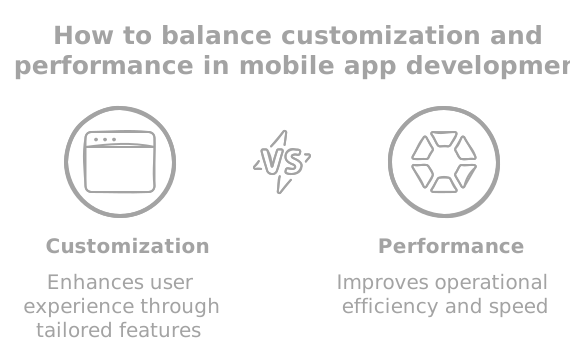
Mobile development carries a constant tension: every new feature, animation, and customization option adds value, but it also consumes resources. An app packed with capabilities that launches slowly or drains the battery ends up frustrating the very users it was meant to delight. The challenge isn’t picking a side, it’s finding the balance. And that balance is rarely a one-time decision: it gets tuned release after release, by watching how real users react to every trade-off between richness and speed.
Before going deeper, it’s worth naming the three ideas that hold up the rest of this article:
- Performance is the foundation everything else is built on.
- Customization, done well, deepens the bond with the user.
- The real craft is combining both with judgment, not forcing one over the other.
Why performance rules
On mobile, perceived quality is measured in milliseconds. A quick launch, fluid transitions, and reasonable battery use are the foundation everything else rests on. If the app feels heavy, no advanced feature makes up for that first bad impression, and uninstalls follow fast. Users don’t reason their way through the problem: they simply feel that something is off and leave, often without even a review that explains why.
The data backs up that instinct. Google’s research on mobile speed shows that more than half of visits are abandoned when loading takes longer than three seconds, a threshold that is brutal in practice: three seconds is nothing to whoever wrote the code, but an eternity to whoever is waiting. Performance, then, isn’t an engineering luxury or a metric to show off on a dashboard; it’s the condition that decides whether the user ever gets to discover everything you built.
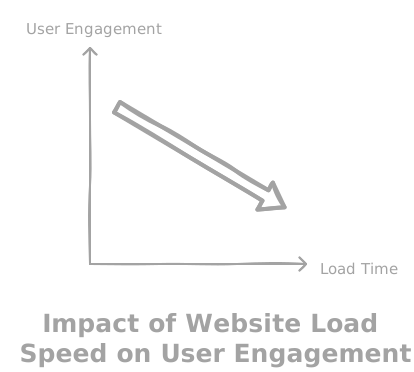
There’s a detail many teams overlook: performance isn’t experienced the same way on every phone. Whoever designs the app usually tests it on a recent device with a strong connection, while a huge share of users open it on mid-range hardware, with memory nearly full and a shaky network. That gap between the lab and the street is where most complaints are born. So it pays to measure in the real scenario, not the ideal one: if the app flies on the developer’s phone but crawls on the customer’s, the one that counts is always the second.
It helps to ground what “performance” actually means, because it’s a word that gets used a lot and measured little:
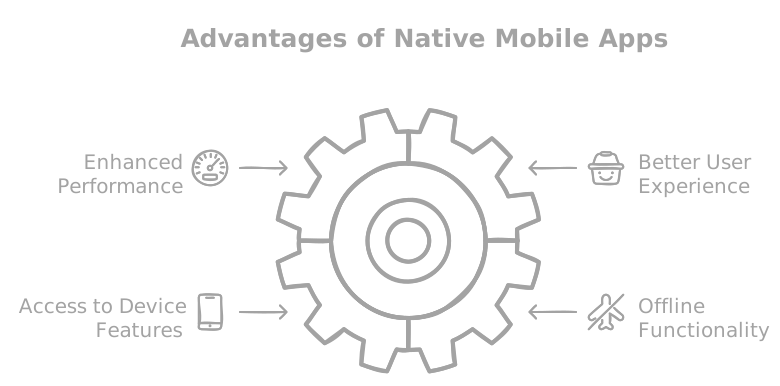
- Startup time: the seconds between tapping the icon and truly being able to use the app; it’s the first promise you make and the easiest to break.
- Fluidity: transitions and scrolling at a steady frame rate, with none of the stutter that reveals a clogged main thread.
- Stability: an app that doesn’t close on its own or freeze; every crash erodes trust faster than any feature can build it.
- Resource use: battery, data, and memory; what the user never sees on screen but definitely feels on their phone by the end of the day.
“The details are not the details. They make the design.” The line is from Charles Eames, and on mobile it holds true to the letter, because users judge the whole app by those milliseconds almost no one notices until they’re missing.
The real value of customization
Done well, customization makes an app feel tailored to the user: themes, adapted flows, relevant content, and settings that respect their preferences. That closeness boosts engagement and retention. The mistake is confusing customization with accumulation, more options don’t mean a better experience. An app that asks you to configure twenty things before it’s useful doesn’t feel personal, it feels like a chore.
The customization that actually works tends to be quiet. It doesn’t ask the user everything, it observes and adapts: it remembers what they use, anticipates what they need, and removes friction where there used to be repeated steps. Think of a commerce app that reorders its catalog around what each person tends to buy, or a tool that brings the actions a given profile uses daily to the front. There the technology disappears and what remains is the sense that the app understands the person using it, which is exactly the ground where custom-built software outperforms generic solutions.
When it’s designed with intent, customization delivers very concrete benefits to the product:
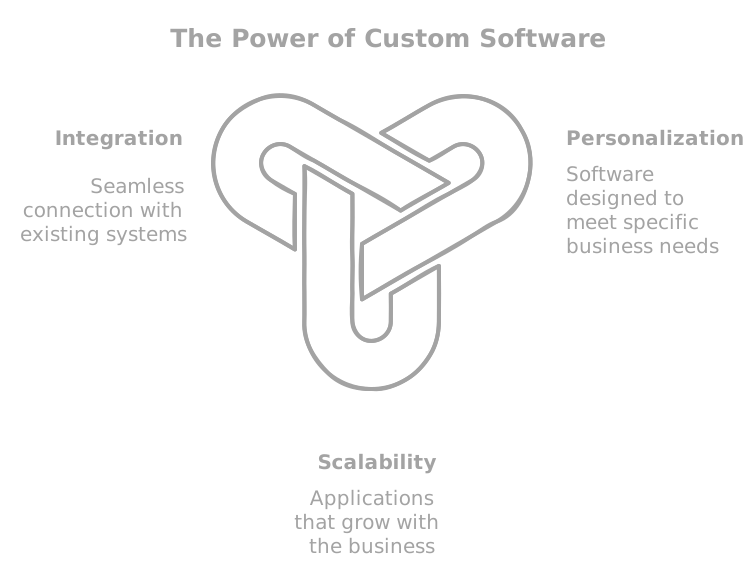
- Deeper engagement: an experience that responds to the person invites them back, and retention is the real engine of any sustainable app.
- Brand identity: colors, tone, and distinctive touches set the product apart in a store crowded with apps that look alike.
- Relevant content: showing the right thing at the right moment cuts the noise and multiplies the perceived value of every session.
- Room to grow: a foundation built to fit evolves with the business without a full rebuild each time needs change.
“You’ve got to start with the customer experience and work backwards to the technology.” Steve Jobs said it, and it captures the only correct direction for personalizing: you don’t start from the available feature, you start from what the person actually needs.
Where the balance usually breaks
Problems appear when customization is built without weighing its cost: unoptimized images, over-fetched data, animations that choke the main thread. Technical discipline, lazy loading, smart caching, and constant measurement, lets you deliver visual richness without paying for it in sluggishness. What you don’t measure, you can’t balance. That last idea is the most important in the whole article: without instruments, any debate about performance is just an opinion.
| Criterion | Customization | Performance |
|---|---|---|
| What it prioritizes | Closeness and relevance for the user | Speed, fluidity, and battery |
| Risk if overdone | A heavy app that launches slowly | A generic, soulless experience |
| When it matters most | Tools and occasional-use apps | Daily, mass-use services |
The conflict is rarely the fault of customization itself; it’s the fault of implementing it without a technical budget. A gallery of themes only becomes a problem when each theme drags along heavy assets nobody optimized. Personalized content only turns slow when the server is asked for more than necessary on every open. The good news is that almost all of these costs can be contained with practices that are already part of the craft: defer what isn’t visible, cache what repeats, and move heavy work off the thread that draws the screen.

To sustain the balance over time, it pays to lean on a few engineering habits:
- Lazy loading: bringing in resources only when they’re needed avoids paying upfront for a cost that may never be incurred.
- Smart caching: storing what rarely changes cuts network round trips and makes the second visit always feel faster than the first.
- Performance budget: setting size and time limits from the start turns speed into a requirement, not a last-minute fix.
- Continuous measurement: watching load times, crash rate, and fluidity on every release catches the regression before the user does.
The MDN web performance documentation insists on this point: performance is a product feature you design, not a side effect that shows up on its own. Treating it that way, as a feature with an owner and with metrics, is what separates the teams that balance from the ones that improvise.
How to decide by product
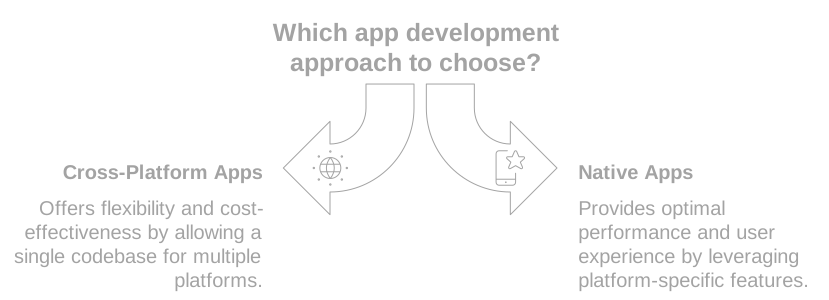
The answer depends on the app’s purpose. A productivity tool can prioritize advanced options; a high-frequency, mass-use service should prioritize speed and simplicity. Define which experience is non-negotiable for your user and build from there, adding customization only where it delivers measurable value. There is no universal ratio between the two forces: there is the right ratio for your product, your user, and the stage your business is in.
A practical way to avoid getting it wrong is to start with a minimum viable product that does the essentials very well and runs fast, then leave advanced customization for later iterations guided by how people actually behave. It’s far cheaper to add a feature people asked for than to rescue an app that turned slow under features nobody uses. That incremental approach, the way many startups operate, keeps the product light while it learns what is worth building.
It also helps to think about the product’s full life cycle, not just the launch. An app that serves a few thousand users today will have to hold up hundreds of thousands tomorrow if the business grows, and every customization feature added without measuring its cost becomes more expensive to maintain over time. Scalability isn’t only about handling more load: it’s about being able to keep adding value without the foundation turning brittle. Whoever plans with that long view makes different decisions than someone chasing a flashy first demo, and the difference shows months later, when it’s time to grow without rewriting everything.
A few questions help make the call with a clear head instead of with the trend of the moment:
- How often is it used? The more daily and mass-scale the use, the more speed outweighs any ornament.
- What does the user truly value? Sometimes they ask for options, but what they really want is to finish their task without waiting.
- Does each feature earn its cost? Every bit of customization carries a cost in complexity and maintenance; if it doesn’t return clear value, it’s excess.
- Is scalability accounted for? What feels light with a thousand users can wobble with a million if it wasn’t measured in time.
“The best way to predict the future is to invent it.” The line, attributed to Alan Kay, is a reminder that these decisions aren’t inherited from a manual: every team defines, through its choices, the kind of product it wants to build.
In short
Customization wins users over, but performance is what keeps them; success lies in combining both with judgment. The practical rule is easy to state and hard to hold: the app should never feel slow, and within that limit, it should feel as much yours as possible. Whoever protects speed first and then personalizes with discipline ends up with a product people enjoy and keep coming back to.
At LabWeb we build apps that feel like yours without sacrificing fluidity, measuring the impact of each feature so the experience stays fast and memorable. If you’re looking for a team that understands this balance from day one, and treats it as what it is, an engineering and a business decision at once, that’s exactly the kind of partner we are.