
When a company decides to build an app, the first major fork in the road is usually hybrid or native. More than a technical debate, it’s a business decision: it defines how much you invest, how fast you reach the market, and what experience your customer receives. The right choice doesn’t come from a universal rule, but from your context: your budget, your audience, and the features that truly move the needle. In Mexico, where very different devices coexist alongside network conditions that change by region, that decision carries even more weight. In this guide we break down both paths with practical criteria so you choose with your head, not with the trend.
Before getting into detail, it helps to be clear about the questions that organize the whole conversation:
- What’s your real budget, both today and in maintenance?
- Who is your audience, and what devices do they reach you with?
- Which features are critical to your value proposition?
- Is the app an experiment or the primary channel of the business?
What a hybrid app solves
A hybrid app uses a single codebase for both iOS and Android, usually built with web technologies (HTML, CSS, and JavaScript) wrapped in a container that installs like any other application. That architecture has a direct consequence: instead of maintaining two developments in parallel, your team cares for a single base and ships to both stores at almost the same time. For many companies, especially those validating an idea or needing a mobile presence without a huge budget, it’s the most sensible route.
The appeal isn’t only the upfront savings. A single codebase means faster fixes, a more consistent experience across platforms, and less friction to iterate while the product is still finding its place in the market. It’s the natural home of an MVP: you launch early, listen to real users, and adjust before committing a large investment.
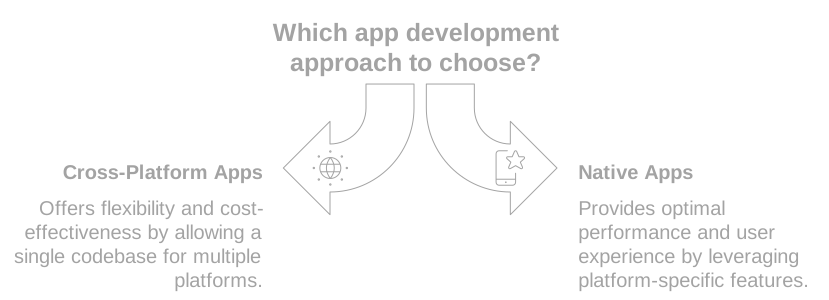
The clearest advantages of going hybrid tend to be these:
- Contained cost: one development for two platforms noticeably lowers the investment compared to building two native apps separately.
- Faster time to market: publishing and updating on iOS and Android at once shortens cycles and lets you react quickly to what users ask for.
- Broad reach: a single version reaches a diverse audience without forcing your customer to own the latest device, decisive in a market with many tiers.
- Simpler maintenance: a single base to look after frees the team’s time to innovate instead of duplicating tasks.
When native is worth it
Native shines when experience and performance are the product, not an accessory. A native app is built specifically for one platform, with its own tools and languages (Swift or the Apple stack for iOS, Kotlin for Android), which gives it direct access to the device hardware. The result is a smoother app, better integrated, and with more room to grow into complex features.
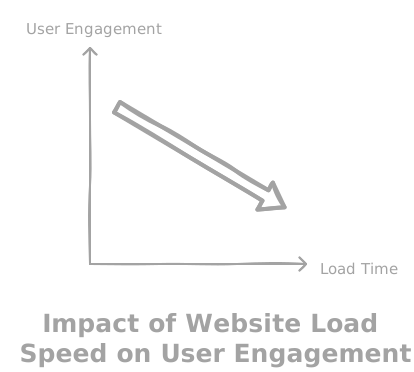
That closeness to the device shows up in what the user feels: smooth animations, instant response, and natural use of the camera, GPS, sensors, biometrics, or notifications. When your app lives on demanding graphics, heavy processing, augmented reality, or very fine interaction, native stops being a luxury and becomes the right call. Performance, moreover, isn’t a vanity metric: speed directly influences how many people stay. As the web performance guide from MDN reminds us, every second of waiting erodes the perception of quality and retention.
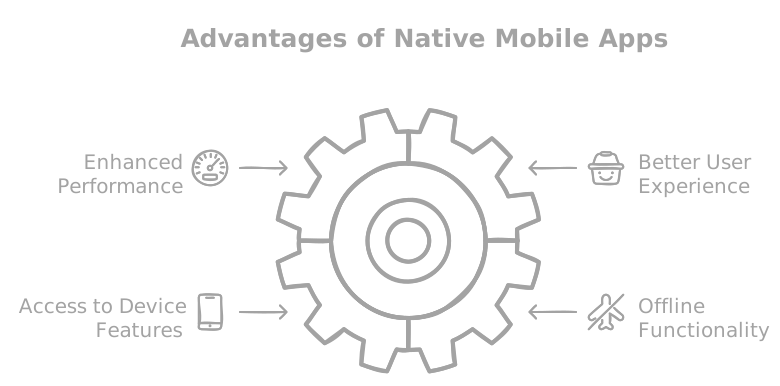
The reasons to lean native usually boil down to these:
- Maximum performance: by talking directly to the hardware, the app responds with a speed another approach can hardly match.
- Premium experience: fine integration with the operating system produces a polished feel that users reward with their loyalty.
- Access to advanced features: cutting-edge device capabilities, such as specialized sensors or augmented reality, are available without detours.
- Better for demanding cases: if the app is the heart of the business and not an experiment, that solidity justifies the added investment.
It’s worth naming the cost of that power too: two developments instead of one, more time to launch, and more demanding maintenance, because each platform evolves on its own. That isn’t a flaw, it’s the price of playing in the high end, and the question is whether your business needs that level from day one.
The market factor in Mexico
No comparison makes sense in the abstract: the right answer depends on who you want to reach. And in Mexico that question has its own nuances. A wide range of device tiers coexists, from high-performance handsets to entry-level phones with limited storage and memory, and network conditions vary considerably between a major city and an area with patchy coverage. Designing as if all your users had the latest model and fiber optics is a quiet way to lose market.
Here hybrid has a strong argument: a well-optimized app reaches a broad audience without demanding the latest device, which matters in a country where smartphone penetration keeps growing and spans every income level. Native, on the other hand, lets you fine-tune performance for specific audiences that value (and pay for) a flawless experience. Mexico’s digital economy, within the Latin American region the OECD tracks closely, rewards those who understand that diversity instead of ignoring it.
To ground the decision in the local context, it’s worth reviewing:
- The real profile of their devices: research which tier dominates among your users; that tends to tilt the balance more than any trend.
- Network conditions: if part of your audience runs on limited data or irregular coverage, the app’s size and its offline behavior become critical.
- Consumption behavior: sectors like digital banking, e-commerce, and logistics grow fast and demand trust, where cybersecurity and stability weigh as much as design.
- Growth projection: think not only about your users today, but about how you’ll want to scale the product tomorrow without rebuilding it from scratch.
How to choose wisely
With the picture clear, the decision becomes less intimidating. Start with the four questions from the beginning and use them as a filter. If you need to validate fast, reach far on little, and still don’t know which features will stick, hybrid usually wins. If a premium experience defines your offering, if you depend on advanced hardware, or if the app will be the central channel of the business, native is worth it. The best app isn’t the most sophisticated on paper, but the one that meets your goals without strangling your operation.
It’s also worth remembering that this isn’t an eternal choice or a dead end. Many companies start with a hybrid approach to test the market and migrate components to native as the product matures, users grow, and the business justifies the investment. A good architecture from the start, designed to scale, makes that path an evolution rather than a demolition. That’s where a partner who masters both worlds makes the difference: it isn’t about selling one approach, but choosing the right one for your stage.
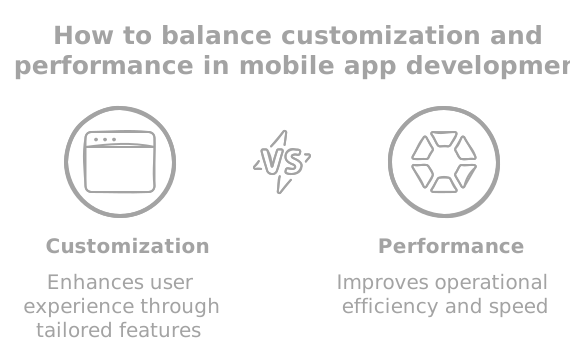
A short checklist to organize the conversation with your team or your provider:
- Define the goal before the technology: decide what problem the app solves and for whom; the tool comes after, not the other way around.
- Put numbers on the full budget: add development, maintenance, and two years of evolution, not just the launch cost.
- Prioritize three critical features: identify what truly can’t be missing and assess whether it demands capabilities only native delivers well.
- Think about scalability: choose a base that can grow with you, so you don’t rebuild the product when success arrives.
| Criterion | Hybrid | Native |
|---|---|---|
| Cost | Lower, one codebase for both stores | Higher, per-platform development |
| Performance and UX | Very good for common cases | Maximum, with fine device integration |
| Time to market | Fast, a single release | Longer, two parallel developments |
| Maintenance | Simpler, a single base | More demanding, two bases to evolve |
| Best for | Validating ideas and mobile presence on a contained budget | Premium, demanding apps or a primary business channel |
“Simplicity is a prerequisite for reliability.” Computer scientist Edsger W. Dijkstra said it, and it applies squarely here: choosing the simplest approach that meets your goals is almost always worth more than chasing the flashiest solution.
The best technology isn’t the most advanced one, but the one your business can sustain, maintain, and grow with the team and budget you actually have.
In short
Hybrid prioritizes cost, speed, and reach; native prioritizes experience, performance, and depth, and the answer lives in your business goals, not in a trend. Start with your budget, your audience, and your critical features, decide whether the app is an experiment or the central channel, and let those answers guide the architecture. At LabWeb we translate those goals into the right decision, whether hybrid, native, or a route that blends the best of both, so your mobile investment pays off today and still makes sense tomorrow.