

APIs are the fabric that connects modern software: payments, messaging, data, AI. Almost no serious product is built in isolation today; it leans on dozens of external services that talk to each other through interfaces. The catch is that a poorly built integration rarely fails on day one. It fails weeks later, in production, when a provider changes a field, a traffic spike trips the rate limits, or a credential expires without anyone noticing. Those failures show up late and cost a lot.
The good news is that most integration problems are not mysterious: they repeat over and over, and they can be prevented at design time. Below we walk through the most common mistakes when connecting APIs and the concrete practices that avoid them, so you have a mental checklist every time your system depends on a service you do not control. The key points are:
- Ignoring errors and retries: someone else’s outage becomes your blackout.
- Not respecting rate limits: it leads to blocks, incomplete data, or suspended accounts.
- Neglecting security: exposed keys and unencrypted connections are open doors.
- Forgetting versioning and monitoring: the integration breaks without warning.
- Trusting external data blindly: what comes in unchecked ends up breaking what is inside.
- Skipping documentation and tests: the knowledge leaves with the person who wrote it.
Ignoring errors and retries
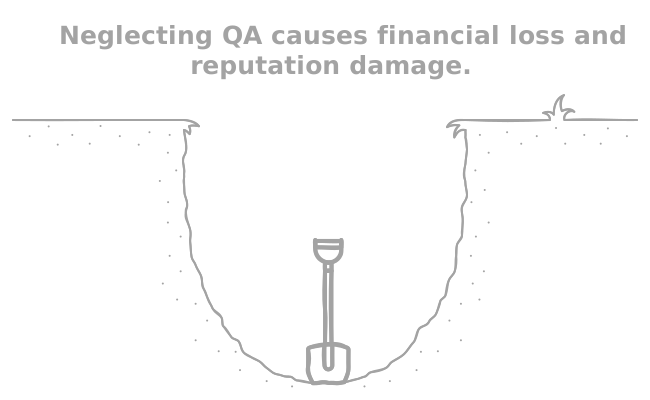
External APIs fail, and it pays to assume so from the start: they go down, respond slowly, return unexpected data, or simply do not answer. Building as if the other end will always respond correctly is the surest way to land incidents in production. The difference between a fragile system and a robust one almost never lives on the happy path, but in how it reacts when something goes wrong: a call that fails silently can leave a half-finished payment or an unconfirmed order.
Proper error handling starts by telling apart what kind of failure occurred. A temporary error, like a timeout or a “service unavailable”, deserves a retry; a permanent error, like an invalid credential or a malformed payload, does not get fixed by insisting and only wastes resources. Here a key piece comes in: idempotency, meaning operations designed so that repeating the same request produces no duplicate effects. Without it, retrying a charge can bill the customer twice.
To make your integrations survive real-world failures, keep these practices in mind:
- Retries with exponential backoff: instead of retrying instantly in a loop, wait growing intervals so you do not overwhelm a service that is already struggling.
- Clear time limits: set timeouts on every call so a slow response does not freeze your whole system waiting indefinitely.
- Useful messages and logs: capture the error context (status code, response body, request identifier) so you can diagnose without guessing.
- Graceful degradation: when a secondary service fails, offer a reduced version of the feature instead of taking down the entire application.
“Anything that can go wrong will go wrong.” Murphy’s law sums up the right mindset for integrating APIs: code that does not account for failure is just an optimistic hypothesis.
Not respecting rate limits
Almost every API imposes request limits, known as rate limits. They are a legitimate way for the provider to protect its infrastructure and share capacity among all its clients. Ignoring them is not a harmless prank: it leads to temporary blocks, responses with status code 429 “Too Many Requests”, incomplete data, and even account suspension. The dangerous part is that these limits tend to show up exactly when the product grows and traffic rises, that is, at the worst possible moment.
Respecting limits is not just about going slower, but about designing the integration so it regulates itself. That means reading the provider’s documentation to learn the real quotas, watching the headers that many APIs send to indicate how many requests remain, and building mechanisms that adapt in real time. A well-built system slows down as it nears the limit, rather than crashing head-on into it.
Some techniques that keep the connection stable even under load:
- Your own rate limiting: control from your side how many requests you send per second so you never exceed the provider’s quota.
- Queues and batch processing: accumulate operations and process them in an orderly way, instead of firing them all at once during a spike.
- Response caching: store data that changes little so you do not request the same thing again and again, saving calls and latency.
- Respect the server’s signals: when the API responds with a 429 status and a “Retry-After” header, obey it instead of insisting immediately.
Neglecting security
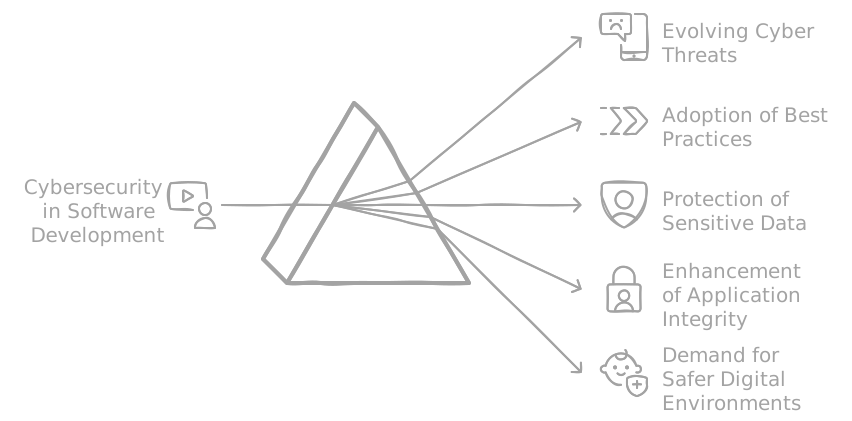
Integrations handle data and access that, in the wrong hands, turn into a serious problem. Keys exposed in code, tokens that are never rotated, or unencrypted connections are open doors that an attacker is glad to find. The most classic mistake, and surprisingly common, is leaving a credential written straight into the repository: once there, it lives forever in the history, even if you delete it later. Your integration’s security is only as strong as its weakest link.
Protecting an integration does not require heroic measures, just constant discipline. Credentials should live in environment variables or in a secret manager, never in source code or in screenshots shared over chat. All communication should be encrypted with HTTPS, and each service should have only the permissions it needs, not one more. This is where integration meets cybersecurity, and where a small slip can have large consequences.
Good practices that cut the risk noticeably:
- Secrets out of the code: use environment variables or a dedicated secret manager, and rotate keys periodically.
- End-to-end encryption: require HTTPS on every call and verify certificates; never send credentials over unencrypted channels.
- Least privilege: grant each token only the permissions it strictly needs, so a leak has the smallest possible blast radius.
- Auditing and expiry: log who accesses what and set short lifetimes for tokens, so a leaked access does not work indefinitely.
“There are only two types of companies: those that have been hacked, and those that don’t yet know it.” The line, attributed to Robert Mueller during his time leading the FBI, is a reminder that security is not a state you reach, but a practice you maintain.
Forgetting versioning and monitoring
APIs change. Providers release new versions, deprecate fields, adjust formats, and every so often retire features entirely. An integration that does not account for this fact breaks without warning, usually on a Friday afternoon. The mistake is treating an external API as if it were an immutable constant, when it is really a living service that evolves on its own schedule, not yours.
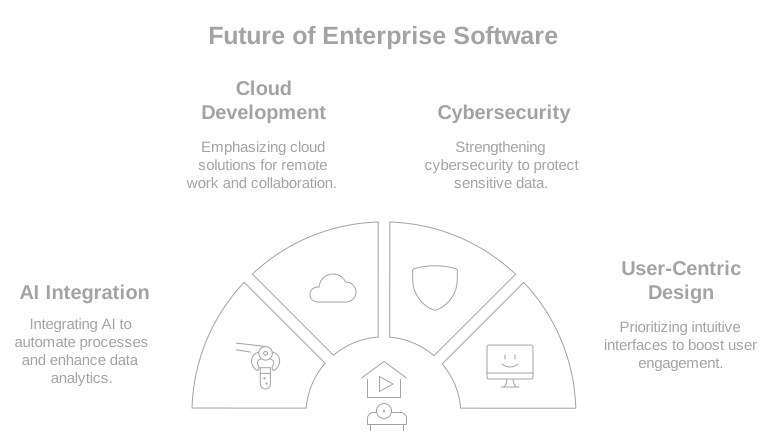
The defense has two complementary fronts. The first is versioning: pin the version you use, read the provider’s change notes, and plan migrations with time to spare instead of reacting in a rush. The second is monitoring: an integration you do not observe is a black box that only tells you about its problems once users have already complained. Measuring latency, error rate, and usage volume gives you the chance to catch an anomaly before it turns into an incident.
To make versioning and monitoring work in your favor:
- Pinned, documented versions: state which API version you integrate with, and make it clear in the code when and why it will be updated.
- Alerts on key metrics: set up automatic notifications when latency or errors cross a reasonable threshold.
- Traceability of calls: keep logs that let you reconstruct what happened in a specific request when something fails.
- Tests ahead of announced changes: when the provider announces a new version, validate the integration in a test environment before updating production.
Trusting external data blindly
A subtle but costly mistake is assuming the response from an API will always have the expected shape. In practice, a field can arrive empty, with a different data type, with a null value, or simply missing. If your code takes the format for granted and does not validate it, that unexpected data leaks inward and breaks processes that had nothing to do with the original integration. What comes in unchecked ends up contaminating what was working fine.
Validating incoming data is one of the highest-return investments in an integration. It is not about distrust for its own sake, but about drawing a clear boundary between the external world, which you do not control, and your internal logic, which you do. That boundary translates, cleans, and verifies everything that arrives, so the rest of the system always works with trustworthy data. It is the same philosophy behind serious software quality: preventing at the entrance costs far less than repairing in production.
Concrete measures so you are not at the mercy of someone else’s data:
- Schema validation: check that the response has the expected fields, types, and formats before processing it.
- Safe defaults: decide what to do when a piece of data is missing, instead of letting the system fail over an unexpected absence.
- A translation layer: convert external data into your own internal model, so a change at the provider does not ripple through your whole codebase.
- Explicit null handling: treat null and empty values as anticipated cases, not as exceptions that take down the flow.
Skipping documentation and tests
The last trap is treating the integration as code that is “done” and forgetting about it. Without documentation, the knowledge lives only in the head of whoever wrote it, and it leaves with that person when they move on to another project or company. Without tests, every change is a gamble: nobody knows for sure whether an innocent tweak broke the connection to a critical service until a user finds out for you.
Documenting and testing is not bureaucracy; it is what keeps an integration maintainable over time. Good documentation explains what the integration does, what assumptions it makes, what known issues it has, and how to configure it from scratch. Automated tests, in turn, freeze the expected behavior and warn you when something drifts. This matters most when you think about scalability: an integration you cannot test with confidence is one you cannot grow with confidence either.

Practices that keep an integration healthy for the long run:
- Living documentation: describe the endpoints, the credentials required, and the key assumptions, and keep it close to the code.
- Automated tests: cover the happy paths and, above all, the error paths, to catch regressions before you deploy.
- Sandbox environments: use the test environments many providers offer to experiment without touching real data.
- Failure simulation: deliberately test what happens when the API responds slowly, returns an error, or goes down, to confirm your system reacts well.
“Programming without tests is like driving blindfolded.” The idea, popular in agile development culture, applies just as well to integrations: without automated checks, you move blind, and the crash is only a matter of time.
In short
A good integration isn’t measured when everything works, but when something fails. The most common mistakes (ignoring failures, steamrolling rate limits, neglecting security, forgetting versioning and monitoring, trusting external data blindly, and skipping documentation and tests) share one trait: they are prevented at design time and cost a fortune when discovered late. Thinking about the error path from the start is what separates a connection that holds from an experiment that collapses at the first surprise.
At LabWeb we build integrations designed for the real world: resilient, secure, and observable, with the custom software and the teams that make your systems communicate without surprises. If connecting your product to the rest of the ecosystem is part of your roadmap, we are exactly the kind of partner that would rather prevent the incident than put out the fire.