
Redefining limits with innovations
Whether you're looking to:
Our team of experts is here to bring your vision to life.
Expert Insights
Exceptional Solutions Designed for You
Discover innovative, tailored solutions that cater to your unique challenges and drive excellence. Our expert insights empower you to stay ahead with strategic, cutting-edge tools designed for success. Uncover opportunities that elevate your business through precision and innovation.
Innovative Financial Solutions
Our FinTech and banking solutions drive digital transformation in financial services, streamlining transactions and enhancing customer experience.
We offer secure, scalable tools for payments, loan management, and compliance to keep institutions competitive and resilient.
Our expertise empowers financial organizations to meet modern demands with efficiency and trust.
Efficient Tax and Fiscal Solutions
Our fiscal technology solutions automate tax processes, ensuring compliance with local and global regulations.
From digital invoicing to automated tax filing, we streamline workflows for accuracy and reduced administrative burden.
These tools support businesses in managing fiscal responsibilities efficiently, freeing resources for growth.
Data-Driven Marketing Insights
Our marketing intelligence solutions turn data into actionable insights, guiding strategies that resonate with target audiences.
Through social listening, trend analysis, and performance metrics, we help brands make informed, impactful decisions.
These tools empower companies to optimize campaigns, boost engagement, and drive growth with confidence.
Optimized Warehouse Operations
Our warehouse automation solutions improve inventory management and operational efficiency through advanced robotics and AI.
From real-time tracking to automated sorting and storage, we streamline logistics to reduce costs and enhance speed.
These innovations support businesses in managing supply chains more effectively, ensuring timely and accurate fulfillment.
Comprehensive Cybersecurity Solutions
Our cybersecurity solutions safeguard organizations from digital threats with advanced monitoring and proactive defense measures.
We provide multi-layered security, including threat detection, data encryption, and network protection to ensure resilience.
With a focus on data integrity and risk mitigation, our solutions offer peace of mind in a rapidly evolving threat landscape.
Why Industry-Specialized Software Wins
Generic software promises to serve everyone and ends up serving no one well. Every industry has its own vocabulary, rules, rhythms, and risks. That’s why software that truly understands your vertical doesn’t just “work”, it gives you an edge a one-size-fits-all tool can never match. The gap between a platform that tolerates your business and one that comprehends it shows up in every workflow, every report, and every audit. Here is why vertical expertise wins in the end:
- Generic software hides a cost you pay every single day.
- Speaking your industry’s language speeds up the whole team.
- Compliance should be built in, not bolted on later.
- The right integrations create a single source of truth.
- Each sector has its own security rules.
The hidden cost of generic software
A platform built for “any business” forces you to bend your operation around it, not the other way around. At first it looks like a bargain: a low monthly subscription, a polished demo, and the promise of covering every need. The trouble starts when your reality doesn’t fit the predefined fields and the patches begin: parallel spreadsheets, manual workarounds for the gaps, and data trapped in silos that can never be cross-referenced.
That mismatch is paid for every day, in time, errors, and missed opportunities. Every hour your team spends forcing the tool to behave is an hour not spent selling, producing, or serving customers. And the bigger the business grows, the wider the crack gets: what was a minor annoyance with ten employees becomes a serious bottleneck with a hundred. What looks cheap upfront gets expensive to run, because the real cost isn’t in the license, it’s in everything that surrounds it.
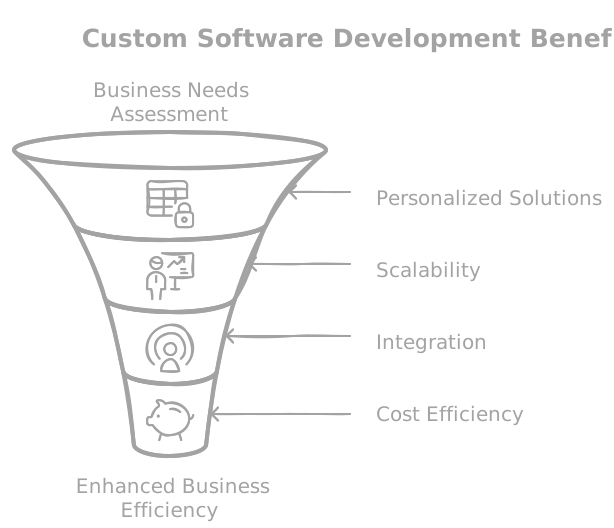
It’s worth tracing where that silent overhead comes from, because it rarely shows up on a single invoice:
- Recurring manual work. Every gap in the tool gets covered by a person copying data from one system to another, a task that adds no value and multiplies mistakes.
- Endless onboarding. An interface built for everyone forces you to teach each new hire how to “translate” the business into the software, instead of the software speaking their language from day one.
- Decisions in the dark. When data lives scattered, reports arrive late and stale, so the important calls get made on partial information.
- Accumulated operational debt. Each patch leans on the last one, and over time nobody dares touch the scaffolding for fear the whole thing collapses.
“Price is what you pay. Value is what you get.” The line, attributed to Warren Buffett, captures the trap of cheap software perfectly: the license price is only the visible tip of a much larger cost.
The advantage of speaking your industry’s language
Specialized software models your reality with precision. It doesn’t ask you to map your concepts onto generic categories: it already knows yours. A banking solution understands reconciliations, anti-money-laundering checks, and the controls the regulator demands. A fiscal one knows electronic invoicing, payment complements, and the tax authority’s deadlines. A warehouse one thinks in SKUs, marketplaces, and fulfillment. When the tool already speaks your language, your team stops translating and starts executing.
That precision isn’t an aesthetic luxury, it’s pure speed. A team that doesn’t have to explain the business to the tool moves faster, makes fewer mistakes, and focuses on what actually matters. The learning curve shrinks because the interface mirrors processes the user already knows by heart. And when an edge case arrives, the vertical solution has probably already anticipated it, because it was built by people who understand the sector from the inside.
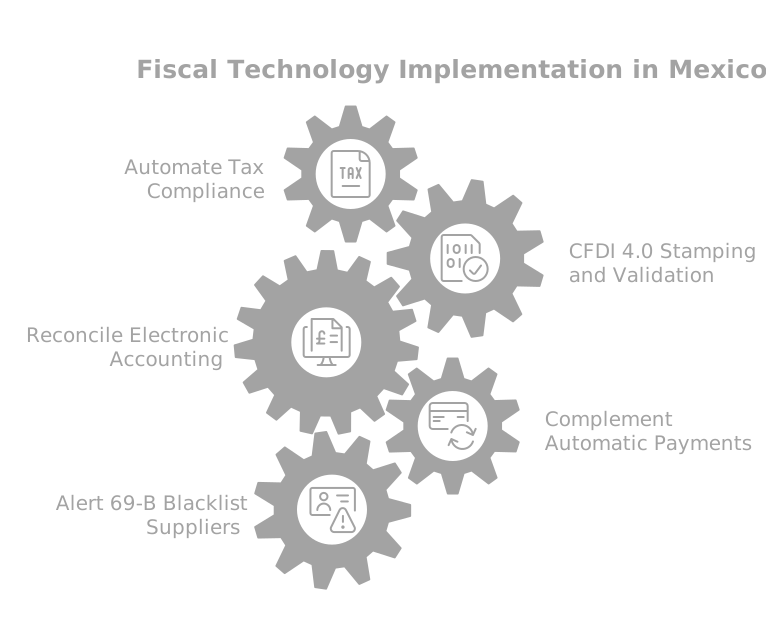
Speaking the industry’s language translates into very concrete benefits:
- Less initial setup. The templates, workflows, and reports are already designed for your sector, so you go live in weeks rather than months.
- Shared vocabulary. Fields, statuses, and alerts use the terms your team already employs, which cuts misunderstandings and data-entry errors.
- Edge cases solved. The exceptions specific to each industry, returns, reconciliations, withholdings, are already handled instead of improvised.
- Best practices baked in. The software reflects how the best in the sector operate, so adopting it also means adopting a more mature way of working.
“Any fool can make something complicated. It takes a genius to make it simple.” This idea, attributed to Woody Guthrie, captures the value of vertical software: it turns the complexity of an industry into a tool that feels natural.
Compliance built in from the start
In regulated industries, compliance isn’t an optional feature, it’s the condition for operating at all. A banking system that ignores the regulator’s controls isn’t a banking system, it’s a liability. A fiscal platform that issues documents with errors doesn’t save work, it multiplies it. Vertical software bakes in the controls, validations, and audit trails your sector demands from the design stage, instead of leaving them as an add-on someone will have to code later.
That difference is enormous when an audit arrives or a rule changes. Built-in compliance lowers the risk of fines, speeds up reviews, and spares you from re-architecting the system every time a regulation is updated. In Mexico’s digital economy, where electronic invoicing and mandatory reporting change often, having a provider that keeps pace with the rules stops being a technical detail and becomes operational peace of mind. Sound handling of personal data and full traceability of every operation become part of the product, not a promise.
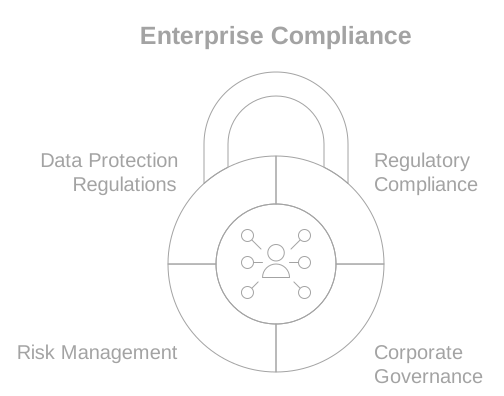
Built-in compliance shows up in areas generic software tends to ignore:
- Complete audit trails. Every action is logged with user, date, and context, turning a tense audit into an orderly procedure.
- Validation at the source. Data is checked the moment it’s entered, so errors are stopped before they spread into an official report.
- Updates for regulatory change. When the authority modifies a format or a deadline, the provider adjusts it and you simply keep operating.
- Role-based access controls. Each person sees and edits only what concerns them, a basic requirement in sectors where confidentiality is law.
According to the OECD, a clear and predictable regulatory framework is one of the factors that most boosts trust and investment in the digital economy. Software that builds it in from the design stage turns that requirement into an advantage.
Integration with what you already use
No system lives in isolation. Industry expertise also means knowing how to connect with the ecosystem you already run, payment gateways, the tax authority, marketplaces, ERPs, or your CRM, without friction. A provider that knows your vertical doesn’t arrive to replace everything you have: it arrives to integrate with it, because it understands which pieces are critical and which are worth keeping. That maturity avoids the classic project that promised to simplify and ended up adding one more island.
The right integrations turn scattered data into a single source of truth, and that visibility is what lets you decide with confidence. When sales, inventory, billing, and support information flows without copy-pasting, reports stop lying and dashboards reflect the business in real time. Scalability depends on this too: a well-integrated system grows by adding modules, not by improvising fragile bridges every time a new need appears.
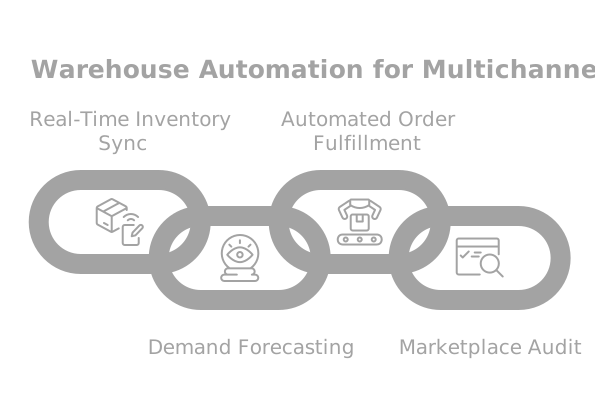
For integration to be an advantage rather than a headache, several fronts deserve attention:
- Ready-made connectors. Vertical solutions usually ship with predefined integrations for the sector’s most-used services, saving months of development.
- Documented APIs. A clear programming interface, following standards like those described by the W3C, lets your systems talk to each other without surprises.
- Reliable synchronization. Data updates consistently across platforms, so nobody works on a stale version of the truth.
- A single source of truth. By consolidating information in one place, decisions are made on complete data instead of contradictory fragments.
Security designed for your sector
Cybersecurity isn’t the same for everyone. A hospital protects medical records; a bank protects transactions; an online store protects card data. Each sector faces different threats and answers to different standards, and vertical software knows it. Instead of offering a generic security layer, it builds defenses aligned with the real risks of your industry and with the rules you must meet, from encrypting sensitive information to carefully managing who accesses what.
That specialization matters because attackers specialize too. Whoever targets a fintech doesn’t use the same tactics as whoever targets an e-commerce store, and protection designed for “any company” leaves gaps exactly where your sector is most vulnerable. Software built with vertical expertise anticipates those vectors, incorporates the right monitoring, and treats security as a living process, not a box you tick once and forget.
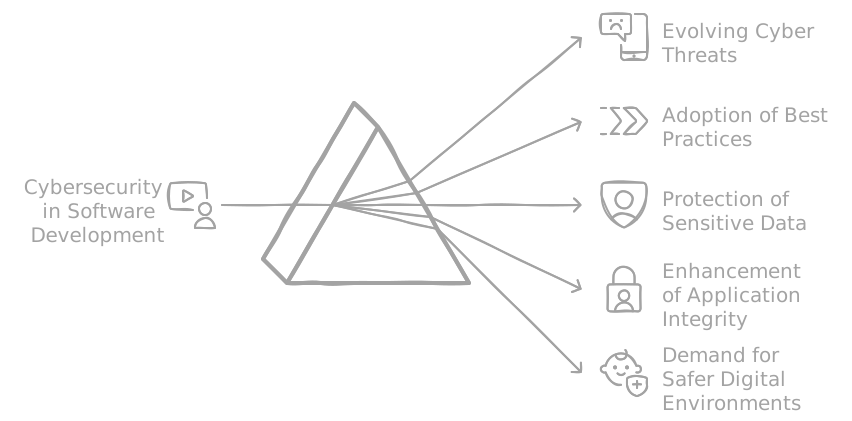
Security designed by industry rests on practices generic software rarely prioritizes:
- End-to-end encryption. Sensitive information travels and is stored protected, so even a leak leaves it unreadable.
- Threat-specific defenses. Protections are tuned to the typical attacks of each sector, rather than applying a single recipe for all.
- Monitoring and response. The system watches for anomalous behavior and lets you react before an incident escalates.
- Privacy by design. Care for personal data is built into the architecture, not added as a late patch once a problem has already happened.
“There are only two types of companies: those that have been hacked, and those that will be.” The warning, attributed to Robert Mueller, is a reminder that security isn’t optional, and that it’s best built with someone who understands your sector’s risks.
In short
Generic software optimizes for the average; specialized software optimizes for you. The difference compounds day after day: less manual work, teams that execute without translating, compliance built in from the start, integrations that create a single source of truth, and security designed for the real risks of your sector. What looked like savings on the one-size-fits-all tool ends up costing in time, errors, and missed opportunities.
At LabWeb we build solutions designed around your industry, its language, its regulations, and its real workflows. We combine custom software development with vertical expertise so technology stops being an obstacle and becomes your strongest competitive advantage. If your business lives in a sector with rules of its own, let’s talk: that is exactly where specialized expertise makes the difference.
Full-Cycle Expertise and Process Mastery
From concept to deployment, we offer comprehensive development services. We manage the entire lifecycle of your project, ensuring each phase, planning, design, development, testing, and maintenance, is expertly executed to meet your business needs.
Strategic Project Blueprinting
We start by understanding your industry: its vocabulary, regulations, and the workflows that make it distinct. A vertical solution is born from that context.
We define scope, sector risks, and measurable success criteria. The generic is dropped in favor of what your sector actually needs.
We align business goals with your market's specific demands. That alignment avoids rebuilding the system when a rule changes.
Let's Get In Touch!
Send us a message, and we'll promptly discuss your project with you.
What's Next?
- We start by signing an NDA to ensure your ideas are protected.
- Then, our team will analyze your requirements.
- You get a detailed project outline.
- We bring your project to life, so you can focus on growing your business.
© 2019–2026 LabWeb · Laboratorio Internacional Web S.A. de C.V. · All rights reserved.