
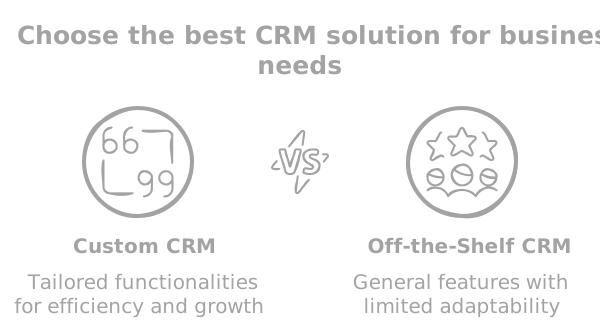
A CRM should adapt to how you sell, not force you to sell the way the software expects. That is why more and more Mexican companies, after wrestling with generic tools that promise “everything for everyone,” end up choosing a custom-built CRM: it fits their real process, integrates with their operation, and pays off as they grow. This is not a technology whim but a business decision that changes how a team manages its customer relationships. Here are the five main reasons behind the trend:
- Tailored functionality and flexibility, not someone else’s mold.
- A competitive edge through personalization.
- A better experience for your team and your customers.
- Real integration with the tools you already use.
- Costs that make sense over the long term.
1. Tailored functionality and flexibility
Off-the-shelf CRMs impose their own sales logic, and teams end up filling fields they never use or bending their process to fit a template designed for someone else’s company. A custom CRM flips that relationship: it reflects how you actually work, with your stages, your rules, and your vocabulary. The tool supports the team instead of getting in the way, and that shows from day one in how many clicks each person needs to close a deal.
That flexibility goes well beyond moving a couple of buttons. It means the system can grow at the pace of the business without forcing a painful migration every time you change strategy. When a new product line, a new sales channel, or a new regulation reshapes how you operate, the CRM adjusts instead of becoming a brake. A good example is Mexico’s energy sector, where companies use bespoke systems to manage complex client relationships while navigating regulatory requirements unique to the industry, something no generic template solves on its own.
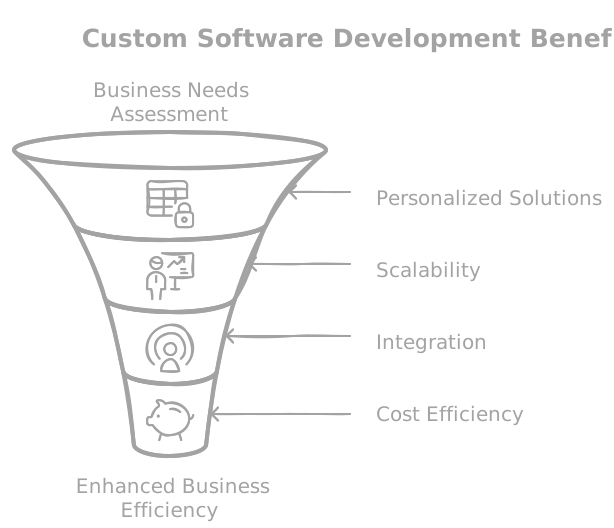
With a custom CRM you can expect:
- Specific feature sets: you choose and prioritize exactly what your operation needs, whether that is lead management, sales forecasting, or after-sales support, without paying for modules you will never open.
- Continuous adaptability: as market conditions shift, the system adjusts without needing a complete replacement, the kind of agility that matters in a competitive environment.
- Scalability without breakage: the tool evolves with the company, so adding users, branches, or business lines never means starting from scratch.
“Flexibility is the key to stability.” The line, attributed to legendary coach John Wooden, captures why a system that bends without breaking ends up sturdier than a rigid one.
The takeaway is direct: investing in custom software is not just buying new technology, it is gaining a tool that evolves with the business and rewards, month after month, the company that designed it around its own operation rather than a market average.
2. A competitive edge through personalization
In a market as competitive as Mexico’s, personalization has stopped being a luxury and become an expectation. Customers expect companies to recognize their history, anticipate their needs, and speak to them as individuals rather than as one more record in a database. A custom CRM is precisely the tool that makes that closeness possible at scale, because it captures the data that matters to your business and puts it to work.
The difference against a generic system is in the detail. While an off-the-shelf tool offers standard reports, a custom CRM lets you measure what truly moves the needle in your industry, segment customers with criteria that make sense to you, and automate the right message at the right moment. That intelligence, accumulated over time, becomes an advantage that is hard to copy. You can see it clearly in retail in Mexico City, where brands that adopted custom tools recommend products based on past purchases or browsing history, turning a casual shopper into a returning customer.
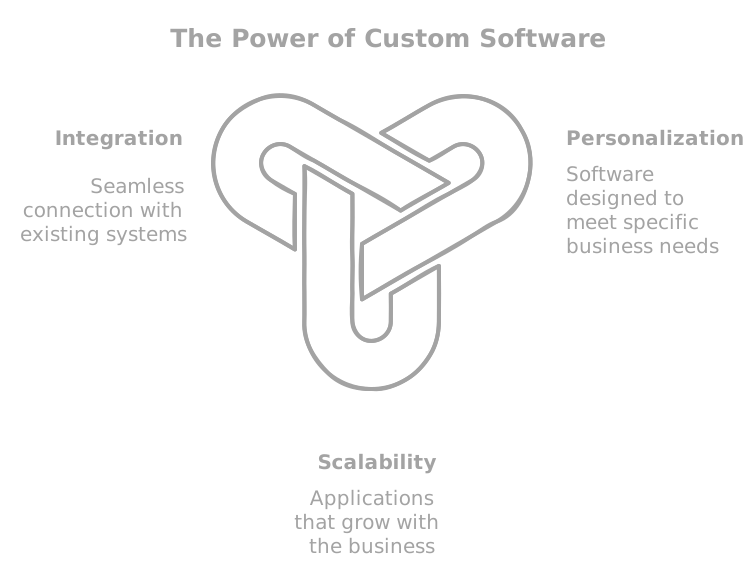
Personalization translates into concrete benefits:
- Strategic customer insights: the system gathers and analyzes data specific to your book of business, turning buying behavior into better-grounded marketing and product decisions.
- Communication that resonates: you can automate messages based on each interaction, so a follow-up or a promotion arrives with context instead of as one more mass email.
- Higher retention: anticipating customer needs and resolving friction before it escalates strengthens loyalty, and keeping a customer costs far less than winning one back.
“Personalization is no longer optional: it is the expectation of today’s customer.”
Companies that invest in personalizing the customer relationship do not only improve their immediate metrics, they also build a reputation as attentive and modern brands. And that perception, over time, translates into market share.
3. A better experience for your team and your customers
Experience matters in both directions. Internally, an intuitive interface built around the real flow of work reduces training time and daily frustration. Externally, a well-designed CRM lets you deliver service that feels personal at every touchpoint. Picture walking into a store where every team member knows your name, your preferences, and your history: that is the level of attention a custom CRM makes operational.
A generic system usually forces the team to jump between screens, copy data back and forth, and memorize shortcuts no one designed with them in mind. A custom solution tidies that chaos: the information lives in one place, the screens follow the logic of the work, and every representative has what they need exactly when they need it. The capital’s hospitality industry proves the point: hotels that run bespoke systems tailor their service based on previous stays and preferences, and that attention turns a first-time guest into a repeat one.

In practice, that experience is built from concrete elements:
- User-centered design: screens and flows adapt to how your people work, not the other way around, which means fewer errors and more speed.
- Proactive support: the system can trigger alerts and reminders based on customer behavior, so a timely follow-up replaces the missed opportunity.
- Unified processes: calls, emails, and messages converge on a single platform, so nobody loses the thread of a conversation halfway through.
“The best companies do not just sell products: they create memorable experiences.”
When the customer feels recognized and the team works without friction, the relationship lasts longer. Putting the customer at the center of operations is not a slogan: it is a design decision that shows up in retention and, eventually, in revenue.
4. Real integration with your operation
Few things slow a team down like a system that lives on an island. Billing, inventory, messaging, local payment gateways: a custom CRM connects with the tools you already use instead of forcing you to enter the same information two or three times. That integration eliminates double data entry, reduces human error, and gives your team a single source of truth about every customer.
Interconnection is not a technical luxury, it is an operational necessity. When data flows in real time between the CRM, accounting, and inventory, decisions rest on current information rather than a stale snapshot. A sales team stops chasing data across platforms and focuses on what really matters: building relationships and closing deals. And by joining areas that used to work apart, collaboration across departments stops depending on scattered emails and starts leaning on shared dashboards where everyone sees the same reality.
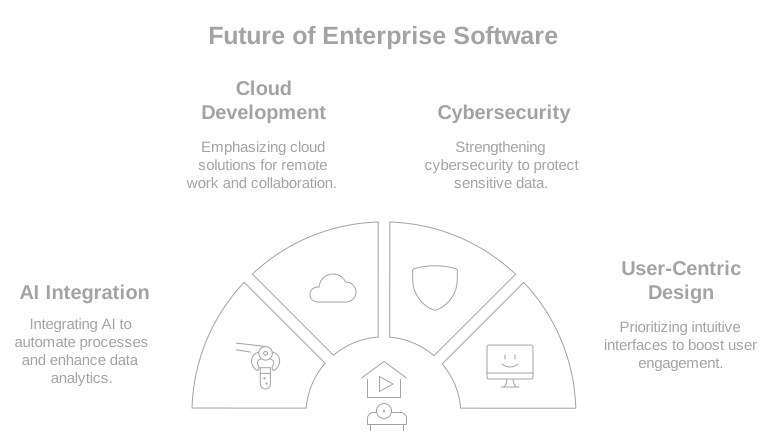
The benefits of well-built integration are felt across the whole company:
- Real connectivity: the CRM links with accounting, logistics, and other internal systems to share data instantly, so every team works from the same information.
- Simplified workflows: bringing functions into one environment removes redundant steps and shortens the time each process takes.
- Greater data accuracy: automatic syncing avoids the errors of entering the same figure into two different places.
“Integration is not just about technology: it is about creating opportunities for collaboration.”
A clear example is in manufacturing, where companies use custom systems to coordinate suppliers while linking them to inventory control. That enables sharper forecasting and production schedules that line up with the real availability of inputs. In a business where agility rules, that ability to integrate is the difference between reacting in time and falling behind.
5. Costs that make sense over the long term
The financial argument is usually the one that closes the decision. Per-user licenses on commercial CRMs grow with your team and rarely stop: every person you add, every extra module, every additional feature shows up as a recurring charge that scales with the success of the business. A custom solution means a larger upfront investment, but it removes that perpetual rent and, seen over the right horizon, tends to pay off.
It pays to look at total cost of ownership rather than just the entry price. A custom system is designed for your operation, which lowers maintenance expenses and the costly patches typical of generic software. And when the business changes, extending the tool is cheaper because you start from a foundation built for you, not from a product you have to force into shape. Adding a new function on top of your own foundation costs a fraction of what vendors charge to adapt someone else’s product, and that gap compounds year after year.
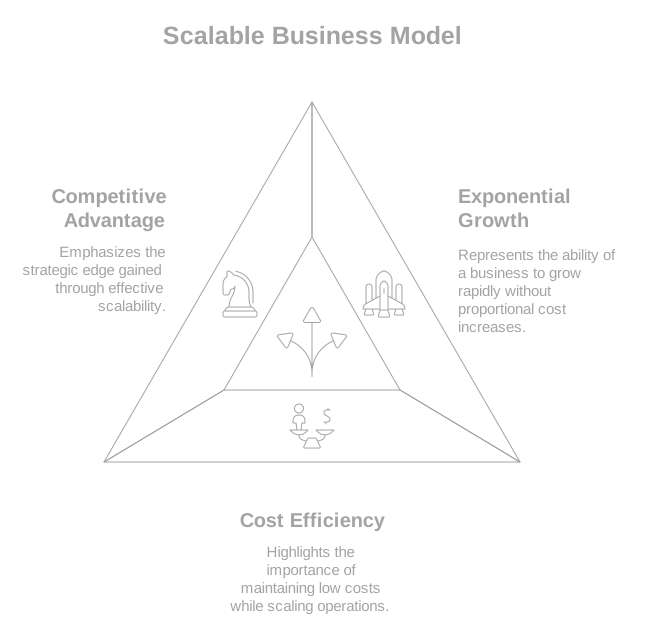
Over the long term, the numbers lean toward owning the software:
- No licenses that scale without end: you avoid the recurring charge that multiplies with every user or feature you add to an off-the-shelf product.
- Lower maintenance cost: built for your operation, the system reduces the odds of forced upgrades and expensive support.
- Cheaper personalization over time: adding new functions costs less when a solid base already exists, instead of paying steep fees to adapt someone else’s product.
- Data control as an asset: your customer information lives where you decide, with the access and compliance rules your business needs, something increasingly valuable as data protection grows more demanding.
According to the OECD, companies that invest in their own digital capabilities tend to sustain their productivity better over time, a pattern worth weighing when you treat technology as an investment rather than an expense.
That control over data and costs also connects with a topic no company can ignore: cybersecurity. When you decide where and how your customers’ information is stored, protecting that asset stops depending on an outside vendor’s policies and comes under your own rules, aligned with local regulation and with your own appetite for risk.
In short
A custom CRM turns the way you sell into an advantage, instead of forcing you into someone else’s mold. Flexible functionality, real personalization, a better experience, genuine integration, and costs that make sense over the long term are the reasons more and more Mexican companies are taking the step. It is not just adopting technology: it is aligning the system with the real operation of the business and ceasing to pay for what goes unused.
At LabWeb we build CRMs that fit your process, integrate with your operation, and grow with you. If your current tool holds you back instead of pushing you forward, we are exactly the kind of partner that turns the way you sell into a competitive advantage.