Compliance is often seen as a necessary evil: paperwork, audits, and boxes to check. But that view misses something important: in practice, a solid compliance posture becomes an enabler of growth, not a brake on it. Far from being a purely legal obligation, a strong compliance framework builds a culture of integrity that resonates with customers, partners, and investors, and ends up driving operational efficiency and financial performance. It’s worth looking at what isn’t so obvious.
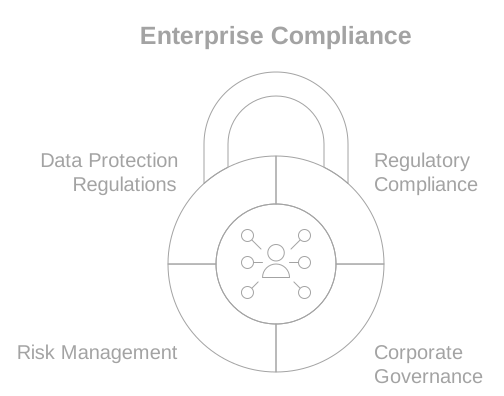
Before going deeper, it helps to have the map. When we talk about enterprise compliance, we mean several pieces that work together:
- Regulatory compliance: meeting the local and international laws that govern operations.
- Corporate governance: clear rules for how a company is directed and controlled.
- Risk management: identifying threats and designing strategies to mitigate them.
- Data protection: safeguarding sensitive information under frameworks like GDPR or local privacy laws.
Trust as business currency
In the digital world, customers trust you with their data before they trust you with their money. Demonstrating that you protect that information, with clear privacy and security practices, builds trust that translates directly into business. Compliance stops being an internal formality and becomes an external signal: a tangible way of telling the market they can work with you with confidence.
That trust is not a fuzzy intangible, it shows up in retention and market share. When a customer senses that a company prioritizes transparency and the responsible handling of their information, they come back, they refer others, and they tolerate the normal bumps of any business relationship far better. Consistency is exactly what sustains it, which is why compliance, the practice of disciplined repetition over time, is one of its strongest foundations.
The reverse is also true, and it is where many companies underestimate the stakes. A single mishandled incident can undo years of goodwill, because customers rarely forgive the sense that their data was treated carelessly. Compliance, in that light, is not just how you earn trust, it is how you keep from losing it overnight.

In practice, trust is earned in the small things far more than in big announcements:
- Active transparency: clearly explaining what data is collected, why, and for how long, instead of burying those decisions in fine print.
- Consistency over time: holding the same practices quarter after quarter, because trust is built with consistency, not one-off campaigns.
- Incident response: having a clear plan to communicate and resolve when something goes wrong, since how you react often weighs more than the incident itself.
“Trust is built with consistency.” Lincoln Chafee said it, and it captures why sustained compliance is worth more than any isolated promise.
The key to bigger clients
Large enterprises and regulated sectors don’t negotiate on security: they demand evidence of compliance before signing. Without those standards, you don’t even enter the conversation; with them, you reach contracts and markets that would otherwise be out of range. In this way, compliance acts as a key that opens doors to higher-value clients and more ambitious opportunities.
Corporate governance is the other half of that key. Clear decision processes, well-defined responsibilities, and genuine accountability are exactly what a corporate buyer reviews before trusting you with part of their operation. It’s no accident: according to the OECD, good governance practices are associated with stronger financial performance and a greater ability to attract investment. For a company that wants to sell upmarket, that structure isn’t bureaucracy, it’s a credential.
It’s worth seeing how compliance opens concrete commercial doors:
- Faster procurement: security questionnaires and certifications answered in advance shorten sales cycles that would otherwise stall for months.
- Access to regulated sectors: banking, healthcare, and government only work with vendors who can prove controls, so compliance is the ticket in, not an extra.
- Stronger negotiating position: a company seen as low-risk earns loyalty and bargaining power over competitors viewed as an uncertain bet.
Less risk, fewer costly surprises
A data breach or a regulatory penalty doesn’t just cost money: it erodes the reputation you spent years building. Building compliance in from the start reduces that exposure and avoids the costly stoppages that derail growth. Seen this way, it’s less an expense and more an insurance policy protecting the continuity and stability of the business.
The numbers help put it in perspective. According to IBM’s Cost of a Data Breach report, IBM puts the average cost of a data breach at around 4.45 million dollars, a hit that for a small company can be existential. Risk management is not about eliminating all uncertainty, it’s about anticipating it: planning scenarios, stress-testing systems, and fixing things before a minor issue becomes a crisis.
Good risk discipline shows up on very concrete fronts:
- Proactive problem-solving: foreseeing obstacles through scenario planning lets you respond with a ready plan instead of improvising under pressure.
- Resource optimization: analyzing where the real vulnerabilities are prevents overspending on minor problems while the critical ones go unwatched.
- Regulatory alignment: staying current with shifting rules avoids penalties and creates a more stable, predictable operating environment.
“It takes twenty years to build a reputation and five minutes to ruin it.” The line is Warren Buffett’s, and it captures why preventing risk is worth far more than repairing it after the fact.
The technology that supports compliance
Modern compliance isn’t managed with scattered spreadsheets and human memory. Specialized software has become a key ally for sustaining adherence to standards without slowing the business down. It automates repetitive tasks, centralizes information, and monitors in real time, so the team spends its energy on strategic decisions instead of mechanical, error-prone chores.
That same approach is what we apply when we build custom software: security and traceability aren’t patched on at the end, they’re designed into the architecture. A system built that way produces reliable audit trails, controls access, and scales without becoming a liability as the company grows. Scalability and compliance, far from competing, reinforce each other when the product is born with both in mind.
A few capabilities mark the difference between complying with effort and complying with ease:
- Automated processes: automating data entry and report generation reduces human error and frees up time for higher-value initiatives.
- Centralized data: consolidating information on a single platform simplifies access, keeps records accurate, and prepares the company for any audit.
- Real-time monitoring: automated alerts flag potential deviations before they escalate, turning oversight into prevention.
- Culture and training: internal training modules help everyone understand the rules, because the best control is an aware team.
“Technology is best when it brings people together.” Matt Mullenweg’s reflection applies here too: the best compliance tool is the one that makes work simpler, not heavier.
From obligation to competitive advantage
When compliance is built into the product and processes, rather than patched on at the end, it stops being a burden and becomes a capability. Companies that treat it this way move faster in sales, deploy with more confidence, and stand apart from competitors who still treat it as a nuisance. What began as an obligation ends up as a real advantage.
The secret is culture. When leadership leads by example and treats ethics as part of the daily job, compliance stops depending on occasional audits and becomes a collective habit. That culture protects the company from penalties, yes, but above all it creates value: it attracts talent that wants to work for serious organizations, it reassures investors who assess risk before committing capital, and it makes the business more resilient in the face of the unexpected.
There is also a compounding effect at play. A company that embeds compliance early spends less time firefighting later, which frees its people to focus on building rather than patching. Over a few years, that difference separates the organizations that scale smoothly from those that stall every time a new market or regulation appears.
It’s worth summarizing why this view turns obligation into an engine for growth:
- Operational efficiency: clear protocols cut redundancies and let you allocate resources where they truly create value.
- Trust and transparency: customers prefer brands that prove they do the right thing, and that translates into longer-lasting relationships.
- Sustained financial performance: avoiding penalties and protecting reputation shows up in healthier margins and greater investor confidence.
“An ounce of prevention is worth a pound of cure.” Benjamin Franklin’s maxim still holds: investing in compliance today is protecting yourself tomorrow from far greater costs.
In short
Compliance, properly understood, doesn’t slow growth: it enables it, by building trust, opening markets, and reducing risk. It is at once a signal of seriousness to the market, a key to bigger clients, an insurance policy against costly surprises, and, when lived as culture, a genuine competitive advantage. Obligation and opportunity, seen up close, are the same thing.
At LabWeb we build security and compliance in from the architecture, so your product meets the standards your customers, and your growth, demand. If you want to build on foundations that inspire confidence from day one, that’s exactly the kind of partner we are.