Core Web Vitals are the metrics Google uses to measure your users’ real experience. They aren’t developer trivia reserved for engineers: every tenth of a second your site takes to respond eventually shows up as conversion, ranking, and trust. A slow site doesn’t just frustrate; it quietly costs money, because people leave before they ever see what you offer and rarely come back to tell you why. The good news is that web performance has stopped being a black box: today it can be measured precisely, diagnosed with data, and improved through concrete architectural decisions. Here are the points worth keeping clear:
- What LCP, INP, and CLS actually measure.
- How much slowness costs in conversion and bounce.
- Why Google rewards fast, stable sites.
- How speed is built into the architecture.
- How to measure real performance, not just lab results.
The three metrics that truly matter
Google distills the loading experience into three complementary signals, and each answers a different question your user asks without realizing it. The first is: has this loaded yet? The second: does it respond when I tap it? The third: can I trust where things are? When all three score well, the page feels solid and professional even though the user never knows why. When one fails, the experience reads as slow, fragile, or annoying, even if the content itself is excellent.
The key is to understand that these metrics aren’t arbitrary: they come from years of research into human perception and real behavior on the web. They capture the moment a user decides whether it’s worth staying. That’s why it helps to think of them not as isolated numbers, but as three dimensions of the same promise: that your site is fast to see, fast to use, and stable while you use it.
- LCP (Largest Contentful Paint): measures how long the main content takes to appear, usually the largest image or block of text. The recommended threshold is under 2.5 seconds. It’s the first impression: if it lags, the user hesitates.
- INP (Interaction to Next Paint): measures how quickly the page responds when the user clicks, taps, or types. The goal is to stay under 200 milliseconds. It replaced the older FID metric because it evaluates interaction across the whole visit, not just the first tap.
- CLS (Cumulative Layout Shift): measures how much the layout “jumps” while loading, those annoying shifts that make you click the wrong button. The ideal is a value close to zero. It reflects visual stability and, with it, trust.
According to the official documentation at web.dev, Core Web Vitals are the central quality-of-experience signals that every page should measure and optimize.
The real cost of slowness
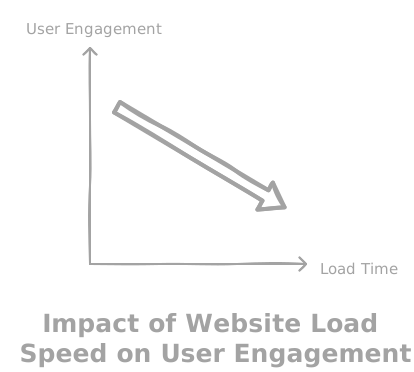
Studies on speed and behavior are remarkably consistent: the longer the load time, the higher the bounce rate. The relationship is neither linear nor kind. Every extra second raises the odds that the user closes the tab, and it does so at the most expensive moment possible: before your site has a chance to show its value proposition. In e-commerce, those lost milliseconds are sales that never happen; in lead generation, they’re forms abandoned halfway through.
The most deceptive part is that this cost is invisible in traditional reports. Nobody writes to tell you “your page took four seconds, so I left.” They simply don’t show up, and you read that absence as a lack of interest or a marketing problem, when it’s often a performance problem. That’s what makes slowness one of the hardest business leaks to spot: it appears nowhere unless you deliberately measure it.

There’s also a perception effect that goes beyond the stopwatch. A site that responds instantly feels reliable, polished, and serious; one that drags signals carelessness, even if the company behind it is impeccable. Speed works as a silent signal of quality, and users read it in seconds without thinking it through. In competitive markets, where visitors compare options across parallel tabs, that first impression decides who gets their attention and who gets dismissed.
- Early abandonment: most drop-off happens before the first interaction, so you never even get to present your offer.
- Lost carts: in online stores, every delay at checkout translates directly into purchases that go uncompleted.
- Wasted acquisition cost: if you pay for traffic that bounces over slowness, you’re funding visits that never convert.
- Brand damage: a slow site erodes trust cumulatively, and rebuilding that perception costs far more than preventing the loss.
SEO: Google rewards fast and stable
Core Web Vitals aren’t only about experience: they’re a ranking signal that Google folds into its algorithm. Between two sites with comparable content, the faster and more stable one tends to rank higher in results. It isn’t the only factor, and good content is still king, but when content is tied, performance becomes the tiebreaker. Optimizing speed is, in practice, optimizing your visibility.
It’s worth adding nuance so you don’t fall for myths: improving your Core Web Vitals won’t magically vault you to first place overnight. It works more like a quality floor. A site that fails these metrics starts at a disadvantage that a well-optimized competitor doesn’t carry, and that disadvantage shows up especially on mobile, where most traffic happens today and where network conditions are far less forgiving.

What’s interesting is that SEO and experience have stopped being competing goals and become the same goal. What makes Google happy is exactly what makes your user happy: a page that loads soon, responds fast, and doesn’t move under the finger. That’s why optimizing performance is one of the few investments that pays twice, in organic traffic and in conversion.
Google folded page experience into its evaluation for a simple reason: the search engine prioritizes what the visitor already preferred, a page that loads fast and responds without friction.
- A real ranking signal: Google confirmed that Core Web Vitals influence ranking, built into its page experience evaluation.
- Mobile advantage: with mobile-first indexing, phone performance weighs more than ever in how the search engine sees you.
- Double return: the same optimization improves both your visibility and your conversion rate, with no need to choose between them.
- Competitive differentiator: many sites still ignore these metrics, so meeting them well remains an edge not everyone reaches.
- More efficient crawling: a light, fast page is crawled and indexed with less friction, which helps your new content surface sooner in results.
How a fast site is built
The most common mistake is treating speed as a patch applied at the end, right before launch. It doesn’t work that way. Performance is designed into the architecture, in the earliest technical decisions, and rescuing it later usually costs several times more than building it right from the start. A site is born fast or born slow; the latter is almost never fully fixed through late optimizations.
The foundation of a fast site is sending the browser exactly what it needs, when it needs it. That means favoring static rendering whenever possible, so content arrives already built instead of being assembled on the user’s device; serving images in modern formats and at the right size; loading fonts without triggering layout shifts; and keeping JavaScript to a minimum, deferring anything not essential to the first view. Every kilobyte you don’t send is time the user doesn’t wait.

These decisions also depend on the technology you build on. Modern architectures, designed to ship fast HTML and minimal JavaScript, start ahead of approaches that load heavy frameworks before showing anything. This is where custom software development makes the difference against generic templates: a site designed for your specific case can prioritize exactly what your users need to see first, without the dead weight of features no one uses. Scalability and performance, far from being opposites, are designed together.
- Static rendering (SSG): serving pre-built pages reduces the browser’s work and directly improves LCP.
- Optimized images: modern formats, correct dimensions, and lazy loading avoid downloading unnecessary megabytes.
- Minimal, deferred JavaScript: less code to execute means an interactive page sooner and a better INP.
- Well-managed fonts: preloading and reserving space for text eliminates the shifts that drive up CLS.
Measure real performance, not just the lab
Optimizing blind is as risky as not optimizing at all. One of the most frequent traps is trusting only lab tests, the ones you run from your own machine on a good connection with powerful hardware. They’re useful for diagnosis, but they don’t tell the whole story, because your real users don’t browse under those conditions: they’re on mid-range phones, unstable networks, and contexts your lab never reproduces.
That’s why the professional standard combines two views. Synthetic tools, such as automated audits, give you a controlled, repeatable diagnosis to catch problems before you publish. Field measurement, known as RUM (Real User Monitoring), captures how your site behaves on the actual devices of the people visiting it, segmented by geography, network, and hardware. Only when you combine both do you get a faithful picture of what your audience experiences.
“What gets measured gets managed.” This maxim, often attributed to Peter Drucker, sums up why performance without measurement is little more than a hunch: to improve it, you first have to see it in data.
Measuring well also changes the conversation inside the team. When performance becomes a visible, shared number, it stops being an opinion and turns into a concrete goal that can be sustained over time. A site that’s fast on launch day can degrade with every new feature if no one is watching; continuous measurement is what keeps progress from slipping away. Cybersecurity teaches a similar lesson: what isn’t monitored gets neglected, and performance is no exception.
- Measure in the field, not just the lab: your users’ real conditions are the only ones that matter to the business.
- Segment the data: performance varies by device, network, and region, and averages can hide serious problems.
- Monitor continuously: build measurement into your process so each deploy doesn’t undo what you gained.
- Set clear thresholds: agreeing on explicit targets turns performance into a shared responsibility, not a good intention.
In short
Core Web Vitals translate something that used to be pure intuition (that a fast site sells more and earns more trust) into concrete metrics you can measure, improve, and sustain. LCP, INP, and CLS aren’t an engineer’s whim: they’re the bridge between your users’ experience and your business results, from conversion to your standing in Google. A fast site isn’t a technical luxury, it’s a measurable competitive advantage that many competitors still ignore.
At LabWeb we build with Core Web Vitals in mind from the architecture up, not as a final touch, and we measure real performance to sustain it over time. If you want a site that loads fast, responds instantly, and turns that speed into business, we’re exactly the kind of partner that designs it that way from day one.