
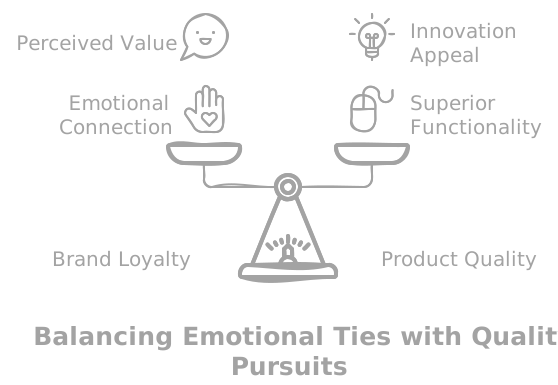
Customers rarely choose with their heads alone. Behind every repeat purchase is a blend of habit, trust, and emotion that sometimes outweighs the product’s specs. In a market where choices are as diverse as the products on a supermarket shelf, the tug of war between brand loyalty and real quality is more relevant than ever. The uncomfortable question is whether that loyalty clouds judgment, or whether, well earned, it reflects quality sustained over time. The answer, as we will see, depends less on the brand and more on what that brand chooses to deliver every single day.
To make sense of this relationship, it helps to keep a few recurring concepts clear:
- Brand identity: how a brand presents itself to the world, its logo, colors, and messaging.
- Brand strategy: the deliberate plan to build awareness, loyalty, and differentiation.
- Brand positioning: the place it occupies against competitors in the customer’s mind.
- Brand equity: the value reputation adds to a product, beyond its technical attributes.
When the emotional bond outweighs the spec sheet
Brand loyalty works like a mental shortcut: faced with many options, the customer returns to the familiar to avoid decision fatigue. That attachment reduces friction and offers reassurance, but it can also prop up a brand that no longer delivers what it once promised. The risk appears when habit replaces honest evaluation, and the customer buys out of inertia rather than conviction. The psychology behind that habit is powerful: the brain rewards the familiar because it saves energy, and a brand that has been present for years becomes an almost automatic choice.

Think of iconic brands like Apple or Nike. Their audiences stay loyal even when rival products beat them on a specific feature. Why? Because they have built powerful narratives that connect on a deeper level than any spec sheet. People do not just buy a pair of shoes: they buy into an ethos of ambition and perseverance that links them to like minded people. That is the real strength of a brand built with care. Nike’s “Just Do It” does not describe a product, it describes an attitude, and that is why it ages better than any campaign focused on the sole or the material.
That emotional bond rests on several concrete pillars:
- Emotional connection: a strong bond evokes nostalgia and belonging, making customers less inclined to switch. According to analysis from Forbes, emotionally connected customers are far more likely to become loyal buyers.
- Consistent experience: brands that deliver the same quality again and again reinforce trust. Starbucks is a good example: offering the same coffee experience in any city creates certainty.
- Social proof: the opinions of others carry weight. When friends and family recommend a brand, its perceived value rises, especially on platforms where recommendations travel fast.
- Loyalty programs: reward schemes add an extra layer of engagement and give the customer a tangible reason to return, beyond mere affection for the brand.
“A brand is no longer what we tell the consumer it is: it is what consumers tell each other it is.” Scott Cook, cofounder of Intuit, said it, and it captures why experience and word of mouth end up shaping perception more than any campaign.
It pays not to mistake that loyalty for a blank check. The customer grants it as long as the brand delivers, and withdraws it quietly the moment it stops. The line between a beloved brand and a brand taken for granted is thin, and it is almost always crossed on the day the experience stops living up to the story.
Quality as foundation, not decoration
No loyalty survives a repeated bad experience. Quality, of the product, the service, the support, is the foundation on which any lasting bond is built. Brands that mistake marketing for substance are buying borrowed time: sooner or later, the customer notices the gap between a promise and a result, and that gap is very hard to paper over. A brilliant campaign can get someone to try a product once; only quality brings them back a second and a third time.
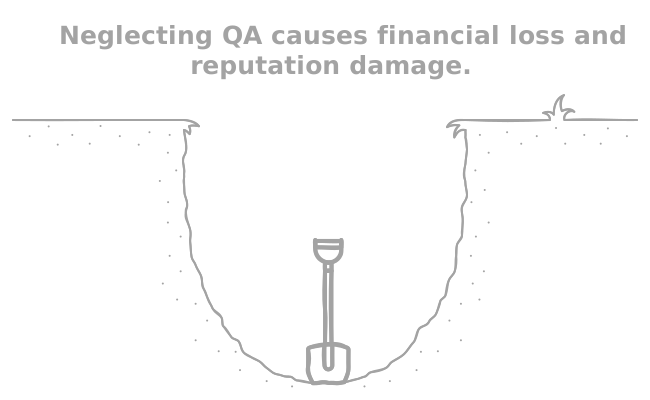
Quality shows up in tangible attributes: durability, functionality, performance, and even design. In a market full of alternatives, the weight customers give those attributes tends to be higher than marketing would like to admit. Brands like Toyota earned their place precisely through reliable manufacturing, not a slogan, and that reputation for delivering sustains the purchase decision for years. The same holds true in software: an application that loads fast, does not crash, and protects user data builds a quiet reputation no ad spend can buy.
When it comes time to choose, quality shapes the decision through several channels at once:
- Functional superiority: a well made product performs better in measurable ways, whether that is longer battery life or greater comfort. The customer often prioritizes that something works over the prestige of the logo.
- Perceived value: people equate higher quality with greater value, and they are willing to pay for it when the difference is clear in daily use.
- Reviews and feedback: in the information age, online reviews shape the perception of quality before the first purchase, and a track record of failures goes public within hours.
- Sustained innovation: brands that improve the product before customers complain project a commitment to excellence that reinforces trust.
“Quality is not an act, it is a habit.” The line, attributed to Aristotle, is a reminder that sustained excellence, not the occasional stroke of luck, is what builds relationships that last.
Trust earned through consistency
Real loyalty is not bought with a discount: it is built by delivering, again and again, on what you promise. Every positive interaction adds to a reputation the customer ends up defending out of conviction, not inertia. That consistency is what turns an isolated transaction into a long term relationship, and it is far more profitable than chasing new customers without pause. Keeping someone who already trusts you costs a fraction of what it takes to convince a stranger from scratch.
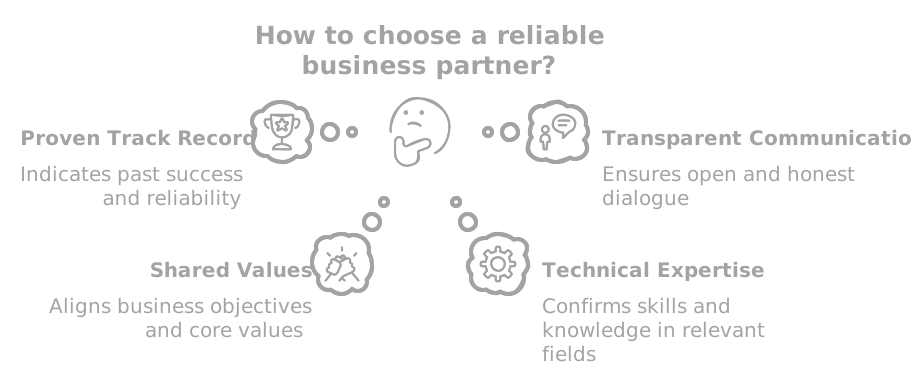
Trust also feeds on how a brand responds when something goes wrong. Listening to an unhappy customer, fixing the issue, and coming back with a solution says more than a thousand ads. Companies that treat a complaint as learning, rather than a nuisance, turn a moment of friction into a chance to strengthen the bond. A problem solved well often leaves a customer more loyal than if nothing had failed at all, because it proves the brand shows up when it matters.
Sustaining that trust over time takes work on several fronts:
- Communicating quality transparently: explaining where materials come from, how something is made, and what performance to expect builds credibility with an increasingly informed customer.
- Listening and acting on feedback: customers return more readily to brands that genuinely respond to their comments, rather than filing them away.
- Coherence across every touchpoint: a uniform experience across the store, the app, and support reinforces the sense that a serious standard sits behind it.
- Delivering on the promise without fine print: a brand that provides exactly what it offers, with no unpleasant surprises, builds a reputation customers repeat without being asked.
“Your most unhappy customers are your greatest source of learning.” Bill Gates said it, and it points to an uncomfortable truth: criticism, well received, is almost always the best map for improvement.
Consistency, moreover, has a cumulative effect marketing cannot replicate: every delivery that keeps its promise raises the psychological cost of switching, and that sum of small proofs of reliability ends up being the hardest asset for a competitor to imitate that any brand can own.
The balance that serves both sides
Customer choice is not “compromised” when loyalty and quality point in the same direction. A serious brand’s goal is not to trap the customer, but to deserve that they stay. When the emotional bond rests on real quality, everyone wins: the customer chooses well and the brand grows on solid ground, not on a promise that deflates. That is the terrain where emotion and reason stop competing and start pushing in the same direction.
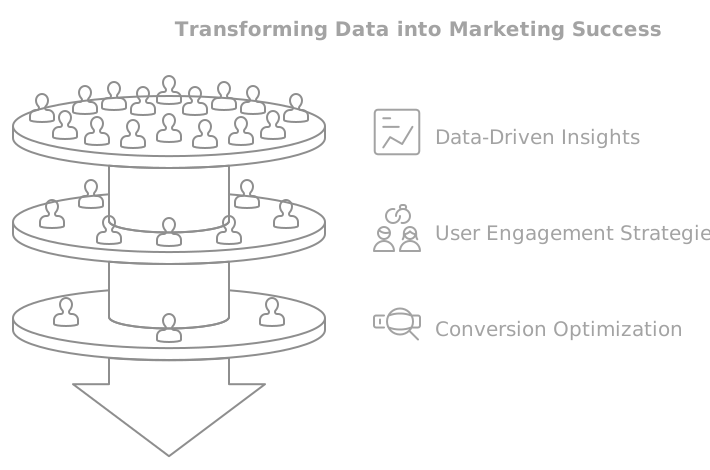
Successful cases show that the two elements do not compete, they reinforce each other. Coca-Cola keeps its loyalty thanks to a consistent taste and a narrative steeped in nostalgia. IKEA pairs attractive design with accessible prices and careful quality. Nike balances aspirational positioning with high performance products. In all three, emotion opens the door, but quality is what sustains the relationship over time. Remove either piece and the whole weakens: a beloved brand with a poor product becomes a joke, and a great product with no story becomes easy to replace with a cheaper one.
To reach that balance, the brands that understand it work with method:
- Integrating quality into their values: aligning the message with a real commitment to doing things well, as Tesla did around innovation, keeps the promise from ringing hollow.
- Deciding with data, not hunches: analyzing customer preferences helps refine the product. Companies like Netflix adjust their catalog based on what people actually consume.
- Building brand consistency: a coherent experience across every channel reinforces trust, and according to Harvard Business Review, narratives that connect emotionally markedly improve brand recall.
- Caring for every digital touchpoint: in a world where the first impression is usually a screen, the speed, clarity, and security of the digital product become an inseparable part of the quality promise.
“In the end, people will not remember what you said or did: they will remember how you made them feel.” The reflection, from Maya Angelou, captures why experience matters as much as the spec sheet when it comes to building loyalty.
| Criterion | Brand loyalty | Quality |
|---|---|---|
| What drives it | Habit, trust, and emotion | The product, the service, and the support |
| Its strength | Reduces the friction of deciding | Sustains the relationship over time |
| Its risk | Propping up a brand that no longer delivers | Without a bond, you compete on price alone |
| When it wins | When it rests on real quality | When it becomes the reason to return |
In short
Healthy loyalty does not override quality: it assumes it. Emotion can attract a customer the first time, but it is sustained quality that brings them back. The brands that treat trust as an asset earned day by day, rather than a marketing trick, are the ones that build relationships that withstand both time and competition. Customer choice is never compromised when what holds someone is, at the same time, what serves them best.
At LabWeb we build digital products designed to earn trust with every use, fast, reliable, and well made, with the same attention to scalability and cybersecurity as to the visible experience. If you are looking for custom software your customers choose out of conviction, not just habit, we are exactly the kind of partner that turns quality into loyalty.