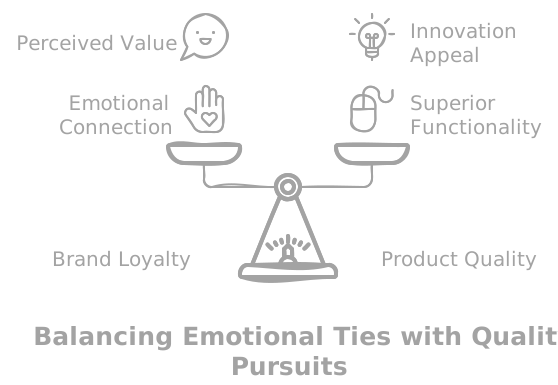
The best UX design is the kind you don’t notice. When everything flows, the user rarely thinks about the experience; they just act. But that invisibility hides an enormous influence: at every step, UX decides whether someone moves forward, trusts, and returns, or leaves without quite knowing why. In a world where first impressions form in seconds, user experience has stopped being an aesthetic detail and become a pillar of the business. Picture walking into a store where everything fits: the layout is intuitive and the atmosphere invites you to stay. Bringing that feeling into the digital world is what good UX does.
Before we dig in, it helps to keep a few guiding ideas in mind:
- Friction is invisible but costly. Most users never complain, they simply abandon.
- Trust is earned in the details. A large share of a business’s credibility is judged by the design of its site.
- Aesthetics change perception. A polished interface raises perceived value before the product is even used.
- Retention is born from experience. Coming back has to be easy and pleasant for it to become a habit.
That last idea was captured well by Steve Jobs, and it is worth keeping in mind throughout this piece:
“Design is not just what it looks like and feels like. Design is how it works.” Steve Jobs.
The essence of UX design
The essence of UX design lies in harmonizing function with user satisfaction, in making every interaction feel fluid and purposeful. That balance sustains an experience that invites action instead of provoking confusion and retreat. UX is not a decorative exercise; it is a strategic approach grounded in understanding human psychology. It helps to separate interface from experience: the interface is what you see, while the experience is what you feel while moving through it. A product can have a striking interface and still fail if the user can’t accomplish what they came to do, which is why good design is measured in outcomes.
- User-centric approach. Research and testing with real users ensure the design responds to what people expect, not to what the team assumes.
- Consistency. A coherent look and behavior across screens builds familiarity and trust. The experience should feel just as solid on mobile as on desktop.
- Accessibility. Designing for everyone, including people with disabilities, expands your audience. The W3C accessibility guidelines are the reference for getting it right.
As Don Norman, one of the founders of the discipline, frames it, “user experience encompasses all aspects of the end user’s interaction with the company, its services, and its products.” UX doesn’t live in an isolated button, it lives in the whole narrative that accompanies a person from arrival to return. Investing in that narrative pays off in lasting relationships, because a user who feels valued tends to move from casual visitor to loyal customer.
The friction that costs sales
Every second of waiting, every confusing step, and every endless form is an invitation to abandon. Users rarely complain, they simply leave and try someone else. Reducing friction, fewer clicks, fast load times, predictable flows, isn’t a design luxury; it removes the silent reasons a sale slips away. The most dangerous thing about this loss is that it almost never shows up in a report: the abandoned cart never tells you why it left.
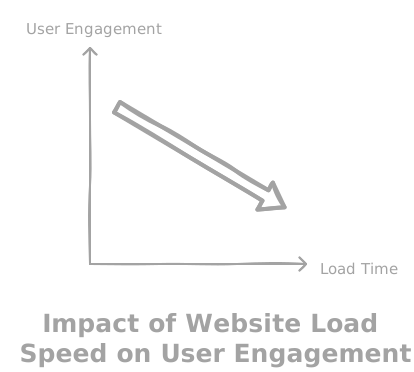
Speed is the clearest example. A site that lags breaks the user’s mental rhythm and gives them time to hesitate. Data from Google shows that the probability of abandonment climbs sharply as a page takes longer to load. It is not an isolated technical concern, it is an experience decision: every millisecond you save is one less reason to leave.
But friction is not only about speed. It appears at many points along the journey, and each one adds a small cost:
- Excessive forms. Asking for more data than necessary punishes conversion: every extra field invites the user to pause and reconsider.
- Unnecessary steps. Forcing account creation before purchase, or splitting a simple task across too many screens, multiplies the points of abandonment.
- Lack of clarity. When it isn’t clear what to do next, doubt turns into paralysis, and paralysis into a closed tab.
Removing friction is, to a large degree, a job of subtraction: not adding flashy features, but stripping away everything that gets between the user’s intention and its fulfillment. That same logic ties directly to load speed and technical stability: a fast, predictable product is, above all, one that respects the user’s time.
Trust is built in the details
Before buying, users assess whether they can trust you, and they do it through signals they don’t always name: careful design, coherent navigation, clear error messages, and transparent checkout. A sloppy site plants the doubt that the business is sloppy too. Trust isn’t declared with a badge, it is transmitted by every detail that says “things are done well here.”
Psychology explains why this works. We make decisions surrounded by subtle cues we rarely process consciously, and those cues carry weight. Social proof is one of the strongest: we tend to trust a product when we see that others already did. Reciprocity works the same way: when someone receives something of value at no cost, they feel inclined to return the favor.
- Social proof. Visible reviews and testimonials lower the user’s guard. Seeing that others made the same choice acts as permission to do the same.
- Transparency. Clear prices, no surprise shipping costs, and readable policies prevent the moment when distrust kills the sale.
- Error handling. A message that explains what happened and how to fix it turns a stumble into a gesture of care rather than a reason to abandon.
Security plays a role here too. A checkout that feels protected, with visible signs of encryption, tells the user their data is safe. Digital trust and cybersecurity are two sides of the same coin: no one completes a purchase where they sense risk.
“Good designs take into account how people think.” Jakob Nielsen, a usability authority.
And people, before buying, think about whether it’s worth trusting you.
Aesthetics and consumer perception
The role of aesthetics in consumer perception is hard to overstate. Far more than decoration, visual design is the first point of contact between a person and a digital product, and it stirs emotion, conveys seriousness, and invites exploration. Research from Stanford University indicates that a majority of users judge a company’s credibility based on its website design, confirming that the first glance weighs far more than it seems.
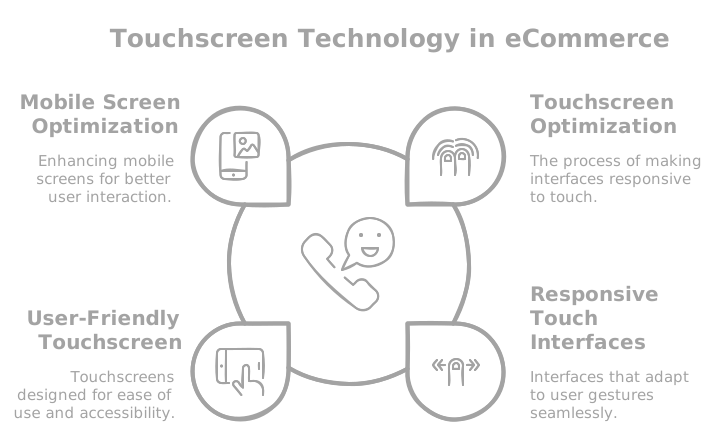
Aesthetics never walk alone: they work hand in hand with function. A product feels more valuable when the experience around it is flawless, and a polished interface raises the perception of quality even before the user touches what’s being sold. Conversely, a clumsy experience cheapens the offer, no matter how good the product itself is.
- Color psychology. Colors trigger emotional responses and steer behavior. Red is often tied to urgency, while blue conveys trust, which is why it is common in banking and finance.
- Typography. The choice of fonts signals professionalism or warmth and defines how easy it is to read. Well-chosen type improves readability and, with it, perceived value.
- Visual hierarchy. A well-structured layout guides the eye toward what matters and toward the action you want to prompt, making it easier to move forward and improving conversion.
In an environment saturated with options, aesthetics become the factor that differentiates and, often, the one that decides. Designer Paul Rand put it precisely: “design is the silent ambassador of your brand.” When the user finds an attractive design that is also intuitive, they form positive associations and tend to stay. Harmonizing beauty and usability not only captures attention, it cultivates lasting bonds built on trust.
How to measure UX impact
Measuring the impact of UX on consumer behavior is key for any business that wants to improve satisfaction and lift conversions. Quantifying that impact turns abstract design principles into concrete results, and lets you decide with data instead of opinions on whether an experience works or merely looks good.

Not all metrics say the same thing, which is why it pays to combine them. Some reveal the “what” (how many completed a purchase), others the “why” (where they got stuck). A healthy number of visits means nothing if almost no one reaches the end of the journey.
- Conversion rate. The most direct indicator: what percentage of users complete the desired action, whether buying or subscribing.
- Satisfaction surveys. Asking users directly about ease of navigation reveals blind spots that numbers alone won’t show.
- A/B testing. Comparing two versions of a screen to see which converts better lets you optimize with evidence rather than hunches.
- Heatmaps and task completion. Seeing where users click, scroll, and stop, and how many finish essential actions like checkout, exposes design flaws worth fixing early.
The point is not to pile up data, but to interpret it to make improvements that matter.
“What gets measured gets managed.” Peter Drucker.
In practice, this means watching real users, forming hypotheses, and validating changes one by one. That discipline makes design sustainable: each iteration learns from the last and brings the product closer to what people actually need.
Retention and the trends ahead
Acquiring a customer is costly; keeping one is where profitability lives. An experience that remembers preferences, simplifies repurchase, and resolves issues without friction turns a transaction into a habit. Loyalty isn’t born from the product alone, but from how easy it is to choose it again. That is why UX doesn’t end at the first purchase: it starts over with every visit.
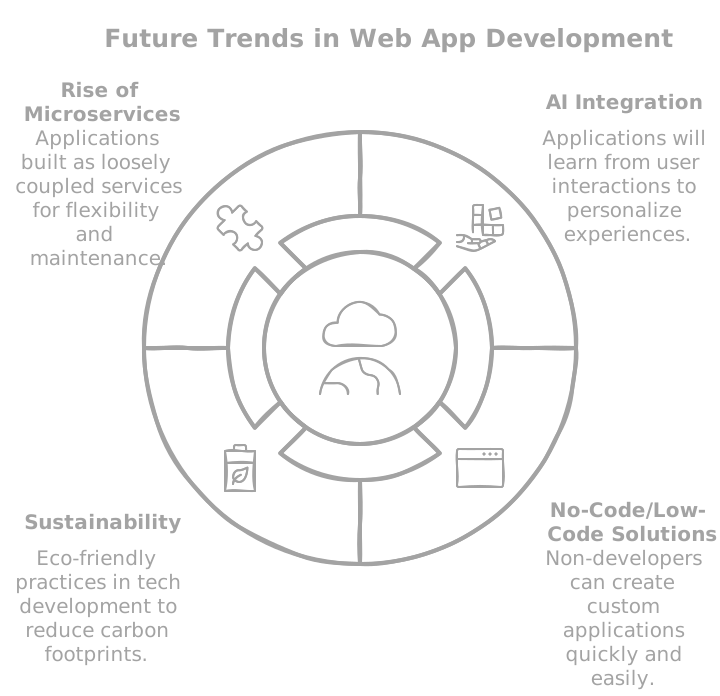
The ground is shifting too. Voice interfaces are gaining space as smart assistants become everyday, which forces us to think about conversational experiences and not just visual ones. Augmented reality opens new ways to show products in the user’s real context, as when someone visualizes a piece of furniture in their living room before buying. And personalization has stopped being a luxury: people expect the experience to adapt to them.
- Data-driven personalization. Tailoring content and recommendations to each user’s behavior raises relevance and conversion, always with respect and without becoming invasive.
- Accessibility as a standard. Far from being an extra, designing for everyone widens the market and aligns with social expectations that keep getting firmer.
- Responsible design. Conscious consumers value calm, fast experiences that respect their attention and their data.
Scalability plays a quiet role in all of this. An experience that stays fast and consistent as the business grows protects the trust it earned; one that degrades under load erodes it. As Marc Andreessen famously declared, “software is eating the world”: in that scenario, UX is what makes software not only usable but desirable. Caring for retention isn’t chasing fashion, it’s ensuring that every return is as good as the first.
In short
UX design influences consumer behavior precisely where it can’t be seen: in the friction that stalls, the trust that convinces, the aesthetics that raise value, and the experience that invites a return. It is not a cosmetic finish, it is a business decision that translates into conversion, loyalty, and sustainable growth. Ignoring that invisible impact usually costs sales that never appear explained in a report.
At LabWeb we design experiences that remove obstacles and build trust, backed by research, measurement, and custom software that scales with your business. If you want every interaction to move the user toward action and invite them back, we are exactly the kind of partner that turns good UX into results.