
We simplify complex processes
Whether you're looking to:
Our team of experts is here to bring your vision to life.
Exceptional Solutions Designed for You
Discover a comprehensive suite of innovative solutions tailored to optimize every aspect of your warehouse operations. From seamless marketplace integration to efficient returns management, each tool is designed to enhance productivity, accuracy, and customer satisfaction. Leverage cutting-edge technology to streamline processes, reduce costs, and elevate your business performance.
Seamless Multiplatform Sync
Our integration solution connects Amazon, Walmart, Mercado Libre, and Coppel for synchronized, consistent listings. Real-time updates ensure accuracy in inventory and pricing across platforms, reducing errors and enhancing efficiency.
Dynamic pricing adapts to competition, optimizing your listing positions and maximizing sales potential. This ensures your business stays competitive across multiple marketplaces.
With automated data sync, manual work is minimized, freeing up resources for growth.
Comprehensive Audit and Insights
Our audit solution consolidates financial transactions, orders, and returns for a complete operational overview. It identifies and corrects discrepancies in commissions and penalties to ensure accurate billing.
With clear summaries of receivables and refunds, it provides a precise financial balance overview. This transparency supports better financial decision-making.
Detailed reporting ensures your accounts remain accurate and compliant, protecting your bottom line.
Enhanced Data Integrity and Accuracy
Our data validation solution performs consistency checks and filtering to ensure reliable data across all records. With scoring and matching processes, accuracy and completeness are verified, boosting the quality of datasets.
Data sanitization strengthens integrity by removing blank fields, standardizing formats, and identifying duplicates for optimized workflows. This leads to more streamlined data management.
Enhanced data integrity supports better decision-making and operational efficiency.
Accurate Inventory and Demand Forecasting
Our stock management solution predicts demand accurately to streamline in and outs. Real-time tracking keeps inventory aligned with demand, reducing stockouts and overstocks.
It supports optimized stock levels, enhancing order fulfillment and customer satisfaction. Automated replenishment features further reduce manual oversight.
This improves inventory turnover rates and overall operational efficiency.
Efficient e-Commerce Platform Management
Our e-commerce solution simplifies multi-channel selling for a smooth, unified customer experience. It centralizes inventory, orders, and product data for seamless management across all online platforms.
From stock updates to order processing, it enhances control and efficiency for e-commerce success. Real-time synchronization prevents errors and discrepancies.
Scalable for growth, it supports expanding your online sales channels effortlessly.
Real-Time Auction Integration
Our auction solution synchronizes listings for single items or pallet bidding in real-time. It provides a smooth bidding experience, maximizing sales potential through dynamic auction management.
With live updates, this solution ensures accurate auction listings, enhancing engagement and revenue. Participants enjoy transparent processes and fair competition.
Customizable settings allow for tailored auction strategies that suit business goals.
Streamlined Order Processing Solution
Our order fulfillment solution coordinates picking, packing, and shipping processes for fast, accurate deliveries. It reduces delays and improves efficiency, providing a reliable experience for customers and partners.
Automated tracking updates ensure visibility, making order management straightforward and efficient. Real-time data offers insights into order status and logistics.
This enhances customer satisfaction and boosts repeat business potential.
Efficient Returns Processing
Our returns solution streamlines return processing, ensuring timely refunds and restocking. It minimizes return handling times, improving customer satisfaction and inventory accuracy.
With detailed tracking, it optimizes the return cycle, reducing operational strain and cost. This helps maintain a positive customer relationship.
Efficient restocking processes ensure that returned items are back on sale quickly.
Cost-Effective Shipping Solutions
Our shipping solution optimizes delivery routes and rates, reducing logistics costs significantly. It provides visibility into shipping options, enabling smarter choices for cost efficiency.
With integration across carriers, this solution enhances delivery speed and reliability for customers. Advanced tracking systems inform both the business and the customer.
Improved logistics contribute to lower operational expenses and higher satisfaction rates.
Warehouse Automation in Mexico: Real-Time Inventory and Multichannel Fulfillment
Selling across several marketplaces at once is a huge opportunity, and, at the same time, a logistics nightmare if you manage it by hand. A single product lives on Amazon, Mercado Libre, Walmart, and your own store, and every sale must be reflected everywhere instantly. Warehouse automation is what keeps that promise without overselling or stockouts. It is not a luxury reserved for large corporations, but the infrastructure that today separates a seller who scales with order from one who lives putting out fires. These are the fronts where automation makes the difference:
- The real cost of out-of-sync inventory.
- One inventory for all your channels.
- Demand forecasting that prevents stockouts.
- Fast fulfillment with no manual intervention.
- Auditing each marketplace’s charges and commissions.
- An operation ready to scale during peak season.
The real cost of out-of-sync inventory
When inventory doesn’t update in real time, two things happen and neither is good. The first: you sell what you no longer have, and then come the cancellations, the marketplace penalties, and the one-star reviews that take months to offset. The second: out of fear of overselling, you leave such a large safety buffer that you end up hiding product you could actually be selling. Phantom stock and hidden stock are silent taxes on your growth, and they rarely show up in a report until they have already done damage.
The problem grows with every new channel you add. With two platforms, a human can still reconcile by hand; with five, manual reconciliation becomes a full-time job that arrives late anyway. Every minute between a sale and the update of available stock is a window in which two customers can buy the last unit. During high-demand seasons, that window opens at exactly the moment when a mistake costs the most.
The most expensive thing, however, is not always the lost sale, but the eroded trust. A buyer who receives a cancellation rarely comes back, and marketplace algorithms punish a bad experience by lowering your visibility. That is why it helps to see out-of-sync inventory for what it really is:
- Accumulated penalties. Every cancellation for lack of stock hurts your performance metric and, with it, your position in marketplace search results.
- Frozen capital. The product you hide “just in case” is money sitting idle that could have financed more inventory that actually sells.
- Wasted team hours. Reconciling tabs and fixing errors by hand consumes time your people should spend growing, not patching.
- Reputation that is hard to recover. One negative review weighs far more than ten positive ones, and reversing that perception takes months of good service.
“If you can’t measure it, you can’t improve it.” The line, attributed to Peter Drucker, sums up why inventory that nobody sees accurately is, in practice, inventory that nobody controls.
One inventory for all your marketplaces
Automation connects your channels to a single source of truth. When a sale closes on any platform, available inventory adjusts everywhere at the same time, without anyone having to copy a number from one dashboard to another. You list once, sync everywhere, and eliminate manual reconciliation between panels. Your team stops arguing over which number is correct and starts trusting a single figure.
That single source doesn’t just prevent errors: it changes how you make decisions. When available stock is reliable, you can sell more aggressively without fear, because you know exactly how many units exist and where they are. Business rules (reserve stock for a priority channel, set aside units for a promotion, halt the sale of a discontinued product) apply on their own, in seconds, instead of depending on someone remembering to update each platform.

E-commerce in Mexico is growing at double digits and multiplying the channels where a seller can appear, so complexity is only going to increase. Centralizing inventory is what lets you add marketplaces without adding chaos. A good integration gives you, concretely:
- Real-time sync. Every sale, return, or adjustment is reflected instantly across all connected channels.
- Centralized listing. You create or edit a product listing once and distribute it to every platform from a single place.
- Per-channel rules. You assign how much stock each marketplace sees and protect your most profitable channels without starving the rest.
- Full traceability. You always know what sold, on which platform, and at what margin, without assembling the puzzle by hand.
Demand forecasting that prevents stockouts
Syncing inventory keeps you from overselling; forecasting demand keeps you from running short. With sales history and seasonality, a well-designed system anticipates when to restock and how much, instead of discovering a stockout after you’ve already lost the sale. The difference between reacting and anticipating is, very often, the difference between a profitable quarter and one of wasted opportunities.
Forecasting becomes more useful the more information it processes. Projecting a steady-selling product is not the same as one tied to a campaign, a weather pattern, or a date like Buen Fin or Christmas. A good model distinguishes those patterns, crosses expected demand with your supplier’s lead times, and tells you not only what to order, but when to place the order so it arrives before you run out. That way, capital is invested in what sells, not in what sits in the warehouse taking up space.
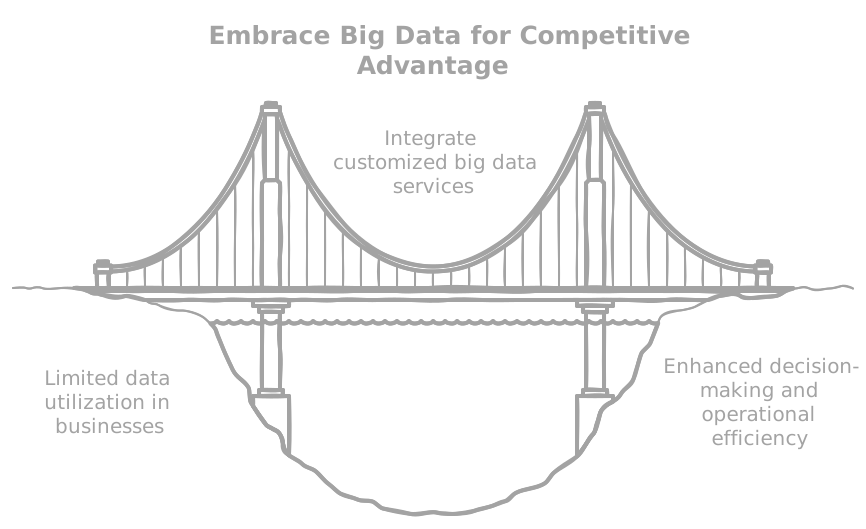
This is where data analytics stops being decoration and turns into margin. A system that learns from your operation delivers very concrete advantages:
- Early alerts. You get restock warnings before hitting the critical point, with time to react without paying for rush shipping.
- Purchase suggestions. The system proposes quantities per product based on turnover and season, reducing both overstock and shortages.
- Trend detection. You spot which products are accelerating and which are cooling off before the shift catches you by surprise.
- Season planning. You prepare inventory for demand peaks weeks in advance, not at the last minute.
“E-commerce is not the cherry on the cake, it is now the cake itself.” The observation from Jeff Bezos, founder of Amazon, explains why inventory discipline has shifted from an operational matter to a strategic one.
Fulfillment and marketplace auditing
Automation doesn’t stop at inventory: it streamlines picking, packing, and label generation, and processes orders without manual intervention. In practice, that means an order comes in, gets validated, is assigned to the correct warehouse location, and ships with its label ready, all in minutes and without anyone typing in data field by field. Every step that gets automated is a step where a human error is removed and delivery speed is gained, which is exactly what the customer remembers.
But money isn’t only earned by shipping fast: it is also protected by reviewing what each marketplace charges you. Platforms apply commissions, fulfillment fees, discounts, and adjustments that change frequently, and reviewing them by hand is practically impossible when you handle thousands of orders. Automation audits those charges order by order and catches discrepancies that, added up, erode your margin without you noticing. Recovering those differences is not pennies: for many sellers it is full points of annual profitability.
A well-built fulfillment and auditing flow gives you control over both ends of the process:
- Touchless processing. Orders move on their own from sale to shipping label, with no manual entry or bottlenecks at peak hours.
- Optimized picking. The system orders routes within the warehouse so each unit is collected in the shortest possible path.
- Charge reconciliation. Every commission and fee is compared against what was agreed, and differences are flagged to be claimed.
- Real margin reports. You know how much you truly earn per product and per channel, with all fees already deducted, not an optimistic estimate.
An operation ready to scale
Everything above is put to the test during peak season. Buen Fin, Hot Sale, and Christmas multiply volume in a matter of days, and a manual operation that worked fine with a hundred orders a day collapses at a thousand. Automation is what lets you absorb that jump without hiring triple the staff or sacrificing the delivery times that hold up your reputation. Scaling stops being a risk and becomes something the system simply handles.
The deeper advantage is that the same platform that brings you order today is the one that lets you grow tomorrow. Adding a new marketplace, opening a second warehouse, or launching a product line becomes a configuration, not a project that reinvents your entire logistics. A scalable business model is built, precisely, on processes that don’t break when volume spikes.
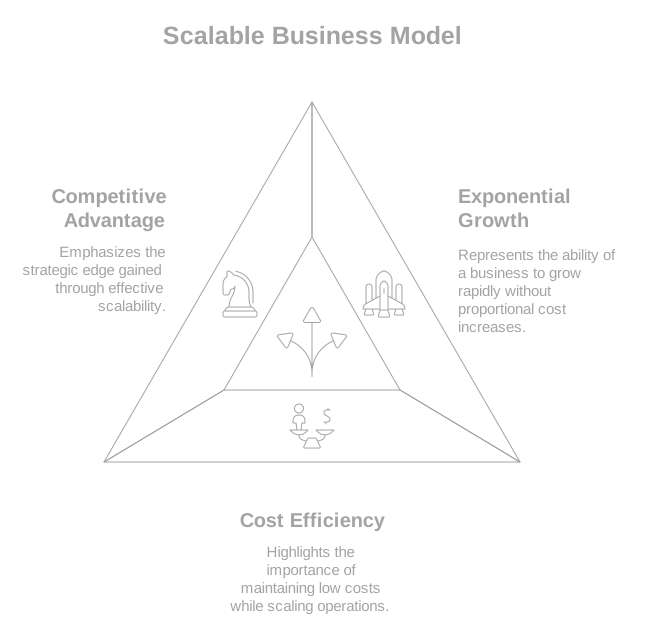
An operation designed to scale shares certain traits:
- Elastic capacity. The system processes ten or ten thousand orders with the same logic, without rewriting anything.
- Open integrations. You connect new channels, carriers, and suppliers through standard interfaces, without rebuilding the core.
- Data as an asset. Every operation leaves a record, so each season you start with better information than the last.
- Security by design. More volume and more integrations mean more exposed surface: protecting the cybersecurity of your sales and inventory data stops being optional.
According to the World Bank, Mexico ranks among the fifteen largest economies in the world, a market deep enough that automating logistics is a real competitive advantage, not an optional expense.
In short
Warehouse automation turns multichannel chaos into a predictable operation: synced inventory, anticipated demand, fast fulfillment, and every peso audited. It is not magic, it is custom software that unites your channels, your warehouse, and your numbers into a single source of truth, and that keeps working precisely when volume gets tight. The difference between selling in many places and selling well in many places lies in that infrastructure.
At LabWeb we build logistics and marketplace-integration solutions designed for sellers in Mexico, connecting inventory, fulfillment, and auditing into a system made to fit your operation. If you want to sell everywhere with the confidence of a single inventory under control, we are exactly the kind of partner that turns your operation into an advantage.
Full-Cycle Warehouse Automation Expertise
From initial assessment to seamless implementation, our full-cycle warehouse automation services guide you at every stage. We design and execute solutions that enhance operational efficiency and deliver impactful results. Count on LabWeb for comprehensive automation tailored to your business growth.
Strategic Requirement Planning
We analyze your warehouse operations and sales channels before proposing a solution. Scope is defined by your real logistics.
We map inventory, marketplaces, and fulfillment processes. What gets automated first is what risks the most sales or costs.
We set clear indicators, turnover, stockouts, accuracy, to measure success from the start.
Tailored Discovery & Innovative Design
We design flows that sync inventory and orders across Amazon, Mercado Libre, Walmart, and your store. A single truth prevents overselling.
We model integration with marketplaces, carriers, and your ERP. Interoperability is the foundation of the operation.
We validate critical journeys, listing, fulfillment, returns, with prototypes before building.
Robust Alfa Development Stage
We build the core with real-time sync and demand forecasting. Phantom stock is eliminated, not tolerated.
We integrate commission auditing, picking, and label generation early. Each feature answers a real cost.
We iterate in short cycles to tune inventory and fulfillment rules to the operation.
Comprehensive Testing Protocols
We test inventory accuracy, cross-channel sync, and order processing. A wrong figure triggers an oversell.
We validate performance under real volume and the reconciliation of each marketplace's charges. Precision protects your margin.
Every finding is reproduced, fixed, and verified before the solution goes live.
Consistent Product Enhancement
We evolve the solution as marketplaces, their commissions, and your channels change. Multichannel logistics doesn't stand still.
We prioritize improvements by their impact on sales, costs, and customer satisfaction. The critical comes first.
Each update guards inventory accuracy and operational efficiency.
Seamless Integration & Deployment
We launch by syncing your catalog and inventory without interrupting ongoing sales. The operation doesn't stop.
We integrate with marketplaces and migrate inventory data with thorough checks. Precision protects your sales.
After deployment we confirm sync, fulfillment, and reconciliation live.
Ongoing Support & Proactive Maintenance
We provide ongoing support to keep your inventory synced and your orders flowing. Logistics demands daily reliability.
Proactive maintenance adapts the solution to marketplace changes and peak seasons.
We resolve incidents quickly so you never lose a sale to a stockout or an oversell.
Let's Get In Touch!
Send us a message, and we'll promptly discuss your project with you.
What's Next?
- We start by signing an NDA to ensure your ideas are protected.
- Then, our team will analyze your requirements.
- You get a detailed project outline.
- We bring your project to life, so you can focus on growing your business.
© 2019–2026 LabWeb · Laboratorio Internacional Web S.A. de C.V. · All rights reserved.