
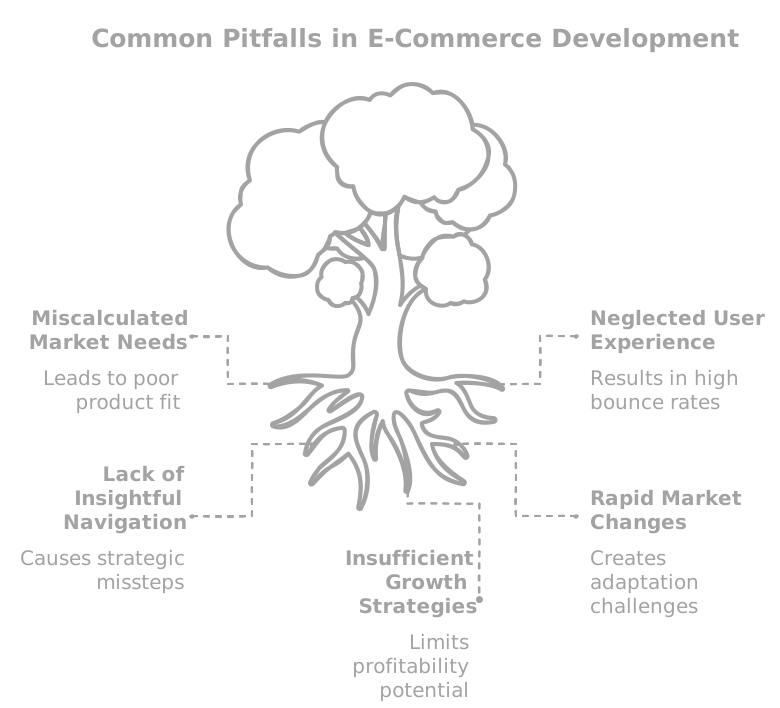
Building an online store is far more than uploading products to a website. In a market where the next competitor is one click away, certain development mistakes get expensive, in lost sales, abandoned carts, and customers who never come back. And the audience keeps growing: e-commerce already moves billions of digital buyers worldwide, so every technical decision, from the platform down to the checkout button, shapes the business directly. The good news is that the costliest stumbles also tend to be the most avoidable. These are the ones that show up again and again:
- Choosing the wrong platform: it won’t scale as traffic grows.
- Neglecting the mobile experience: you lose both sales and ranking.
- A poor user experience: slowness and confusion send visitors away.
- A complicated checkout: it drives cart abandonment.
- Ignoring SEO: your store stays buried in search results.
- Underestimating inventory and integrations: operations break right when the business takes off.
Choosing the wrong platform
Not every platform fits every business. Picking one that doesn’t match your needs, or that won’t scale as traffic grows, is like fitting a square peg into a round hole: it leads to hidden costs, downtime during peak seasons, and features that never arrive. The right choice weighs your current and future needs before committing.
The problem almost never shows up on day one. It shows up during the first campaign that works, the first holiday rush, the first time the catalog multiplies. A rigid platform stifles innovation, and “cheap” pricing models are deceptive: they lure you in with a low upfront cost and then charge fees for every transaction or essential feature. Before committing to a technology, it pays to be clear about the most common risks:
- Incompatibility with the business: every company has unique requirements. A platform that ignores your model (multi-vendor marketplace, subscriptions, specialized inventory control) creates constant operational friction.
- Limited scalability: your growth trajectory should dictate the choice. If the store can’t scale, you will face downtime exactly when you sell the most, and no retailer can afford that.
- Hidden costs: always read the fine print. Fees, payment plugins, and “premium” modules can inflate the real cost well beyond the sticker price.
- Little technical flexibility: a closed architecture makes new integrations harder and blocks experience improvements your customers expect.
“The best e-commerce platforms are the ones that not only meet your current needs but also grow alongside you.” The idea, attributed to consultant Andrew Youderian, captures why the platform decision is strategic, not merely technical.
Neglecting the mobile experience
More than half of e-commerce sales now happen on mobile devices, and the trend keeps accelerating. A site that isn’t designed for small screens, slow, hard to navigate, with an awkward checkout, loses both customers and ranking, because search engines prioritize mobile experiences. Responsive design isn’t an extra: it’s the foundation.
The mobile shopper is impatient by nature: usually on the move, with plenty of alternatives a tap away. That is why speed and clarity matter so much: a polished desktop experience that breaks on the phone is, in practice, half a store closed. And the cost is not just today’s sale, it is the brand too.

What is at stake when mobile takes a back seat is concrete:
- Poor usability: the on-the-go user needs speed and smoothness. A site that isn’t built for the phone breeds frustration and immediate bounces.
- Sales that slip away: every second counts. Without responsive design, the customer finds it easier to buy elsewhere, because the competition is a tap away.
- Less search visibility: Google rewards mobile-optimized sites. Weak mobile functionality sinks your ranking and cuts organic traffic.
- Limited payment options: consumers favor digital wallets and one-tap payments from their phones. Failing to integrate them shrinks conversion noticeably.
“Mobile is no longer an option, it’s an imperative.” The phrase has circulated in the industry for years and still holds: in e-commerce, the phone has gone from a secondary channel to the primary one.
A poor user experience
First impressions are largely about design. Confusing navigation, long load times, and weak visual hierarchy send visitors away before they buy. If your store is a maze where customers lose their way, they won’t hesitate to abandon the search and head to a competitor. User experience is not makeup: it is one of the factors that most influences whether someone buys or leaves.
Every second counts, and the numbers back it up: a large share of mobile users abandon a site that takes longer than three seconds to load. Design, speed, and clarity work together or not at all.
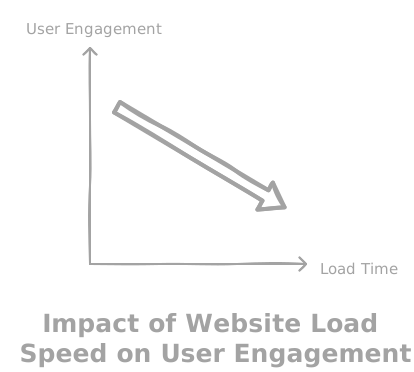
These are the points where a poor experience derails the sale:
- Complicated navigation: tangled menus or unclear categories frustrate visitors. An intuitive structure, with a search bar that actually works, keeps customers moving forward.
- Slow loading: speed matters. A performance-optimized site retains; a heavy one drives people away before the product even appears on screen.
- Weak visual hierarchy: if key information (price, features, availability) doesn’t stand out, the customer scrolls right past. A clear hierarchy guides the buying decision.
- No reviews or social proof: most consumers read opinions before buying. Leaving them no space means giving up one of the most powerful conversion tools there is.
“Designing an online store should be about creating an experience that naturally bridges brands and their customers.” Behavioral psychology, the field where Nobel laureate Daniel Kahneman worked, reminds us that every needless friction is one sale less.
A complicated checkout
Checkout is where the sale is won or lost. Few payment options, endless forms, or missing security signals all drive cart abandonment. This is no small detail: roughly seven out of ten shopping carts are abandoned, and a clunky checkout is one of the main culprits. Integrating reliable gateways, offering diverse payment methods, and communicating costs transparently keeps customers all the way to the end.
Picture the frustration of someone who reaches the payment page only to hit a process that looks like a Rube Goldberg machine: extra steps, unnecessary fields, charges that appear at the very end. Trust weighs heavily too: if the gateway doesn’t convey security, with certificates and clear data-protection signals, the customer leaves. Communicating security is not optional, it is part of the product.

The most frequent checkout stumbles are easy to spot and to fix:
- Few payment options: the customer expects flexibility. Not offering cards, transfers, and digital wallets drives away a meaningful share of buyers.
- Weak security: without robust protocols (encryption, compliance with industry standards) the user hesitates and abandons. Trust is the currency of checkout.
- Too many steps: a convoluted process wears people out. Streamlining the flow, ideally to a few clear steps, lifts conversion directly.
- Opaque costs: surprise charges at the end breed distrust. Communicating everything upfront, shipping included, keeps the sale alive.
“In e-commerce every second counts: make your checkout process as fast and simple as possible.” It is one of the great lessons from cart-abandonment research, and it sums up the goal of any well-designed checkout.
Ignoring SEO
A beautiful store no one can find is a store with its doors locked. Without an SEO strategy, optimized content, speed, technical usability, your products stay buried in search results while competitors gain visibility. With billions of active internet users, making your products discoverable is not a luxury: it is the condition for existing commercially.
The search engine is the modern marketplace: a large share of any site’s traffic arrives through organic search. If your store doesn’t show up, it doesn’t matter how well designed it is: nobody walks through the door. And SEO is not just keywords, it is experience too: search engines reward fast, easy-to-navigate sites, the very attributes that make customers happy.
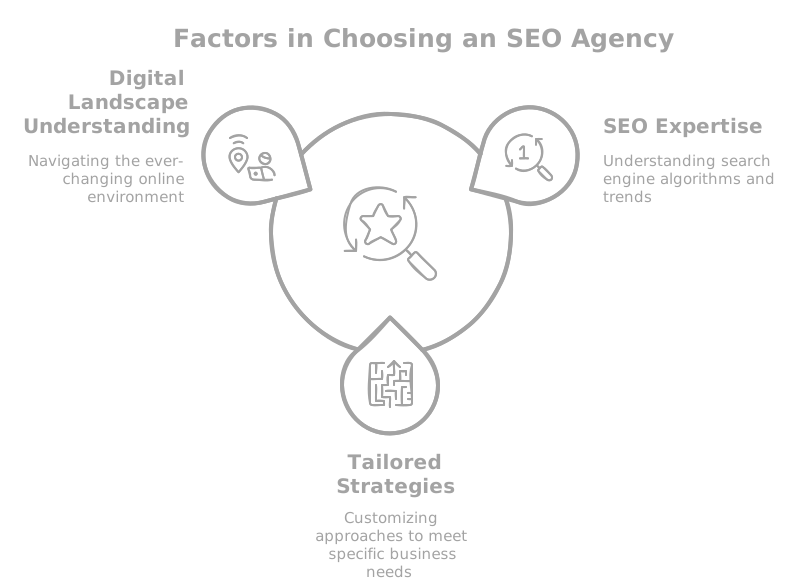
When a store neglects SEO, it sabotages itself in several ways at once:
- Less visibility: without optimization, your site can end up on page ten of results, where it is practically invisible.
- Lower conversions: a store that doesn’t appear attracts fewer visits and therefore fewer sales. Optimized content converts better than almost any outbound tactic.
- Poor technical experience: speed, mobile usability, and clean structure are part of SEO. Neglecting them hurts ranking and conversion at the same time.
- Lost competitive edge: if you don’t work on SEO, you hand competitors a clear path to climb while you stand still.
“SEO is not about gaming the system, it’s about learning to play by its rules.” The idea, attributed to content specialist Jordan Teicher, captures why organic visibility is built through sustained good practice, not shortcuts.
Underestimating inventory and integrations
Some mistakes don’t show on the storefront, yet they break operations right when the business starts to grow. Two of the costliest are the lack of a solid inventory system and the underuse of API integrations. Poorly managed inventory leads to overselling and to out-of-stock products that still appear available; weak integrations lead to slow, error-prone manual work.
APIs are the bridges that connect your store to the ecosystem: payment gateways, shipping, customer management, analytics. Having a store without good integrations is like owning a Swiss Army knife and using only one blade. The automation they enable, syncing inventory in real time across channels, frees up time, reduces errors, and lets you scale without blowing up operating costs.
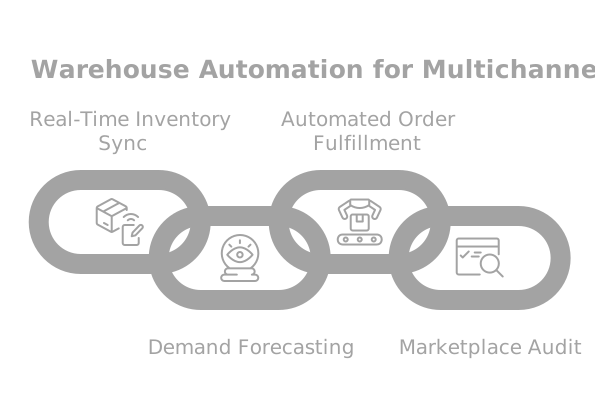
What sits behind a solid operation almost always includes these pillars:
- Real-time inventory: a system that updates stock instantly prevents the overselling and stockouts that cost sales and reputation.
- Synced data: manual entry is slow and error-prone. APIs keep information aligned across store, warehouse, and sales channels.
- Operational scalability: as the business grows, reliable integrations let you add capacity without rebuilding everything from scratch.
- Data-driven personalization: APIs feed the analytics that power recommendations and campaigns tailored to each customer’s real behavior.
“APIs are the lifeblood of digital commerce: they enable agility and flexibility.” The observation, attributed to the analyst firm Forrester, explains why integrations have gone from a background technical concern to a genuine business advantage.
In short
E-commerce mistakes are rarely about visual design: they live in the platform, performance, payments, visibility, and the operation behind the store. Avoiding them protects the business from needless costs and lays the groundwork to grow with order in a fierce market. The good news is that all of them are avoidable with planning, the right technology, and attention to detail from day one.
At LabWeb we build online stores designed from the architecture up to sell, fast, clear, secure, and optimized, not just to look good. We treat the platform, the mobile experience, checkout, SEO, and integrations as parts of a single system, because that is where, in the whole, the sale is won. If you want to build a store that scales with you, we are the kind of partner that turns every technical decision into results.
