
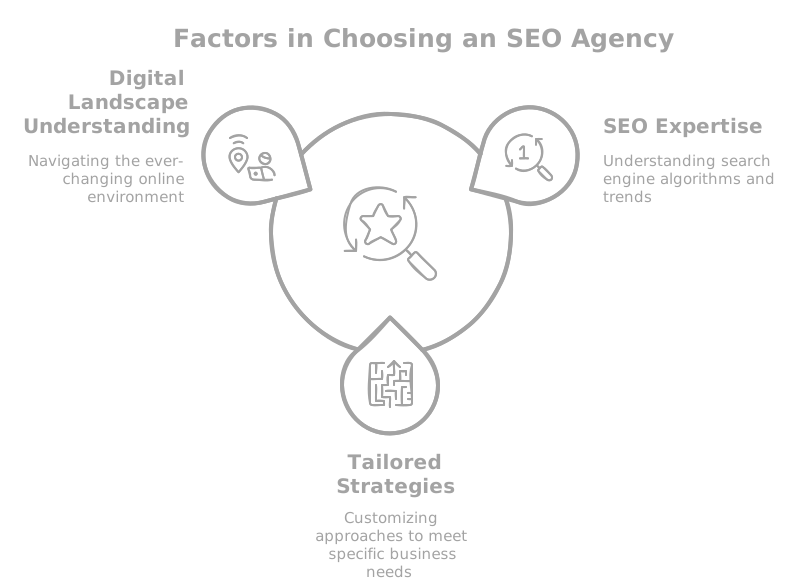
SEO is one of the easiest services to promise and one of the hardest to verify. That’s why the Mexican market is full of agencies that guarantee Google’s number-one spot overnight. Choosing well isn’t a matter of luck, it’s picking an agency that is transparent, measures business results, handles the technical and content sides equally, and avoids the tactics that end in penalties. The decision is strategic, because it shapes much of your visibility and the sales that arrive through organic channels over the coming years. Before signing anything, it pays to check for:
- Transparency: it explains what it does, where the budget goes, and shares access.
- Real results: it talks about traffic, leads, and sales, not vanity rankings.
- Provable experience: it shows cases, certifications, and knowledge of your sector.
- Technical and content: it covers both, not just keywords.
- Clean tactics: it builds authority sustainably, with no black hat.
Define your goals before you search
Before comparing agencies, it pays to look inward. What exactly are you after? Ranking in your city to attract nearby customers is not the same as scaling an online store nationwide, nor is building a content strategy the same as cleaning up inherited technical problems. If you don’t define the goal, every proposal will look reasonable, and that is exactly the ground where bad contracts get signed.
That initial clarity gives you bargaining power. A serious agency starts by asking about your business, your customer, and your current digital situation; one that only wants to sell you a fixed package tends to skip that conversation. Running a small self-audit, even with basic tools, lets you arrive at the table knowing what you are talking about and spot anyone who is improvising.
- Define the business goal: more local leads, more online sales, or more brand visibility each call for a completely different strategy.
- Identify your audience: knowing who you want to reach lets the agency tune content, language, and keywords with real criteria.
- Assess your starting point: reviewing your current traffic, speed, and indexing keeps you from paying for diagnoses you could already sense.
“If you don’t know where you are going, any road will get you there.” The line, popularized by marketing specialist Neil Patel, captures why a clear objective is worth more than any promise of top rankings.
Transparency is the first test

A good agency explains what it does and why, in language you understand. If their method is a secret, if they avoid detailing where your budget goes, or if they won’t share access to your own tools, something is off. Serious SEO has no magic formulas to hide; it has a process it can defend to an informed client, step by step, without resorting to jargon that serves more to impress than to explain.
Transparency also shows in day-to-day operations. The Google Analytics, Search Console, or any platform used for your brand should be under your name, not locked inside the agency. That ownership matters: if you ever decide to switch providers, your history and your data travel with you. A relationship that starts clean on the administrative side almost always matures better on the strategic one.
- Clarity on strategy: you deserve to understand what’s being done to improve your presence, without “professional secrecy” used as an excuse.
- Reports on a cadence: rankings, traffic, and conversions reviewed regularly let you measure real progress, not the feeling of it.
- Open feedback channels: a good agency invites questions and adjusts course when the business changes, instead of walling itself off.
That openness is also the foundation of trust. When you can see what’s being done and why, the relationship stops being an act of faith and becomes a collaboration, far less exposed to misunderstandings about what each side expected.
Real results, not vanity rankings
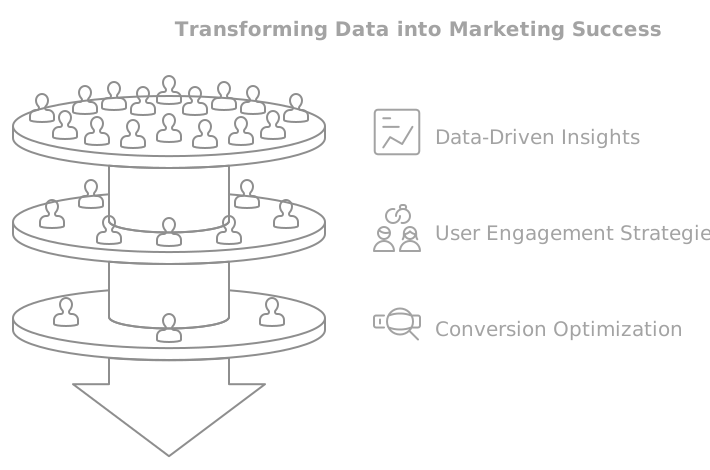
Ranking first for a search no one runs is worthless. What matters is the qualified traffic, leads, and sales that SEO generates for your business. Be wary of anyone who flaunts isolated rankings without tying them to business outcomes; a mature agency talks about commercial goals, not just positions on a list. The right question is never “what position did I land?” but “how much business did that position bring?”.
That’s why it helps to define how success will be measured from the start. Vanity metrics, the ones that look good on a slide but don’t move the cash register, tend to be the refuge of those who don’t deliver real results. A good partner agrees with you on business-linked indicators and sustains them month after month, even when a number disappoints, because honesty in reporting is worth more than a pretty chart.
- Qualified traffic, not just volume: a thousand visits that don’t convert are worth less than a hundred that do.
- Leads and conversions: forms, calls, and sales are the true yardstick for the work.
- Return on investment: every peso invested should be explainable in terms of outcome, not activity.
SEO done right behaves like an investment, not an expense: it takes time to mature, but it compounds when nurtured well. Anyone promising instant fruit is usually selling smoke or, worse, planting a problem you’ll pay for later.
Experience and reputation matter
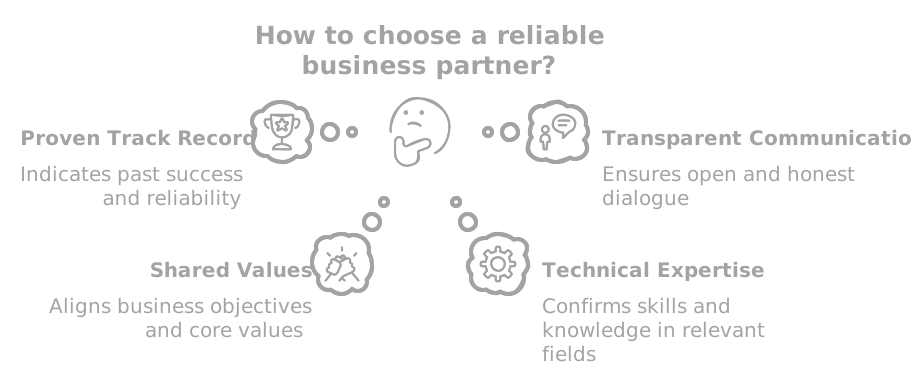
Not all agencies are equal, and experience shows. An agency with several years behind it has already faced algorithm changes, hard projects, and diverse sectors, and learned to adapt. That operational memory is hard to fake: it sets apart those who have walked the path from those who are discovering it on your budget.
Reputation is the natural complement to experience. Reviews, case studies, and recommendations from other clients say far more than any brochure. A solid track record isn’t a gallery of promises but of measurable results the agency can explain in detail: what it did, in how much time, and with what impact on the client’s business.
- Years in the craft: a track record usually translates into a better read on algorithm shifts and trends.
- Verifiable cases: a good portfolio shows concrete results, not adjectives, and lets you check them.
- Knowledge of your sector: an agency that understands your industry recognizes its challenges and opportunities with no learning curve at your expense.
“Experience is not what happens to you; it’s what you do with what happens to you.” Aldous Huxley’s reflection applies squarely to SEO: what’s valuable isn’t having seen many cases, but knowing how to turn that memory into better decisions.
Technical and content go together
Solid SEO rests on two legs: a healthy technical foundation (speed, structure, indexing, correct data) and relevant content that answers what your audience searches for. Anyone who only optimizes keywords ignores half the job, and anyone who only writes without minding the technical builds on sand. The key question is how they handle both dimensions and keep them aligned over time.
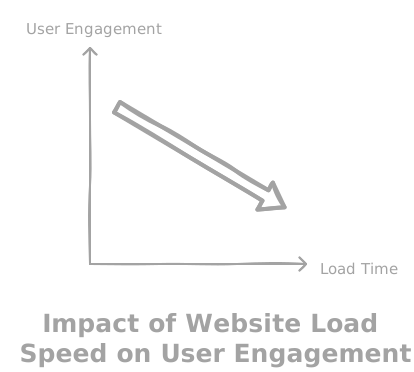
The technical side is the one that usually goes unnoticed until it gets in the way. A slow site, with crawl errors or poor structure, can hold the best content in the world and still fail to rank, because the search engine doesn’t even process it well. Here SEO meets custom software development: performance, clean architecture, and code that loads fast aren’t luxuries, they’re foundations. And since speed directly influences how long people stay, neglecting it hurts twice.
- Technical health: speed, structured data, and correct indexing decide whether your content can even compete.
- Purposeful content: text that answers real questions attracts and retains, it doesn’t just fill space.
- Keyword research: identifying the terms your audience actually uses points the whole effort in the right direction.
When technical and content move together, the effect compounds: every well-built page reinforces the others, and the whole site gains authority. That coherence, sustained over time, is what separates a good streak from growth that endures.
Services, price, and innovation

It pays to review the scope of services and understand the pricing model without losing sight of value. Some agencies charge by the hour, others on a monthly retainer, by project, or by performance. No model is bad in itself; the risk is hiring without clarity on what it includes, on what timelines, and with what deliverables. Ask for detailed proposals, compare equivalent services, and avoid locking into long contracts before you’ve tested the relationship.
The lowest price is almost never the best decision. An agency that cuts essentials to offer a rock-bottom rate tends to charge you later in penalties, rework, or results that never arrive. It helps to think in terms of value: a slightly larger investment that turns into real business outranks the saving that produces nothing. Add to that the ability to adapt, because SEO changes fast and whoever fails to evolve falls behind.
- Clear scope: on-page, technical, and off-page SEO should be well defined in the proposal.
- Price tied to value: cheap turns expensive when it sacrifices what actually moves results.
- Capacity to adapt: adjusting to algorithm changes and testing new approaches marks a partner that lasts.
“SEO is not about gaming the system; it’s about learning how to play by the rules.” The idea, attributed to editor Jordan Teicher, sums up why the best investment is the one made with method, not with shortcuts.
No black-hat tactics
Buying links, stuffing pages with keywords, or cloning content can produce a momentary jump, but search engines penalize those tricks, and recovering costs far more than was gained. An ethical agency builds authority sustainably, with clear and honest reporting. SEO that lasts is earned, not hacked, and that difference becomes obvious exactly when the first penalty arrives.
The damage from a bad practice rarely stays in the rankings. A sharp drop hits traffic, sales, and reputation at once, and winning back the search engine’s trust can take months of clean work. That’s why it’s worth asking directly how they earn links and authority: the answer quickly reveals whether you’re facing a partner or a gambler with your brand.
- Sustainable authority: links and reputation are earned with good content and real relationships, not dubious purchases.
- No penalizable shortcuts: black-hat tactics mortgage the future for a fleeting bump.
- Honesty in reporting: an agency with integrity also tells you what didn’t work, because that’s where the real learning is.
“Reputation is what others think about you; integrity is what you are.” John C. Maxwell’s line applies equally to your brand and to the agency you pick: SEO that endures is born of integrity, not appearance.
In short
Choosing an SEO agency in Mexico means choosing between the shortcut that gets punished and the work that endures. Define your goals, demand transparency, measure business results, weigh experience, and tend equally to the technical and the content: with those filters, ruling out anyone who promises magic becomes simple. At LabWeb we approach SEO with transparency, technical fundamentals, and purposeful content, so your rankings grow on solid ground and translate into real results for your business.