
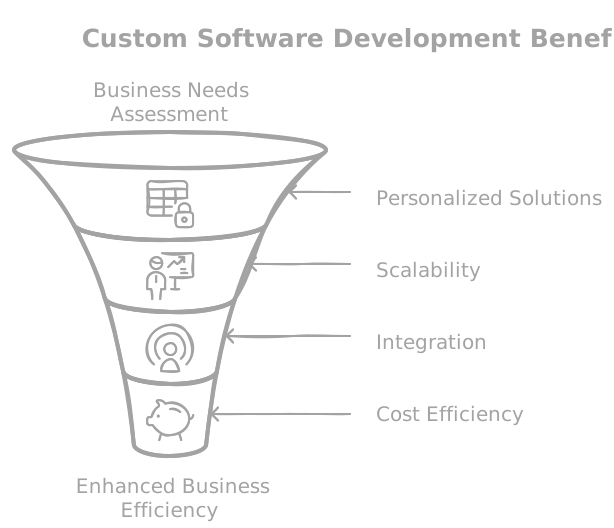
For many enterprises, the first reaction to custom development is the price: it costs more than buying a license and starting tomorrow. But that view ignores the other half of the equation, the return, and that’s exactly where an application built for your operation changes the math entirely. Think of it as a tailored suit: it fits perfectly because it was cut for you, instead of an off-the-rack option that may never quite fit. Understanding the real cost and the potential return of custom software is essential for any organization that wants to innovate and grow on solid ground.
Before getting into the detail, it helps to be clear on the points that weigh most in the decision:
- The upfront investment and what it is actually made of.
- The operational efficiency that compounds over time.
- The savings of avoiding a perpetual per-seat rent.
- Software ownership as a strategic advantage.
- Choosing the right development partner.
The upfront investment in context
Yes, a custom application demands a larger investment at the start than off-the-shelf software. That figure covers discovery, design, development, and testing shaped specifically around your processes. The difference is that you aren’t paying for generic features you may never touch, you’re paying for a tool that solves your concrete problem. The cost is real, but it’s also the foundation of an asset you own.
Building custom software is a bit like preparing a gourmet meal: the ingredients (your budget) and the preparation (your project plan) shape the final flavor (the functionality). The most common mistake is to look only at the headline number and weigh it against a monthly license, without breaking down what sits inside each one. Once you open the box, that number stops being a mystery and starts to read like an investment.
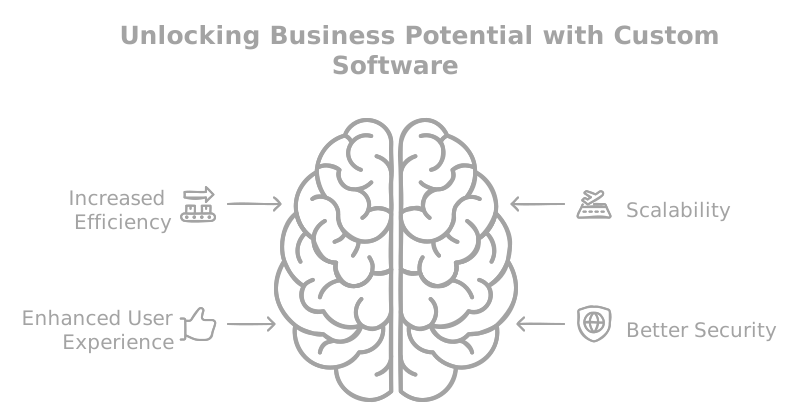
- Project scope: the breadth and depth of what you want to build moves the needle the most. A simple application asks for less investment than a feature-rich platform.
- Technology stack: choosing between existing frameworks or building new components affects both time and money. The most advanced technologies usually carry a premium price tag.
- Team expertise: bringing in seasoned people may look pricier upfront, but their experience saves time (and ultimately money) by avoiding costly pitfalls.
- Ongoing maintenance: software doesn’t stop working when it ships. Support and updates typically account for 15% to 20% of the annual cost and keep your system relevant and efficient.
It pays to treat that maintenance not as a surprise expense but as a budgeted line from day one. A system that gets updated regularly ages better, withstands platform changes, and avoids the technical debt that makes any modification painfully expensive years later. Seen this way, the opening invoice stops being an isolated number and becomes the first line of a longer spreadsheet, where the return shows up in the rows that follow.
Efficiency that compounds
The most tangible return shows up in daily operations. Software that mirrors your real workflows eliminates manual steps, reduces errors, and frees your team for higher-value work. That efficiency isn’t a one-time event, it accumulates month after month and, over time, comfortably outpaces the initial investment. What looked like an expense reveals itself as a lever for sustained productivity.
The effect is especially clear when the tool grows with you. An application built around your business doesn’t force you to start over when demands change: it adapts without traumatic migrations or full replacements. That ability to scale without friction is precisely what separates a well-built asset from a solution that ages badly. Scalability, seen this way, isn’t a technical luxury: it’s what protects the investment as the business changes size.
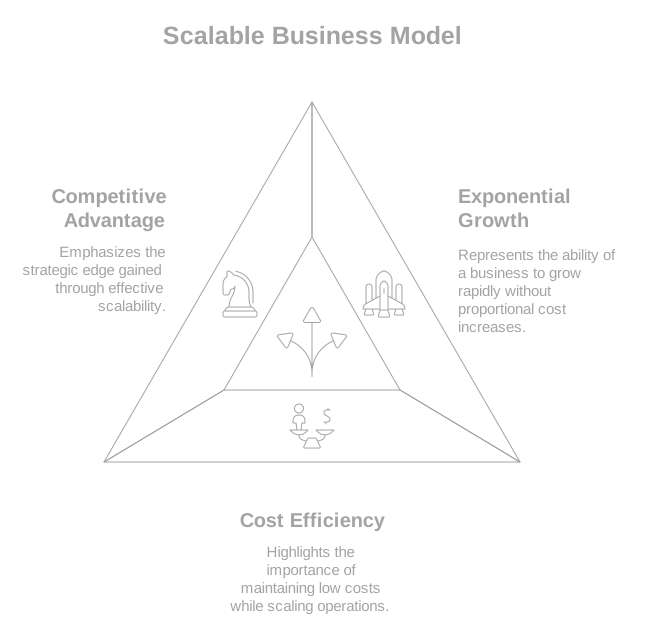
- Less manual work: automating repetitive tasks returns hours your team spends on higher-impact work instead of tedious data entry and reconciliation.
- Fewer errors: a system that validates data and respects your business rules cuts down on corrections and the hidden cost of mistakes.
- Faster decisions: building analytics into the application itself gives real-time visibility into your metrics and speeds up decision making.
- Genuine adoption: when the tool is intuitive, people actually use it, and a technology that gets adopted is the only one that ends up paying for itself.
The data backs up the intuition. According to McKinsey, companies that invest in technology-driven process improvements can raise productivity considerably, and that jump tends to concentrate precisely in the teams that used to lose hours to repeatable tasks. It’s no accident: when the tool fits the real work, it stops getting in the way and starts multiplying output.
“Innovation distinguishes between a leader and a follower.” Steve Jobs said it, and it captures why a tool designed for you opens paths that generic software cannot reach.
Efficiency, in other words, isn’t charged once: it pays off every day your team works with a tool that genuinely makes the job easier.
No perpetual per-seat rent
Commercial platforms typically charge per seat, month after month, and that cost grows precisely as your business grows. With an application you own, there’s no recurring license scaling with your headcount and no features locked behind a higher tier. You pay to build it once and run it on your terms. At scale, avoiding that perpetual rent represents savings that rarely appear in the initial comparison.
This is where the ROI calculation stops being a simple subtraction. It isn’t enough to compare the license price against the cost of development: you have to project how each option behaves over three or five years, when the number of users multiplies and the monthly fees pile up. What looked like the cheap option at the start often turns out to be the most expensive over time. The right question isn’t how much it costs today, but how much you will have paid after five years for something that still isn’t yours.
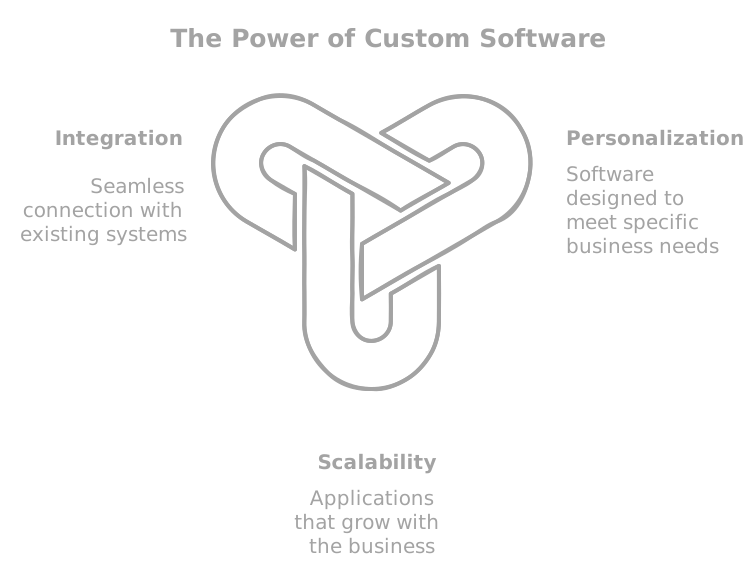
- Cost that doesn’t scale with headcount: adding users doesn’t trigger a higher monthly bill, unlike the per-seat model.
- No features held hostage: you don’t have to upgrade your plan or pay extra to unlock capabilities your operation needs.
- Financial predictability: an asset you own turns a recurring, uncertain expense into an investment with a clear horizon.
- Measurable return: weighing license savings alongside productivity gains lets you see the full ROI, not just one part of it.
For that return to be measurable rather than a hunch, it helps to set indicators from the start: hours saved, error rate, cycle time, cost per transaction. When you compare those numbers before and after, the license savings stop being theoretical and become a figure you can defend in front of leadership.
“The biggest risk is not taking any risk. In a world that is changing really quickly, the only strategy that is guaranteed to fail is not taking risks.” Mark Zuckerberg said it, and it applies squarely to anyone who keeps postponing investment in their own technology.
When you project the numbers across several years, the question stops being how much it costs to build and becomes how much it costs to keep renting something that will never be yours.
Ownership and long-term advantage
When the software is yours, you control how it evolves: you prioritize what matters, integrate it with your systems, and adapt it as the market shifts. That flexibility becomes a competitive advantage, because your tool does things rivals on standard software can’t easily replicate. Ownership isn’t only a technical matter, it’s strategic.
The difference is easier to grasp with a real operating example. A financial services company that adopted a workflow built to measure reported close to a 25% reduction in processing times, and that reduction translated into savings and more satisfied customers. In retail, a company that implemented its own inventory system saw stock discrepancies fall noticeably. It isn’t magic: it’s what happens when the tool fits the business instead of forcing the business to fit the tool.
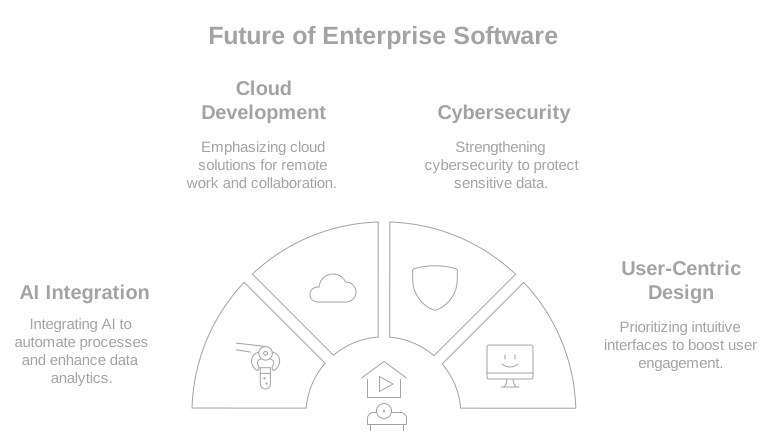
- Alignment with your goals: every feature exists for a reason tied to your strategy, not because it came bundled in a generic package.
- Frictionless integration: an application you own connects with your current systems and reduces disruption to the operation.
- Flexibility to pivot: the agility of custom software lets you react quickly to market changes without being trapped by someone else’s constraints.
- Real differentiation: when your tool does something competitors can’t easily copy, technology stops being a cost and becomes part of your advantage.
There is also a security and compliance dimension that off-the-shelf software rarely tailors to you. When you control the code, you decide how data is protected and how it adapts to your industry’s regulation: cybersecurity stops being a black box managed by a third party and becomes a layer you understand and govern. Ownership, in the end, is what turns software into a strategic asset: something that grows with you, molds to the way you operate, and sets you apart instead of leaving you indistinguishable from everyone else.
Choosing the right development partner
A good part of the return depends on who you build with. Choosing the right development partner is like finding a skilled navigator to cross complex waters: the difference between a smooth voyage and a shipwreck. That’s why it pays to evaluate carefully before committing budget and time.
One point that often gets underestimated is proximity. Working with a team in a compatible time zone and with cultural affinity lets you operate as a single team, with real-time decisions and fewer misunderstandings. That is exactly where the nearshore model from Mexico shines, and where custom software development finds the right people to build it. Proximity doesn’t only reduce friction: it speeds up every iteration and gets adjustments back to you in days, not weeks.
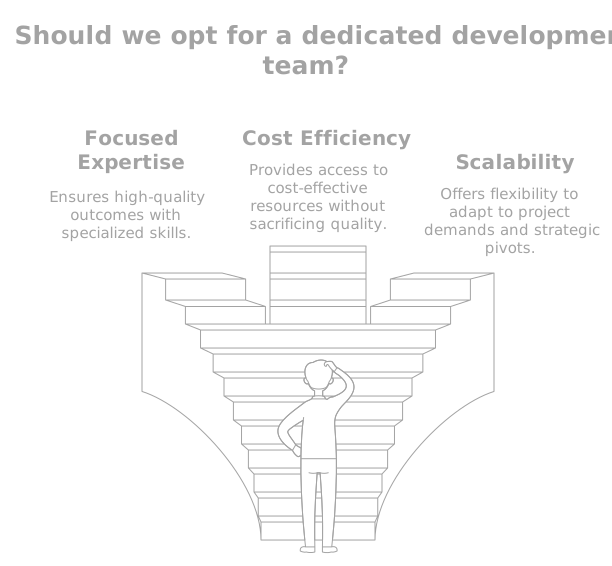
- Provable experience: review the portfolio for real projects relevant to your industry, not just promises.
- Clear communication: a good partner listens and translates technical jargon into business terms, because understanding your problem matters as much as writing code.
- Long-term support: make sure maintenance and continuous improvement are part of the relationship, not a separate one-off service.
- Agile methodology: your needs may change during the project; a flexible team adapts without derailing the entire effort.
The ground, moreover, is favorable. According to data from the World Bank, Mexico maintains a solid base of technical talent and deep integration with the North American economy, two conditions that make it viable to build and maintain enterprise-grade software close to home. Investing time upfront in choosing the right partner pays off many times over later. In the end, it’s better to sail with a clear heading toward the result you set out for than to drift through turbulent waters.
In short
The ROI of custom development isn’t measured in the opening invoice but in years of efficiency, license savings, and the ability to differentiate. The real return shows up when the application grows with you, without scalability becoming a brake, and when you build it with the right partner and an eye on owning the asset. At LabWeb we build enterprise applications that pay for themselves over time, designed as a business asset rather than an expense you rent forever. If you want to figure out what would make sense to build for your operation, we’re exactly the kind of partner that turns that investment into product.