Hiring offshore developers is no longer purely a budget decision. Managed well, it’s a strategy to access talent, move projects faster, and let your in-house team focus on what it does best. In a digital landscape where the demand for new solutions never lets up, leaning on capable teams outside your local market has become one of the most effective levers for growing without inflating fixed costs. These are the benefits that genuinely matter, and how to make the most of them so the model works in your favor.
Before getting into the detail, it helps to summarize the five points that hold this model together:
- Cost efficiency with real results.
- Access to a wider global talent pool.
- Genuine flexibility and scalability.
- Focus on what actually moves your business.
- Higher product quality and innovation.
Cost efficiency with real results
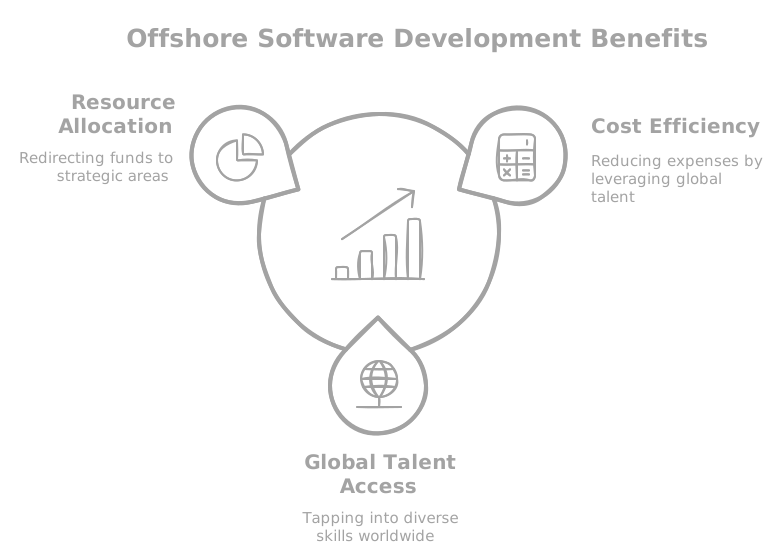
Savings are the most obvious draw, and they are rarely marginal. By collaborating with teams in regions where operating costs are lower, a company can meaningfully reduce its development spend without resigning quality. The key is measuring total cost, not just the hourly rate: delivery speed, rework, maintenance, and the learning curve. A capable team ends up costing less because it delivers right the first time, and your budget goes further when you invest in capability, not just in price.
Those savings don’t simply sit on the balance sheet: they free up resources to reinvest where they generate the most impact. What many companies do with that recovered margin captures the logic of the model well:
- Substantial savings: depending on the project and the skills required, development costs can drop noticeably compared with building the whole team in high-rate markets.
- Resource realignment: the money saved gets redirected toward marketing, customer support, or product innovation, the areas that drive growth.
- Lower infrastructure costs: working with an external partner avoids over-investing in equipment, offices, and tooling, because that burden falls on the partner team.
One clarification is worth making, because it is often misread: cost efficient is not a synonym for cheap or for low quality. The best partners apply rigorous quality assurance practices and methodologies like Agile or DevOps that raise the outcome while keeping the budget under control. Leaning on offshore consulting and development is not about cutting corners; it is about pursuing excellence with financial responsibility. In a competitive market, that combination of efficiency and high standards becomes a tactical advantage that is hard to match.
“Cost-cutting doesn’t mean compromising on quality; it’s about smart allocation of resources.”
Access to a wider global talent pool
The local technical talent market always has limits; offshore breaks them. You can suddenly bring in profiles that would take months to find in your own city, and do it without an endless recruiting process. This matters especially in disciplines where supply is scarce: artificial intelligence, cloud computing, cybersecurity, or data engineering. A diversity of profiles doesn’t just fill vacancies, it also brings fresh perspectives that enrich the product.
What you gain by opening the team to global talent shows up on several fronts at once:
- Specialized skills: teams with experience in emerging technologies that your local market may not readily offer.
- Diverse perspectives: different cultural backgrounds contribute new ways of solving problems, which usually translates into better solutions.
- Agile methodologies: much of the offshore talent pool is fluent in iterative practices that keep the project aligned with market reality.
- International experience: people who have already worked with demanding clients know how to operate to high standards from day one.
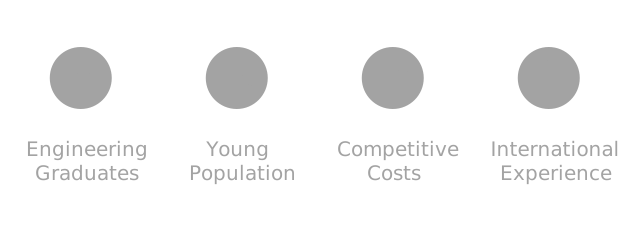
In Mexico’s case, that talent combines solid training with experience serving international clients. The country graduates tens of thousands of engineers every year, with a young population that adopts new technologies naturally. The normalization of remote work finished erasing the borders: today a team in Guadalajara can integrate into a San Francisco company without anyone having to relocate. Diversity, used well, is not a nice detail; it is an engine of results. Research from McKinsey shows that more diverse companies tend to outperform their peers on profitability, precisely because they blend viewpoints that would not otherwise converge.
“The best way to predict the future is to create it.” Peter Drucker said it, and by adding global talent to your project you are not just predicting success: you are actively building it.
Genuine flexibility and scalability
An offshore partner lets you grow or shrink the team to fit the project, without the rigidity of permanent hires. In a volatile market, that ability to match your workforce to demand stops being a luxury and becomes an operational necessity. If a project needs to accelerate, you can add developers in a matter of days, without the time and cost of a local hiring process. And when intensity drops, you adjust without carrying commitments you no longer need.
Flexibility used well translates into very concrete day-to-day advantages:
- Rapid resource allocation: scale the team up or down according to the project stage, without the friction of traditional recruitment.
- Efficient scaling: growing with external resources usually costs less than adding full-time roles, which keeps the operation lean.
- Capacity for diverse projects: access specialized skills as each need arises, without being tied to the limits of the local market.
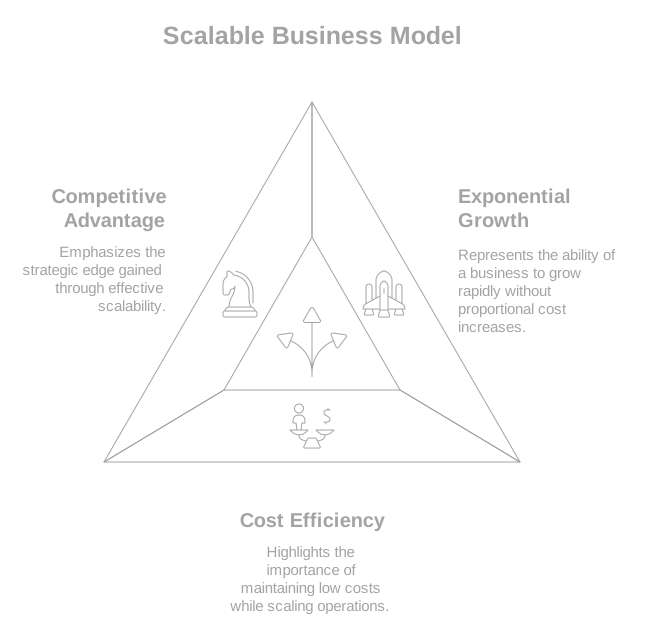
That elasticity supports both short-term urgency and long-term growth. An agile team also lets you iterate the product quickly based on user feedback, which is decisive when trends shift from one quarter to the next. With developers committed to your goals, you gain the ability to refine and improve continuously without losing the market’s pace. Scalability, seen this way, is not just an operational advantage: it is a strategic posture for competing in an environment that never stops moving.
Focus on what actually moves your business
Delegating technical execution frees your in-house team to focus on what truly sets the company apart: serving customers, defining strategy, innovating on the product. The complexities of development tend to pull attention away from those priorities, and when a dedicated team takes over the code, the people in your organization recover time and energy to think big. That shift in focus is no small thing: it usually shows up as better productivity across the operation.
A smart division of labor produces benefits that go beyond simple delegation:
- Increased productivity: by freeing the internal team from technical detail, its effort turns toward strategic planning and the customer relationship.
- More room to innovate: with fewer operational fires to fight, teams have margin to explore new ideas and refine existing ones.
- Better customer experience: concentrating on service and satisfaction, rather than on technical firefighting, strengthens the relationship with the people who buy from you.
There is a point worth underlining: focusing on the essentials does not mean disengaging from the product, but entrusting its construction to capable hands while your team does what it does best. Working with an external partner also lets you absorb good practices learned in projects across different industries, which enriches your own operation. As people often say in the innovation world, innovating is not about saying yes to everything: it is about saying no to all but the truly crucial. Outsourcing execution is, at heart, a way to protect that focus.
“Outsourcing is not about cost-cutting; it’s about finding expertise and innovation beyond your immediate reach.”
Higher product quality and innovation
When it comes to software, a focus on quality is never wasted. A good offshore partner not only brings specialized skills, it also raises the overall standard of the project. This comes down to several factors that the well-executed model puts on the table: rigorous control processes, diverse viewpoints, and access to cutting-edge technologies. Quality, far from being an accident, is the result of deliberate, sustained effort across the entire development cycle.
The pillars that quality is built on are fairly well identified:
- Rigorous assurance: serious partners follow strict quality-control protocols and methodologies like Agile and DevOps, which combine iterative progress with continuous testing.
- Diverse perspectives: collaboration across teams from different backgrounds feeds innovation with approaches a homogeneous group would rarely produce.
- Cutting-edge technologies: many offshore developers specialize in emerging areas that enable more advanced, future-ready solutions.
- Continuous improvement: iterative cycles establish early feedback loops, so the product is tuned according to testing and real needs.
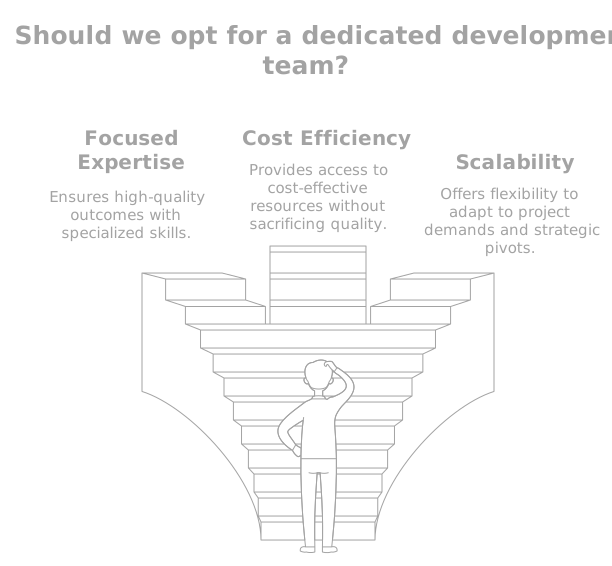
The combination of rigorous control, diverse perspectives, advanced technology, and continuous improvement creates the ideal ground for innovation to flourish. This is not theory: iterative practice, applied well, reduces the risk of each release and keeps the product aligned with what the user actually expects. Securing quality through a strategic partnership not only improves customer satisfaction, it also consolidates brand reputation in competitive markets. Something simple gets confirmed again: quality should never be an afterthought when you execute a project that matters.
“Quality is never an accident; it is always the result of intelligent effort.” John Ruskin.
In short
Offshore development used well combines savings, access to talent, flexibility, focus, and quality: five advantages that reinforce each other when the model is executed with discipline. It is not only a cost decision, it is a strategic way to build better and faster. And the nearshore model from Mexico adds what distant offshore cannot: a compatible time zone, cultural closeness, and real-time communication with North America, so distance shrinks to a logistical detail rather than a daily barrier.
At LabWeb we operate as an extension of your team, with the quality and communication that make remote collaboration truly work. If you are looking for a partner who turns these advantages into product, that is exactly the kind of ally we are.