
Offshore development gets a bad reputation when it goes wrong, but successful partnerships share very clear patterns. It isn’t about luck or low rates: it’s about how the relationship is structured from day one. Companies around the world are tapping into the immense potential of building software with distributed teams, and the ones that thrive tend to do the same handful of things well. The difference between a project that burns up in misunderstandings and one that ships value month after month almost never lives in the code: it lives in the way people work together. Before looking at how that plays out industry by industry, it helps to name why offshore IT keeps growing:
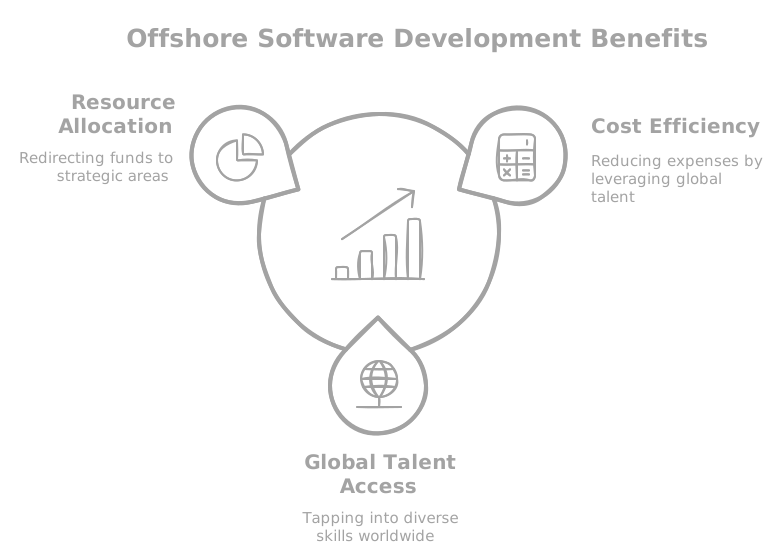
- Cost discipline: Outsourcing isn’t just about cheaper rates; it’s about smart budgeting without compromising quality.
- Access to talent: Specialized skills are within reach without relocating anyone or waiting months to hire locally.
- Scalability: A team can grow or shrink with the project instead of locking you into a fixed headcount.
“If you want to go fast, go alone. If you want to go far, go together.”
That old proverb captures the real lesson. In today’s digital landscape, going far means combining close communication, verifiable quality, and a genuine partnership. One thing is worth saying up front: offshore does not mean giving up control or shipping your project into a black box. The partnerships that work feel like a single company spread across two places, with shared goals, visible boards, and daily conversations. The five sections below show how those traits translate into results across very different industries, and which concrete habits separate the winners from the pack.
Transforming e-commerce with distributed teams
Online retail has exploded, and the businesses that win treat their storefront as living software rather than a brochure. According to the OECD, digital trade has grown into one of the most dynamic parts of the global economy, which means an online store now competes on speed, personalization, and reliability, not just on price. When the catalog grows and traffic spikes during a seasonal rush, technical bottlenecks turn into losses you can measure in sales. A capable distributed team is one of the most effective ways to keep up with that pace without rebuilding the whole engineering org from scratch.
Picture trying to run a busy online store while paddling upstream without an oar. That is how many teams feel when their tech can’t keep up with demand. A well-run offshore partnership changes the equation: it lets a merchant streamline operations, integrate advanced features, and engage customers at a pace an overstretched in-house team simply cannot sustain. The key is delegating well-scoped work with clear acceptance criteria, so every release can be measured and improved.
What actually moves the needle in e-commerce is rarely glamorous. It is the unglamorous discipline of shipping reliable features, fixing checkout friction, and measuring the result of each change before moving on.
- Advanced technology integration: Distributed teams can fold in modern tools like AI-driven recommendations and richer search faster than an overstretched in-house team, which turns browsing into buying.
- Always-on coverage: With overlapping schedules, a store can offer support and monitoring across more hours of the day, so a query or an outage at midnight does not wait until morning.
- Faster time to market: By delegating well-scoped work, a business can launch new payment options or promotions in time for a seasonal rush instead of missing the window entirely.
- Measurable performance: A serious partner instruments the store to track conversion, load speed, and cart abandonment, so each decision rests on data rather than a hunch.
The pattern behind these wins is consistent: the merchant kept ownership of strategy and let a focused team handle execution. That division of labor is exactly what frees a company to do what it does best, which is creating products customers come back for. It is not about paddling upstream alone; it is about working with people who know how to navigate the current and who answer to numbers, not promises.
Scaling startups through remote engineering
In the world of tech startups, speed and efficiency are everything. Scaling can feel like assembling furniture without the instructions: overwhelming and confusing. Remote engineering offers a lifeline for young companies that need to expand their capabilities without burning through a runway they cannot replace. Done right, it lets a startup not just survive but grow in a brutally competitive environment, adding expert hands exactly when the product starts to take off.
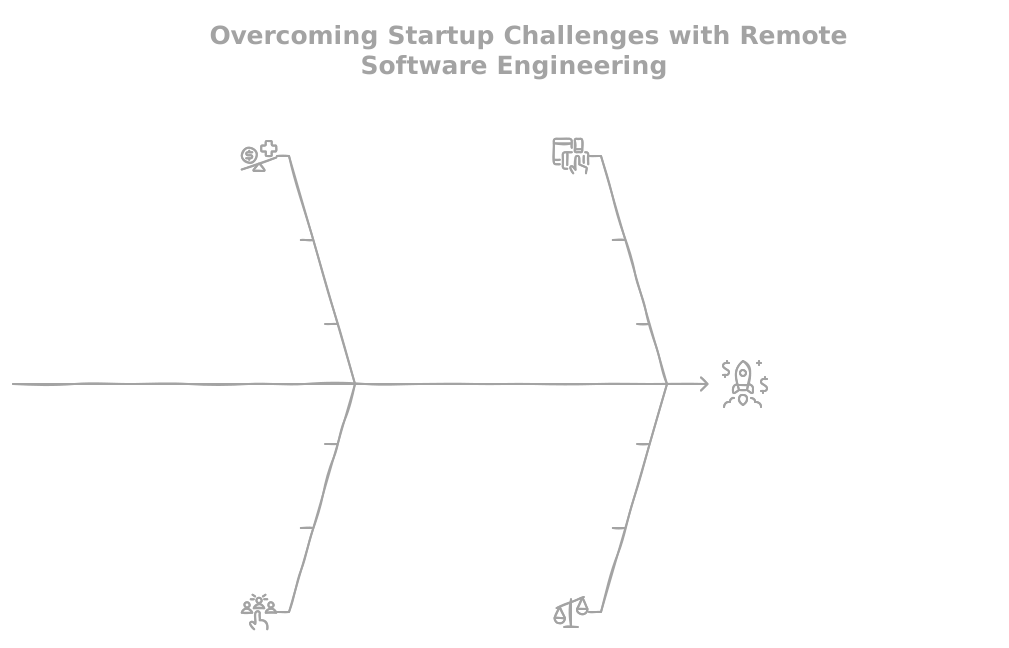
The data backs up the urgency. The Startup Genome global report consistently finds that premature scaling and weak execution, not bad ideas, are what sink most early-stage companies. A reliable engineering partner directly attacks that risk by adding capacity and discipline at the moment a founder needs both. The point is not hiring faster, but hiring the right capability for the right stage.
- Access to diverse talent: Remote teams remove the limit of the local hiring pool, opening the door to specialists whose skills and perspectives can set a product apart.
- Cost savings that extend runway: Money not spent on a bloated fixed team can go toward marketing, research, or simply staying alive longer, which for a startup is the whole game.
- Focus on the core business: Delegating well-defined technical work lets founders spend their scarce attention on vision, customers, and fundraising instead of day-to-day coding.
- User-guided iteration: A focused team can build, measure, and adjust features based on real feedback, shortening the loop between a hypothesis and its validation.
The startups that use this model best do not treat it as a way to offload responsibility. They treat it as a way to move faster on the parts of the product that matter, iterating on real user feedback without overwhelming a tiny core team. That is the difference between outsourcing tasks and extending the company. As the saying goes, innovation needs more than ideas; it needs execution, and execution is exactly what a strong engineering partner provides when it plugs in as part of the team rather than a vendor at arm’s length.
Cost-effective web solutions in healthcare IT
In healthcare, cost-effective software is not a luxury; it is a necessity. Rising operating costs and growing demand for efficient patient care push many providers to look for ways to improve their systems while protecting their budgets. A disciplined development partnership can enhance medical software and save a meaningful slice of spending at the same time, as long as compliance and security stay front and center rather than bolted on at the end.
The shift toward digital care is real and durable. Industry research has documented how telehealth use surged during the pandemic and then settled at levels far above where it started, which means the software behind remote consultations is now core infrastructure rather than an experiment. Building and maintaining that infrastructure reliably, with sensitive data involved, is precisely the kind of work a dedicated team that understands the stakes can take on.
- Streamlined operations: Delegating well-scoped IT work lets a hospital or clinic focus staff on patient care instead of getting buried in maintenance, which often improves uptime as a side effect.
- Better patient experience: A capable team can fold intuitive, accessible interfaces into healthcare apps, keeping patients informed and engaged rather than frustrated.
- Expertise in compliance: Navigating regulation can feel like walking a maze blindfolded, so partnering with people experienced in compliant, secure solutions protects both the budget and the patient.
- Data security: Encryption, access control, and audit logs stop being optional when clinical records are in play, and a good partner treats them as a baseline requirement.
The lesson here is that cost control and quality are not opposites in healthcare; they reinforce each other. A reliable platform means fewer outages, fewer emergencies, and fewer expensive surprises. Investing in solid software is, in the long run, one of the cheapest things a provider can do, because every hour of downtime on a clinical system carries a cost that reaches far beyond the IT invoice.
Boosting innovation in financial services
In financial services, innovation is no longer optional; it is survival. The pace of technology means institutions have to stay ahead of the curve, and a strong development partner can accelerate that effort. Think of it as strapping a more powerful engine onto a traditional banking operation: the destination is the same, but you reach it faster and with more control over the route.
Security is the non-negotiable foundation here, and the stakes keep rising. The trade press has reported repeatedly on the growing global cost of cybercrime, which is why serious financial software treats protection as a first-class requirement rather than an afterthought. A development team that understands this builds safeguards in from the start instead of bolting them on later, when fixing an oversight costs ten times as much.
- Security by design: A capable partner bakes in modern protections and review practices, so sensitive data stays protected as the product evolves rather than becoming a liability.
- Streamlined processes: Automation and clean workflows sit at the heart of efficient institutions, and a focused team can implement them quickly, cutting manual work and freeing people for strategy.
- Agility to experiment: The ability to pivot and test new ideas matters enormously in finance, and added engineering capacity lets a business try innovative features without overextending its core team.
- Auditable compliance: A good team documents and logs every change, so passing a regulatory audit stops being a last-minute scramble.
The institutions that embrace this approach are not merely keeping up; they are setting the pace. With costs kept under control, they can reinvest in the research that produces genuinely better products, from cleaner mobile banking to smarter fraud detection. The goal is not just to keep the lights on; it is to build the next thing customers will rely on, and in finance, trust is earned one successful transaction at a time.
“The only way to earn trust is to be consistently trustworthy.” The idea, as old as it is simple, captures why security and sustained quality matter more than any flashy feature.
Driving efficiency in manufacturing
In manufacturing, efficiency is everything, and software is increasingly how that efficiency is won. Picture a production line running like a well-oiled machine because the right tools and expert support sit behind it. That is what many manufacturers are reaching for when they extend their teams with dedicated engineering capacity, connecting machines, data, and decisions in ways that were impractical a decade ago and now decide who pulls ahead.
The broader trend is well documented. The World Bank has tracked how digital adoption raises productivity across industrial economies, and manufacturing is one of the clearest examples, where better data and automation translate directly into lower costs and faster output. The hard part is building the systems that capture that data reliably, tying old and new equipment into a single view, which is exactly where a strong technical partner earns its keep.
- Real-time data management: A capable team can implement systems that track production metrics live, letting managers make informed decisions on the fly and cut downtime.
- Integration of connected devices: With engineers skilled in connected sensors and equipment, manufacturers can link machines to enable predictive maintenance, catching small issues before they become expensive failures.
- Scalable operations: Dedicated teams provide the flexibility to scale with demand, whether launching a new product line or expanding into a new market, without a permanent jump in fixed cost.
- End-to-end visibility: Connecting inventory, production, and logistics on one dashboard makes it possible to see where time and money leak away, which is the first step to winning them back.
The result of getting this right is compounding: better operational performance leads to higher profitability and faster response to the market. Efficiency on the factory floor and discipline in the software that supports it are two sides of the same coin. The manufacturers pulling ahead understand that you do not want to be left behind on the assembly line, and increasingly that line runs on code someone has to build and maintain well.
In short
Offshore development done right rests on close communication, verifiable quality, and a partnership that goes beyond price. Across e-commerce, startups, healthcare, finance, and manufacturing, the winners share the same habits: they delegate execution without surrendering ownership, they treat the team as partners rather than a task factory, and they measure results instead of trusting promises. The common thread is not the sector or the technology of the moment, but a disciplined, transparent way of working. At LabWeb we work as an extension of your team, nearshore from Mexico, so distance is never an obstacle to building good software. If that is the kind of partner you are looking for, that is exactly the role we are built to play.