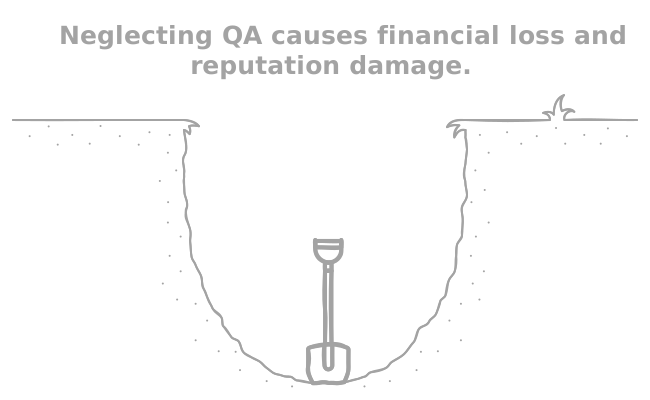
Cutting quality assurance looks like an easy way to save time and money, until a bug reaches production. QA isn’t a luxury or an optional step at the end of a project: it’s what protects your business from costs that multiply when problems are caught late. In a market where the first impression defines the relationship with the customer, neglecting quality isn’t a shortcut, it’s a losing bet that eventually collects on itself. The good news is that the problem is entirely avoidable once quality stops being a phase and becomes a way of working.
Before going into detail, it’s worth summarizing the ideas that hold the whole article together:
- The cost of a defect grows at every stage.
- Reputation is hard to recover and easy to lose.
- Testing is an investment that pays for itself.
- Quality is built in from the start, not bolted on at the end.
- Standards and continuous improvement sustain the result.
The cost grows over time
A bug found while the code is being written is cheap to fix; the same bug discovered by a customer costs far more. This isn’t a hunch, it’s a well documented pattern in the software industry: the later a defect is caught, the more expensive it is to repair, because the team has already built on top of it, it has already shipped to production, and it has already touched real users. What was a single line to adjust in development becomes, in production, support involvement, emergency patches and, in the worst case, compromised data.
That escalation has a simple logic: every stage a defect passes through undetected piles more work on top of it. Fixing it later means reopening code the team already considered closed, retesting everything that depends on it and coordinating a release that was never planned. QA catches problems while they’re still cheap to resolve, before they turn into fires.
The price of the same defect grows at every phase of the cycle, and it’s worth keeping in mind:
- In development: a quick, almost free fix, while the context is still fresh in the mind of whoever wrote the code.
- In testing: a bit more work, but still contained and with no impact on the end user.
- In production: support involved, users affected, emergency deployments and, sometimes, sensitive information at risk.
- After a crisis: the cost stops being technical and becomes reputational, the hardest kind to quantify and to reverse.
Every hour of early testing saves many hours of later repair. Seen this way, QA doesn’t slow delivery down: it makes it cheaper.
Reputation is hard to recover
A customer forgives a price, but rarely forgives a bad experience. An app that crashes, loses data, or behaves erratically erodes trust faster than any campaign can rebuild it. Perceived quality is part of your brand, and QA is what holds it up. A single outage at the worst possible moment, a duplicated charge or a screen that won’t load is enough to send the perception of the entire product into a tailspin.
The trouble is that trust is asymmetric: it’s built slowly, across many flawless interactions, and destroyed in an instant by a single bad one. In the age of public reviews and social media, a failure stops being a private incident between you and one user and becomes visible testimony for thousands of potential customers. Protecting the user experience is, at its core, protecting the business’s reputation and, with it, its ability to grow.

The link between quality and trust shows up on several concrete fronts:
- Word of mouth. Satisfied users recommend; frustrated ones warn others to stay away. Both effects get amplified in public.
- Retention. Winning a new customer costs far more than keeping an existing one, and a bad experience pushes in exactly the wrong direction.
- Brand perception. Technical quality ends up reading as seriousness, care and professionalism, attributes no campaign can fake for long.
“Quality is never an accident; it is always the result of intelligent effort.” John Ruskin said it, and it captures why customer trust can’t be improvised: it has to be designed.
Testing as an investment, not an expense
Seeing QA as a cost leads to cutting it; seeing it as an investment changes the conversation. The difference isn’t just semantic: it decides whether quality is treated as a line item to sacrifice when the budget gets tight or as an asset that protects everything else. Automated tests in particular pay for themselves: once written, they validate the product again and again with no extra effort, on every change, day after day.
That return becomes most obvious when the product starts moving fast. A solid test suite lets you ship changes with confidence and speed, without the fear of breaking what already worked. The team stops moving with excessive caution and starts iterating, because it knows that if something breaks, the test catches it before the customer does. Quality doesn’t slow the team down, it gives it the security to move faster. Testing well is building on solid ground.
It helps to distinguish the ways that investment pays off:
- Less rework. Catching defects early avoids reopening code that was already closed and redoing work that was considered finished.
- More predictable delivery. Without last minute surprises, deadlines hold and releases stop being a gamble.
- Sustainable speed. Automation frees the team from manually validating the same thing over and over, and that time comes back as product.
- Confidence to scale. A well tested system absorbs growth without turning every new feature into a risk, a key foundation when you think about scalability.
“The cost of quality is the expense of failing to do things right the first time.” The line is Philip Crosby’s, and it makes clear that what looks like savings is usually just deferred debt.
Quality built in, not bolted on
The best QA isn’t a separate phase at the end but a practice present throughout development. When quality is built in from the design, with tests, reviews, and clear standards, it stops being a bottleneck and becomes part of the team’s rhythm. The difference is enormous: instead of a gate that holds the product back right before it ships, quality becomes a silent companion that validates every step as it’s taken.
That integration also changes who owns quality. When it’s left for the end, it falls on a single person or a single team reviewing against the clock; when it’s built in from the start, ownership is shared among everyone who touches the product. That culture of quality produces more stable, predictable software, project after project, and it shows especially in custom software development, where every early decision defines how solid the final result will be.
Building quality in from day one translates into very concrete practices:
- Early involvement. Defining quality criteria alongside the requirements keeps problems from surfacing when they’re already expensive to fix.
- Continuous reviews. Reviewing code between peers catches errors and spreads knowledge across the team at the same time.
- Validation with real users. Acceptance testing confronts the product with real world expectations, not just the specification.
- Shared ownership. When everyone understands they contribute to quality, it stops being the job of a few and becomes part of the craft.
Doing it right from the start is always cheaper than fixing it later, and it almost always produces a better product.
Standards and continuous improvement
Quality doesn’t hold up on good intentions alone: it needs a framework that makes it repeatable. That’s where recognized standards come in, offering a common language and a proven guide for building consistent quality management systems. Adopting them isn’t about filling out forms, it’s about leaning on what the industry has already learned so you don’t reinvent the wheel on every project.
But a standard is a starting point, not a finish line. What truly sustains quality over time is continuous improvement: measure, learn and adjust. When a team tracks metrics like defect density or user satisfaction, it stops operating on intuition and starts deciding with data. That discipline turns every project into a lesson for the next one, and it’s also the foundation for critical concerns like cybersecurity, where what you don’t measure is hard to protect.
A culture of continuous improvement is recognizable by a few consistent practices:
- Clear metrics. What gets measured can be managed, and what gets managed tends to improve steadily.
- Feedback loops. Listening to users and to the people building shortens the distance between what gets made and what is actually needed.
- Proactive risk management. Identifying potential failures before they escalate is far cheaper than putting out fires afterward.
- Prevention over correction. Investing in solid processes upfront pays dividends on every later delivery.
“What gets measured gets managed.” The idea, attributed to Peter Drucker, is the heart of continuous improvement: without measurement, there’s no honest way to know whether quality is rising or falling.
In short
Ignoring quality assurance doesn’t save money: it postpones and multiplies it, while putting your reputation at risk. The cost of a defect grows at every stage, customer trust is hard to recover, and well built testing pays for itself. The difference between a fragile product and a reliable one is rarely about talent; it’s about the discipline of building quality in from day one and sustaining it with standards and continuous improvement.
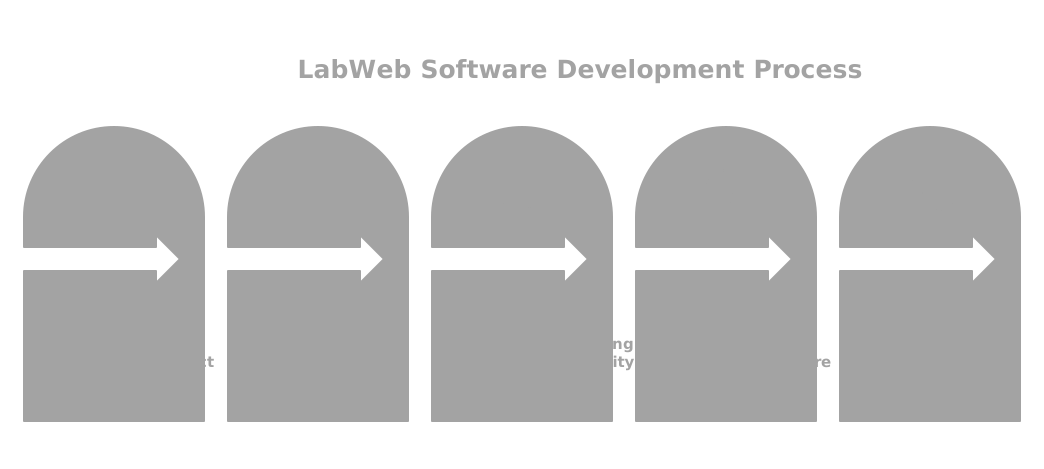
At LabWeb we build QA into the entire development process, so your product reaches users stable, reliable, and ready to grow. If you’re looking for a partner that treats quality as an investment rather than a final formality, that’s exactly the kind of team we are.