
Metrics show you where users click, how long they stay, and where they leave. What they never tell you is why. And that gap, between the data and the motivation, is where many marketing strategies stall: they optimize numbers without understanding the people behind them. Traffic analysis delivers the quantitative side, the precise snapshot of behavior; customer psychology delivers the qualitative side, the story that gives that snapshot meaning. Bridging the two realms is what turns cold figures into narratives that connect, convert, and build relationships that last.
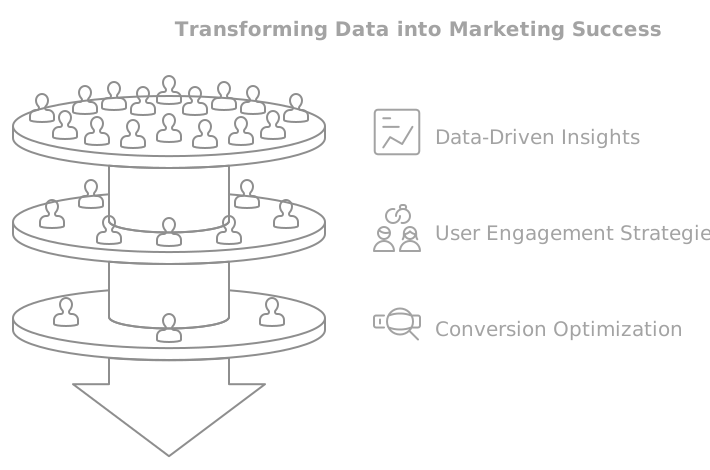
Before going deeper, it helps to be clear about the three pillars this integration rests on:
- Data-driven decisions. Analytics reveals real patterns, preferences, and browsing paths.
- User engagement. Traffic monitoring shows what draws people in and what sends them away.
- Conversion optimization. Conversion tracking and bounce-rate analysis sharpen every step of the funnel.
What data does well
Analytics is irreplaceable for spotting patterns at scale: which pages convert, which channels bring quality traffic, and where the funnel breaks. It gives you measurable facts and takes opinion out of the decision. Without that data, marketing is blind intuition, and intuition alone rarely holds up. Whoever measures can compare, whoever compares can improve, and whoever improves consistently ends up ahead of the competition.
The real value of traffic analysis is not in piling up figures but in reading them to anticipate behavior and adjust strategy on the fly. A heatmap that shows where clicks cluster, a report that catches a blog post surging, a session drop that exposes a slow page: each signal is an opportunity waiting to be read. The difference between collecting and understanding is exactly what separates reactive marketing from strategic marketing.
There is also a compounding effect worth naming. Every campaign, every landing page, every A/B test leaves behind a trail of evidence that makes the next decision a little less of a guess. Teams that treat analytics as a long-term asset, rather than a dashboard they glance at once a month, build an institutional memory of what works for their specific audience. Over time that memory becomes a competitive moat, because rivals can copy a tactic but not the years of context that tell you when and why to use it.
To make that reading useful, it helps to lean on a few concrete fronts:
- Informed targeting: visitor tracking tells you who reaches your site so you can adjust the message; if much of your traffic is mobile, optimizing for that screen changes the experience entirely.
- Trend detection: real-time data lets you catch a pattern as it happens and react before the opportunity cools off.
- Performance metrics: session duration, page views, and exit rate reveal which content resonates and which goes unnoticed.
“Without data, you’re just another person with an opinion.” W. Edwards Deming said it, and it sums up why evidence, not a hunch, should guide every marketing decision.
What data can’t see
A high bounce rate tells you something is wrong, but not whether it was price, trust, an unresolved doubt, or a simple distraction. Motivations, fears, and expectations live outside the metrics dashboard. Treating every drop-off as a technical problem, when it is sometimes deeply emotional, leads to fixes that fix nothing and to budgets spent in the wrong place.
This is where customer psychology comes in, the discipline that studies why people decide what they decide. Emotions weigh far more than we tend to admit: research from the American Psychological Association shows that emotional state directly shapes how we evaluate options and make purchasing choices. Someone who feels trust and closeness toward a brand behaves very differently from someone who is only comparing specifications.

Three psychological phenomena explain much of what analytics cannot see on its own:
- The weight of emotions: a positive emotional connection to a brand tips the scale more than any technical feature, because the decision is felt before it is reasoned.
- Social proof: people trust what others have already validated; testimonials and reviews cut uncertainty and nudge action.
- Cognitive dissonance: the discomfort of holding two conflicting ideas eases when the message, the promise, and the post-purchase experience all point the same way.
“People don’t buy what you do; they buy why you do it.” The line is Simon Sinek’s, and it reminds us that behind every click there is a reason no single metric can fully capture.
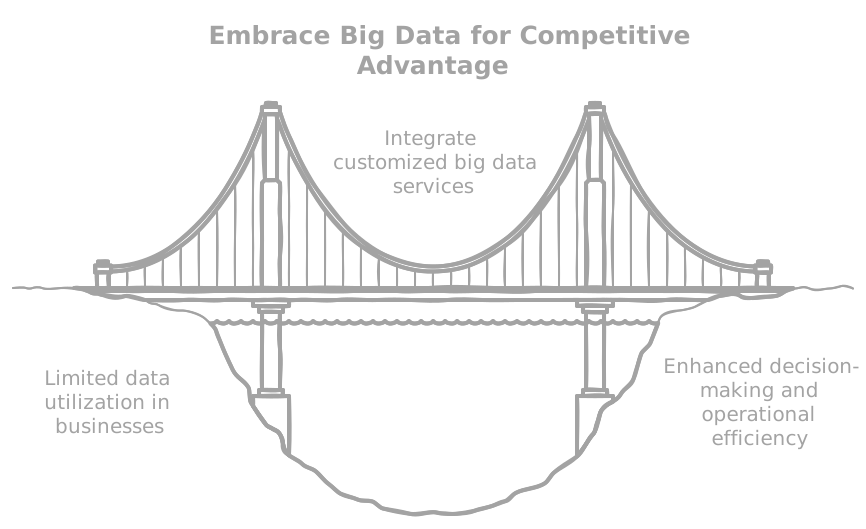
The bridge: data that raises questions
The real power appears when data stops being an answer and becomes a question. “70% leave here” isn’t a conclusion, it’s the start of an investigation: surveys, interviews, heatmaps, and tests that reveal the why. Numbers point to where to look; psychology explains what you’re seeing. Combining both is like pairing the precision of a scalpel with the sensitivity of a good portrait: rigor and empathy working together.
That bridge is built by translating every quantitative finding into a hypothesis about people. If analytics shows users abandoning the cart after viewing a certain product, the question is not only technical, it is human: did the price break an expectation? was a trust signal missing? did the promise fail to land? Major digital platforms have done this for years: they cross browsing history with behavioral patterns to anticipate what each person is looking for, well before they ask for it.

For that translation to work, it helps to break it into concrete steps:
- Finer targeting: analytics tools reveal groups within your audience; a traffic spike from a certain profile calls for content built for that profile.
- Optimized user experience: bounce-rate analysis flags which pages fail, and understanding the psychological expectation behind them lets you redesign with intent, not blindly.
- Personalization with purpose: behavioral data feeds relevant messages and offers, so every interaction feels made for the person, not for an anonymous crowd.
A simple table helps order the two approaches and makes their complementarity clear:
| Criterion | Traffic analysis | Customer psychology |
|---|---|---|
| What it answers | The what: where they click and where they leave | The why: the motivation behind the behavior |
| Its strength | Measurable patterns at scale, free of opinion | Understanding fears, doubts, and expectations |
| Its blind spot | Can’t explain the cause of each drop-off | Alone, it chases hunches without evidence |
Empathy that improves every decision
When you understand the motivation behind the behavior, every marketing decision gets sharper: the message speaks to the real fear, the design removes the right friction, and the offer answers what truly matters. Data without empathy optimizes the trivial; empathy without data chases hunches. Together they tune both the what and the why, and that tuning shows up in every metric that matters.
The impact of this combination is not theoretical, it is economic. Analysis from the Harvard Business Review shows that a customer emotionally connected to a brand can be worth far more than one who is merely satisfied: they buy more, stay longer, and recommend more strongly. Empathy, far from being a soft add-on, is one of the most profitable multipliers there is.
It is worth being honest about the failure mode on each side, because that is where most teams lose money. Pure data people fall in love with marginal gains: they shave a button by two pixels and celebrate a half-point lift while ignoring that the headline scares people off. Pure intuition people fall in love with their own taste: they ship a beautiful redesign that feels right and never check whether anyone could find the checkout. The bridge between the two is not a compromise where each side gives up half of what it knows; it is a workflow where the numbers decide what to investigate and the humans decide what it means.

In practice, that data-backed empathy translates into very concrete habits:
- Interpret, don’t just measure: every figure is the start of a conversation with the user, not the end of the analysis.
- Design for real emotions: mapping the customer journey reveals where interest fades and where it catches, so you can adjust content and experience with intent.
- Learn continuously: reviewing and refining strategy with fresh data and constant listening keeps the proposition alive and relevant.
“What gets measured gets managed.” The line, attributed to Peter Drucker, takes on its full meaning when what we measure is not just clicks, but the people behind them.
In short
The best marketing doesn’t choose between numbers and people: it uses data to know where to look and psychology to understand what it sees. Traffic analysis provides the compass; customer psychology provides the map of the human terrain. Whoever masters that blend stops optimizing stray figures and starts building relationships, which is where loyalty, and with it sustained growth, is truly earned.
At LabWeb we combine rigorous analytics with a real understanding of the customer, so your decisions rest on evidence and empathy at once. If you want your marketing to stop chasing numbers and start understanding people, we are exactly the kind of partner that turns data into a story that converts.