

Content that works is rarely the most polished, it’s the kind that strikes a nerve. Behind every shared article or memorable video are psychological principles that explain why some campaigns resonate while others vanish into the noise. It isn’t magic; it’s understanding how your audience decides and feels. A content campaign is not a pile of posts tossed into the digital void: it’s a carefully crafted narrative built to connect with real people who carry very specific desires, fears, and time pressures.
In a world flooded with information, attention has become the scarcest resource, and earning it takes more than correct facts. It takes speaking to the whole person: to their memory, their emotions, their biases, and their need to feel part of something. These are the psychological pillars that separate a campaign that sticks from one that fades:
- Stories are remembered; facts are forgotten.
- Emotion moves before reason does.
- Cognitive biases guide decisions we believe are rational.
- Visuals land faster and linger longer.
- Personalization turns a generic message into something that feels like mine.
- Consistency, across channels and over time, builds trust.
Stories are remembered, facts are forgotten
The human brain is wired for narrative, not feature lists. A story with a protagonist, a conflict, and a resolution sticks because it gives information context and emotion. Successful campaigns don’t enumerate benefits, they tell how someone’s life changes because of them. That is why a brand that shares the why behind what it does, not only the what, creates a bond no feature catalog can match.
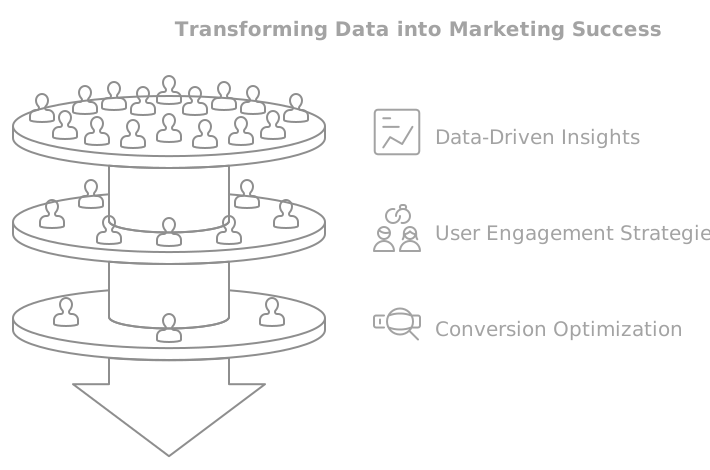
Narrative also organizes information. An isolated fact evaporates; the same fact inside a story finds a place to stay, because the mind ties it to a character, a tension, and an outcome. When a testimonial shows a real person overcoming a problem your audience recognizes, it stops being advertising and becomes a mirror. That is the difference between informing and moving someone.
For the story to work, a few elements deserve care:
- A recognizable protagonist: the audience needs someone to identify with, whether a customer who cleared an obstacle or a team that chased an idea with passion.
- A real conflict: without tension there is no story; naming the problem honestly is what makes the solution believable.
- A clear resolution: the ending should show the change rather than vaguely promise it, so the message leaves a concrete mark.
- A why beyond the product: brands that communicate their values, not just their features, build loyalty that outlasts the first purchase.
“People don’t buy what you do; they buy why you do it.” Simon Sinek said it, and it captures why purpose sells more than a feature list.
Emotion moves before reason
We decide with emotion and justify with logic, not the other way around. Content that sparks a reaction, relief, aspiration, belonging, even a smile, gets shared and acted on more than the merely informative. That doesn’t mean manipulating; it means speaking to the whole person, not just their analytical side. Emotion is what turns a passive viewer into someone who shares, comments, and recommends.
The effect is not just anecdotal, it has business consequences. According to the Forbes Communications Council, customers who are emotionally connected to a brand can be considerably more valuable than merely satisfied ones, because they show greater loyalty and a more durable bond. Used well, emotion is not decoration: it is one of the most profitable engines a campaign has.
To engage that emotional spring without resorting to cheap tricks, a method helps:
- Use relatable characters: build narratives around figures who embody your audience’s traits, their struggles, and their small victories.
- Highlight shared values: aligning your message with what your audience stands for creates instant affinity and genuine reasons to engage.
- Create a sense of belonging: inclusive language and imagery make the person feel part of a community rather than part of a transaction.
- Use humor wisely: it can make a message memorable, as long as it fits the brand voice and respects the sensibility of whoever receives it.
“Marketing is no longer about the stuff you make, but about the stories you tell.” The line is Seth Godin’s, and it explains why emotion beats an inventory of attributes.
Cognitive biases guide decisions we believe are rational
Cognitive biases are mental shortcuts that influence, more than we admit, how we perceive and respond to content. They are not flaws to exploit but patterns of human thinking worth understanding so you can communicate with clarity and honesty. Recognizing them lets you frame a message so it is easier to process, not easier to deceive.
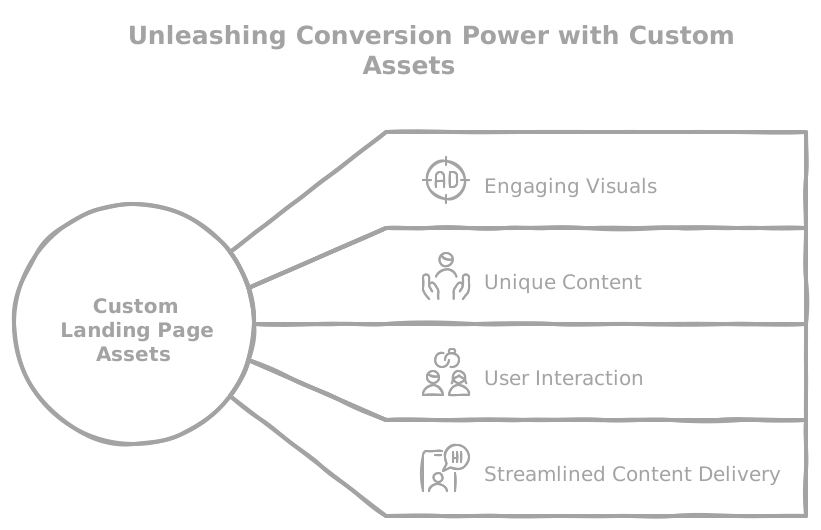
A few of the biases that weigh most on an audience’s decision include:
- The anchoring effect: the first information a person receives shapes everything they evaluate afterward, which is why the opening message and the way value is framed matter so much.
- Confirmation bias: we tend to pay attention to what confirms what we already believe, so content aligned with the audience’s values meets less resistance.
- The bandwagon effect: people adopt ideas or behaviors when they sense others already have; showing real adoption, like reviews and testimonials, reinforces trust.
- Loss aversion: losing weighs more than gaining, so clearly communicating what is at stake often moves people more than promising an abstract benefit.
Understanding these patterns, and respecting them, improves how a campaign supports the user’s decision. Research in consumer behavior, gathered in publications such as the Journal of Consumer Research, shows that aligning a message with the way people think and feel raises its effectiveness. Testing variants of the same message also helps reveal which framing truly resonates with each audience, instead of assuming it.
“Marketing is about understanding how people think and feel.” The idea, attributed to Brian Halligan, is a reminder that every buying decision begins in the mind before it reaches the wallet.
Visuals land faster and linger longer
Visual narratives have a unique power: they simplify complex ideas and stir emotion almost instantly. In an environment saturated with text, a well-made image, video, or graphic stands out because the brain processes it with a speed words can’t match. This is not only about aesthetics: it’s about making something digestible at a glance that would feel heavy in paragraphs.

Visuals don’t replace text, they amplify it. A good infographic turns dry figures into a readable story; a short video conveys a tone no paragraph achieves with the same economy. And above all, visuals are remembered: people retain far more of what they see than what they only read, which makes images a memory tool, not just decoration.
It pays to lean on visuals for concrete reasons:
- They simplify information: complex concepts become digestible when translated into charts, diagrams, or illustrations that highlight the essentials.
- They drive emotional engagement: an image or a clip can touch chords that text alone struggles to reach, reinforcing closeness with the audience.
- They improve recall: information presented visually is retained better and for longer than purely textual information.
- They reinforce brand identity: using certain colors and styles consistently creates a language of your own that the audience learns to recognize.
“The best marketing doesn’t feel like marketing.” Tom Fishburne’s line explains why a strong visual connects without the user feeling they are being sold to.
Personalization turns the generic into something that feels like mine
Personalization transforms a generic message into one that feels written for a particular person. In an environment where every user receives hundreds of impacts a day, relevance is the only thing that survives. A message for everyone reaches no one; relevance comes from knowing the concerns, language, and timing of your specific audience, so the content feels written for me.

Campaigns that use data to understand behavior and preferences achieve a closeness the generic message never reaches. It is not about knowing the person’s name, but about getting the context right: offering the right thing, at the right moment, in the right tone. When someone recognizes their own problem in your words, attention stops being a favor and becomes genuine interest.
For personalization to work without feeling invasive, a few practices help:
- Dynamic content: adapting what the user sees based on their real behavior makes each interaction feel built for them.
- Profiles and preferences: letting people signal what interests them opens the door to recommendations that are more useful and less intrusive.
- Testing and learning: comparing different approaches reveals which version connects best and avoids deciding blindly.
- Active listening: opening channels to gather feedback keeps a living dialogue going and improves relevance over time.
“The best way to predict the future is to create it.” The line, attributed to Peter Drucker, applies to content too: anticipating what your audience needs is, in itself, a form of personalization.
Consistency builds trust, across channels and over time
Trust isn’t won with a viral hit but through sustained presence. Publishing regularly, keeping a coherent voice, and delivering what the content promises creates familiarity, and familiarity becomes credibility. Campaigns that last understand that content is a relationship, not a transaction. A brand that shows up, disappears, and returns in a different tone teaches its audience not to trust it.
That consistency has two dimensions. The first is temporal: being present over time, without vanishing the moment enthusiasm dips. The second is across channels: telling one story, in one voice, whether the user finds you on social media, on the blog, or in their inbox. When channels coordinate instead of competing, the message isn’t diluted, it is reinforced at every touchpoint.
A few principles hold that coherence together:
- Uniform messaging: keeping a single voice across channels reinforces identity and makes it easier for the audience to recognize the brand.
- Each channel in its role: different formats attract different people, so it pays to adapt the message without breaking the unity of the whole.
- A sustainable rhythm: a steady, realistic cadence beats a spike of activity followed by a long silence.
- Data to improve: measuring what works on each channel lets you refine the next campaigns instead of repeating out of habit.
“Integrated marketing is not about getting your message out; it’s about getting your message through.” Jamie Turner’s reflection sums up why coordination across channels matters as much as the message itself.
In short
Successful content campaigns connect because they respect how the mind remembers, feels, decides, and trusts. Story gives context, emotion moves, biases explain decisions we believe are rational, visuals land first, personalization makes the message feel like our own, and consistency, over time and across channels, turns attention into trust. None of these pillars works alone: together they turn casual observers into a loyal audience.
At LabWeb we create content with strategy and purpose, story, emotion, and consistency, so your brand doesn’t just show up, but stays in your audience’s memory. If you want your content to stop competing for attention and start earning it, we are exactly the kind of partner that turns psychology into results.
