
We ensure precise compliance
Whether you're looking to:
Our team of experts is here to bring your vision to life.
Exceptional Solutions Designed for You
Explore our tailored fiscal solutions designed to ensure compliance, optimize financial workflows, and enhance operational efficiency. Our suite of tools offers advanced automation, seamless integration with existing systems, and real-time analytics to support informed decision-making. From tax reporting and regulatory adherence to comprehensive fiscal audits, our solutions empower your organization to navigate complex fiscal environments confidently and effectively.
Documents Secure and Updated
This secure storage solution provides a safe place for essential documents. It keeps tax files, payroll records, and contracts organized and accessible.
With automated alerts, you’ll never miss a critical deadline or potential penalty. Stay proactive in your document management to prevent issues.
Ensure easy access to all files, making audits a breeze. Keep everything organized and compliant for smooth operations.
Continuous Auditing Process
Stay updated with real-time account reconciliation that aligns with SAT-stored invoices. Maintain precise financial records for complete accuracy.
Continuous auditing keeps your books accurate and transparent. This provides instant insights into your financial health.
Access all data and communicate with stakeholders through a secure portal. Enhance trust and efficiency with reliable, user-friendly tools.
Blacklisted Suppliers Alerts
Receive timely alerts about suppliers who appear on government blacklists. Make informed decisions to safeguard your business.
Identify and adjust supplier relationships proactively. This helps you avoid potential compliance and legal issues.
Protect your company from financial and reputational risks. Stay ahead with reliable, automated monitoring.
Simplify Tax Payments
Automate complex tax tasks, including VAT and ISR payments. Schedule payments confidently with reliable systems.
Key fiscal calculations are managed effortlessly. Reduce administrative tasks and ensure smooth operations.
Stay compliant with accurate tax filings. Enjoy peace of mind with well-maintained fiscal processes.
IMSS Social Security Compliance
Conduct comprehensive IMSS audits to ensure compliance. Detect issues early to prevent costly errors.
Accurate reporting safeguards your business from penalties. Be proactive with complete social security checks.
Maintain compliance and avoid unexpected fines. Ensure smooth, compliant operations with ongoing monitoring.
Prevent Fines and Penalties
Detailed reviews align payroll reports with ISERTP standards. Reduce compliance risks with thorough auditing.
Avoid potential fines with consistent regulatory checks. Stay up-to-date and aligned with payroll regulations.
Our audits provide transparency and compliance. Protect your payroll processes from legal and financial issues.
Streamline Contract Management
Legally binding digital contracts simplify agreements. Manage contracts efficiently with secure platforms.
Multiparty signing keeps processes quick and transparent. Track updates in real-time for better control.
Add annexes and multiple data types seamlessly. Ensure comprehensive, hassle-free contract management.
Accurate Financial Insights Today
Analyze financial statements with precision. Evaluate your business's financial health effectively.
In-depth assessments support data-driven decisions. Optimize fiscal strategies for sustainable growth.
Identify improvement areas and enhance performance. Rely on comprehensive audits for continued success.
Expert Fiscal Resource Guidance
Receive customized guidance for fiscal and accounting needs. Expert advisors help optimize your resources.
Navigate regulatory changes confidently. Ensure smooth operations with specialized support.
Plan strategically with tailored advice. Maximize benefits and maintain efficient processes.
Fiscal Technology in Mexico: Automating CFDI, Electronic Accounting, and Compliance
In Mexico, tax work isn’t a once-a-year errand: it’s a continuous, regulated process that changes often. The SAT requires you to invoice, validate, reconcile, and file with millimetric precision, and every manual mistake can cost a fine, a rejected deduction, or a halted operation. Fiscal technology turns that maze into an automatic, reliable flow, where the rules apply themselves and your team stops policing deadlines so it can focus on the business. This is not a luxury reserved for large corporates: today a well-systematized small business complies better, and with fewer people, than a big company chained to spreadsheets.
Before getting into detail, it helps to be clear about what a modern fiscal platform actually solves:
- Automatic CFDI 4.0 stamping and validation.
- Timely generation of payment complements.
- Electronic accounting reconciled in real time.
- Protection against the 69-B list and other official lists.
- Filings and reports ready without assembling everything by hand.
The SAT doesn’t forgive manual errors
Keying invoices by hand, tracking deadlines on a calendar, and cross-checking figures in spreadsheets is a recipe for error. A badly issued CFDI, a forgotten payment complement, or a late filing translate into real penalties, interest, and sometimes the loss of a deduction you had already counted on. The problem is not a careless team, but that the manual process does not scale: the higher the volume, the greater the odds that something breaks right when you least expect it.
Automating the process removes manual data entry and applies the SAT’s rules consistently, every single time. The machine doesn’t get distracted at month’s end, doesn’t take a vacation, and doesn’t mistype a tax ID. That consistency is, in practice, the best policy against fines, because it turns compliance into something that happens by design rather than by heroic effort. And it’s worth sizing up the real cost of an error: a fine rarely arrives alone, behind it come the hours your accountant spends redoing the transaction, the friction with the client, and the risk that a legitimate deduction collapses under review.
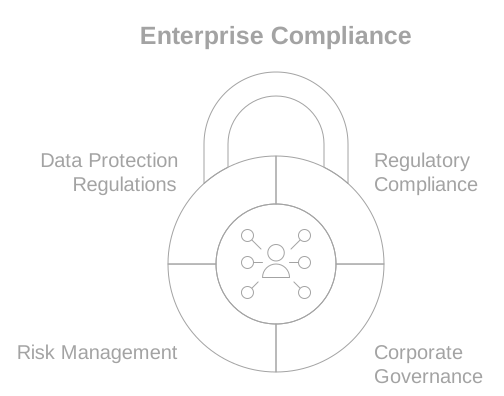
What changes when the system takes the wheel is noticeable from the first month:
- Zero re-entry: information goes in once and flows to the invoice, the journal entry, and the filing without being retyped.
- Always-current rules: when the SAT changes a catalog or a validation, the platform adapts and you don’t have to study the fine print.
- Full traceability: every movement is logged with a date and backup, so a clarification stops being a blind search.
- Alerts before the deadline: due dates are monitored automatically and warn you ahead of time, not at eleven at night on the last day.
“In this world nothing is certain except death and taxes.” The line attributed to Benjamin Franklin still holds: taxes aren’t going anywhere, but the way you comply with them can stop being a headache.
CFDI 4.0 and payment complements without friction
Version 4.0 of the CFDI raised the bar considerably: the recipient’s exact legal name and tax regime, the correct postal code, a properly classified document usage, and prior validation against the SAT’s registry. A single mistyped field is enough for an invoice to be rejected or, worse, for the client to receive it wrong and send it back days later. Doing that check by hand, invoice by invoice, is unworkable when you issue dozens or hundreds a day.
A fiscal platform stamps, validates, and corrects before sending, so your documents are accepted on the first try. It verifies the recipient’s data against official sources, fills in the correct catalogs, and blocks the send if it detects an inconsistency, instead of letting you discover the error when it’s already too late. The difference between regime “601” and “626”, a postal code that no longer matches the tax address, or a misassigned CFDI usage are exactly the kind of errors the human eye lets slip at six in the evening, and that automation checks with the same rigor on invoice one and on invoice a thousand. Payment complements, which so many companies forget, are generated automatically when you record a collection, keeping the loop closed between the invoice and the money that actually came in.
It’s worth stressing why this matters so much in day-to-day operations:
- Prior recipient validation: the system confirms tax ID, name, and regime before stamping, avoiding rejections and reissues.
- Always-correct catalogs: CFDI usage, payment form, and method are assigned properly based on the type of transaction.
- No forgotten complements: when a credit invoice is collected, the payment complement is issued on its own and on time.
- Controlled cancellations: the acceptance flow and cancellation reasons are handled per current rules, with no improvising.
An invoice that’s correct on the first try doesn’t just avoid fines: it also speeds up your collections, because the client has no excuse to delay payment over a flawed document.
Electronic accounting reconciled in real time
Electronic accounting stops being a burden when every CFDI issued and received reconciles itself against your bank movements. Instead of assembling the trial balance at month’s end, against the clock and at risk of balancing by hand, you have it ready at all times, with the information already classified, tied to its document, and backed up. That continuous visibility changes your relationship with the numbers: you stop staring at the distant past and start making decisions with same-day data.
Automatic reconciliation is also one of the tasks that frees up the most time. The system matches bank deposits and charges against the corresponding invoices, flags what doesn’t line up, and presents it for review, instead of forcing you to check everything. The routine resolves itself; the exceptions, which is where a person truly adds value, are flagged for human attention. The shift is cultural too: the accountant stops being the person who fights fires at month’s end and becomes an advisor who interprets fresh numbers, while leadership plans against reality instead of an old snapshot.
In practice, living accounting translates into very concrete benefits:
- Faster closes: the trial balance is built on the fly, so the monthly close goes from days to hours.
- Continuous bank reconciliation: each movement is matched to its CFDI almost in real time, and discrepancies surface immediately.
- Automatic classification: expenses and income are sorted by account and category without manual intervention.
- Reports ready for your accountant: information comes out structured and exportable, ready for review or audit.
“What gets measured gets improved.” The idea, popularized from Peter Drucker’s work on management, applies fully to finance: with up-to-date numbers, improving stops being a hunch and becomes an informed decision.
Protection against the 69-B list and other official lists
Doing business with a supplier on the SAT’s 69-B list can invalidate your deductions and drag you into an uncomfortable review, even if your operation was legitimate. The risk is silent: a supplier can land on the list after you’ve already bought from them, and if no one is watching, you find out when the damage is done. Checking official lists by hand, one by one, is impractical and almost never happens.
Fiscal technology automatically cross-checks your suppliers against the SAT’s official lists and alerts you in real time before the risk materializes. That permanent monitoring turns compliance into something preventive: instead of reacting to a letter from the authority, you act first, stopping a questionable transaction or gathering the documentation that proves the operation was real. It’s the difference between fighting fires and keeping them from starting.
This is neither theoretical nor marginal. The SAT regularly publishes and updates the roster of taxpayers that issued documents without the assets, staff, or infrastructure to deliver the service they invoiced. If one of your suppliers shows up there, the burden of proving the operation was real falls on you, and gathering that evidence months later, sometimes without even knowing you are in the crosshairs, is exactly what makes automatic, permanent monitoring so valuable.

The defenses worth keeping active, and that a good platform automates, are clear:
- Automatic 69-B cross-check: every supplier is reviewed against the definitive and presumed lists on a recurring basis.
- Real-time alerts: if a supplier appears on a list, you get the notice immediately, not at the next audit.
- Validation of received documents: expense CFDIs are verified as valid and properly issued before you deduct them.
- Materiality support: the system helps you keep the evidence that proves the transaction actually took place.
Preventing a problem with a supplier on the 69-B list isn’t paranoia: it’s protecting legitimate deductions and shielding the company from contingencies that can cost far more than any system.
Security and safekeeping of fiscal data
Fiscal data is among the most sensitive information a company handles: it holds your clients, your suppliers, your margins, and your digital seals. That’s why automating compliance without safeguarding security would just swap one problem for another. A serious platform treats fiscal data for what it is, a critical asset, and protects it with the same rigor the SAT demands for compliance.
The Digital Seal Certificate deserves a separate mention. It is, in practice, the signature with which your company stamps every invoice, and whoever controls it can issue documents in your name. Safeguarding it with encryption, restricted access, and usage logging is not a technical whim: it’s keeping a careless slip from turning into bogus invoices issued under your identity. Here cybersecurity stops being an IT topic and becomes part of compliance itself.
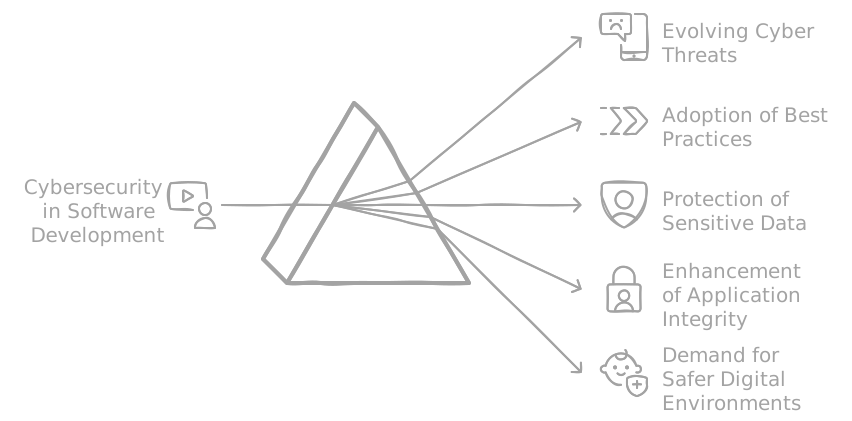
The controls that set a trustworthy fiscal solution apart are concrete:
- End-to-end encryption: data travels and is stored encrypted, so improper access doesn’t translate into readable information.
- Digital seal safekeeping: the certificate is stored protected, with audited usage and never exposed to anyone who shouldn’t operate it.
- Role-based access control: each person sees and does only what their function requires, shrinking the surface for error and abuse.
- Backups and continuity: fiscal information is backed up regularly, ready for an audit or to be restored after any incident.
Complying and protecting are not competing goals: well designed, they are the same thing. A fiscal operation that is both timely and secure is what truly lets the business owner sleep at night.
Data that serves decisions, not just the SAT
All this automation produces an asset many companies waste: clean, structured, up-to-date fiscal data. When invoicing, accounting, and compliance live on the same platform, you stop having information scattered across emails, PDFs, and spreadsheets, and start having a single source of truth about what comes in, what goes out, and what you owe. That orderly base is what later lets you analyze, forecast, and, when needed, integrate with the rest of the company’s systems.
From there, fiscal technology connects to the rest of your operation. A well-built solution exposes that data to your ERP, your point of sale, or control dashboards, so finance, sales, and leadership all look at the same figures. This is exactly where custom software makes the difference: instead of forcing your business to fit into a rigid product, it adapts to your processes, your margins, and your way of operating, with the cybersecurity and scalability needed to grow without rebuilding everything. With that clean history you can even project your tax burden for the coming months and plan accordingly: what is a requirement for the authority becomes, for you, a financial dashboard.
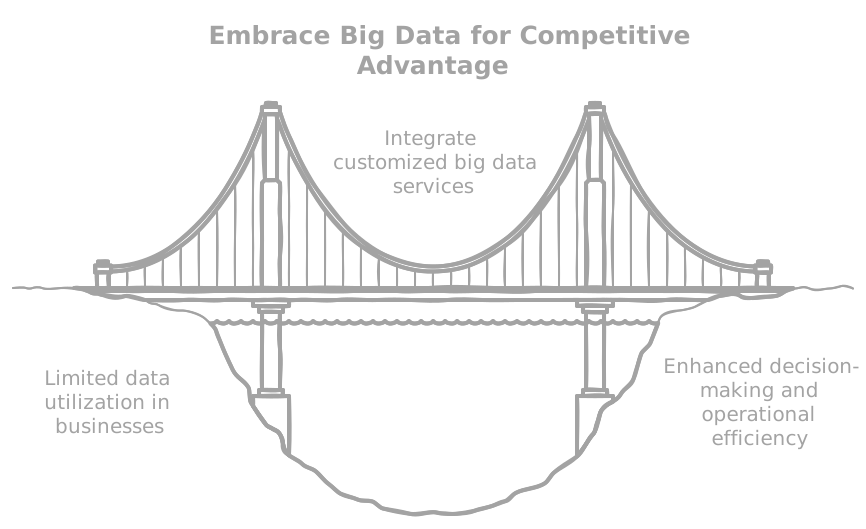
What you gain when fiscal data works for the business is tangible:
- A single source of truth: invoicing, accounting, and compliance aligned, with no versions that contradict each other.
- Decisions on fresh data: margins, cash flow, and tax burden visible to plan ahead, not to regret later.
- Integration with your systems: connection to ERP, banking, or dashboards through secure interfaces.
- Friction-free scale: the same flow handles ten invoices or ten thousand, without reworking the process.
According to the OECD, digitalizing tax administration is one of the great levers for improving compliance and reducing the burden on taxpayers. Mexico has been a pioneer in electronic invoicing, and the companies that leverage that infrastructure run with an advantage.
In short
Fiscal technology doesn’t just keep you compliant: it gives you back time, lowers risk, and gives you certainty about your numbers. Automating the CFDI, reconciling accounting in real time, monitoring the 69-B list, safeguarding your information, and keeping data always ready turns one of the most dreaded functions in any Mexican company into a concrete operational advantage. Compliance stops being a race against the clock and becomes a quiet routine that simply works.
At LabWeb we build fiscal solutions designed for Mexico’s reality, CFDI, electronic accounting, and SAT compliance, integrated with your operation and built to grow with you. If your team is still chasing paperwork instead of growing the business, that’s exactly the problem we like to solve.
Full-Cycle Fiscal Technology Expertise
LabWeb's full-cycle expertise guides businesses from initial analysis to comprehensive support and maintenance. We cover each stage to ensure seamless implementation, efficient operation, and optimal outcomes for fiscal projects.
Plan Your Success Strategy
We analyze your obligations before the SAT and the fiscal calendar before proposing a solution. In tax work, deadlines define the scope.
We map your invoicing, reconciliation, and filing processes. What gets automated first is what carries the most penalty risk.
We set clear compliance, traceability, and audit criteria. Fiscal certainty is the goal.
Crafting a Robust Blueprint
We design flows aligned with CFDI 4.0, payment complements, and electronic accounting. The design respects the rules.
We model integration with the SAT, your ERP, and your accounting systems. Validation against the authority is considered from the start.
We validate critical journeys, stamping, reconciliation, 69-B, with prototypes before building.
Turn Ideas into Reality
We build the core with automatic validation against SAT rules and full traceability. A badly issued CFDI is prevented, not fixed later.
We integrate stamping, bank reconciliation, and blacklist alerts early. Compliance is tested in every increment.
We iterate to adjust the solution as fiscal provisions change.
Ensure Flawless Performance
We test every calculation, filing, and document against real fiscal scenarios. An error here costs fines or rejected deductions.
We validate real-time reconciliation and data integrity against what's stored at the SAT. Accuracy is demonstrated.
Every finding is reproduced, fixed, and verified with traceability for audit.
Stay Ahead with Updates
We evolve the solution every time the SAT changes rules, CFDI versions, or deadlines. Tax work changes often.
We prioritize improvements by compliance risk and administrative time saved. The critical comes first.
Each update preserves conformance and the integrity of your records.
Seamless Integration Guaranteed
We plan a deployment that doesn't interrupt your invoicing or filing cycles. Fiscal operations don't stop.
We migrate your fiscal history with thorough checks. Precision protects your deductions.
After deployment we confirm stamping, reconciliation, and compliance live.
Continuous Support, Uninterrupted Operations
We provide ongoing support attentive to the fiscal calendar and regulatory changes. Compliance is sustained month by month.
Proactive maintenance updates the solution before a SAT change catches you off guard.
We resolve incidents quickly so you never miss a deadline or a deduction.
Let's Get In Touch!
Send us a message, and we'll promptly discuss your project with you.
What's Next?
- We start by signing an NDA to ensure your ideas are protected.
- Then, our team will analyze your requirements.
- You get a detailed project outline.
- We bring your project to life, so you can focus on growing your business.
© 2019–2026 LabWeb · Laboratorio Internacional Web S.A. de C.V. · All rights reserved.