

A landing page has one job: turn the visitor into action. A high-converting landing page is clear, fast, and focused on a single goal, with a value proposition obvious at first glance and trust signals that reduce friction. It’s not a brochure or a catch-all page; it’s a focused design decision. In an increasingly competitive digital landscape, that precision is no longer a luxury but a necessity: the page is often the first and only contact between your product and someone who does not know you yet. A good landing page is measured not by how pretty it looks but by how well it converts. These are the essential principles that separate it from pages that merely look good:
- A clear value proposition at first glance.
- One goal and one call to action.
- A simple design that guides instead of distracting.
- Speed and mobile design, no excuses.
- Trust that reduces friction and continuous improvement with data.
Understand your audience before writing a single line
The foundation of any high-converting landing page is understanding who you are talking to. Who are they? What concrete problem brought them here? Tailoring content and design to that person matters more than any visual trick. As marketing expert Jay Abraham often says, people do not buy products, they buy solutions to their problems. That simple idea changes how you write: instead of boasting features, you describe the outcome the visitor is looking for, in their own words and from their own starting point.
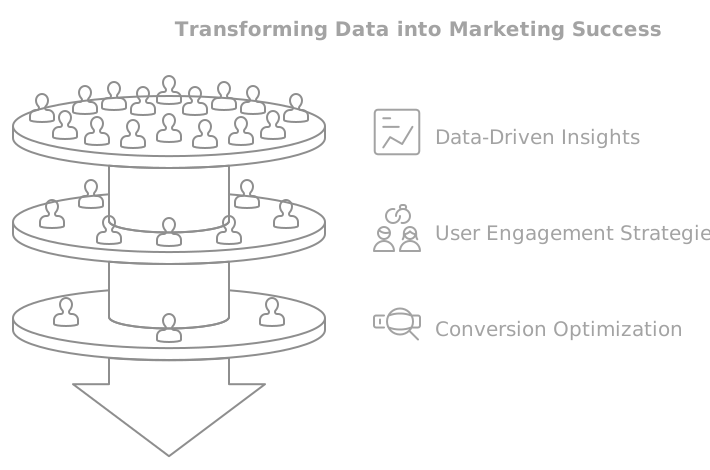
To get there, it pays to research before you design. Analytics tools and behavioral signals tell you where people come from, what they search for, and where they drop off. With that data you can segment and speak to each group in its own language, instead of pushing a generic message that resonates with no one in particular.
- Behavioral segmentation: look at how visitors interacted with previous campaigns or content and adjust the offer to match their real intent.
- Demographic segmentation: use age, location, or context to build messages aligned with each group’s priorities.
- Pain point mapping: identify the dominant problem for each segment and present it next to the solution, so the visitor feels the page was written for them.
- Customer language: collect the real phrases your audience uses in surveys, reviews, or support, and hand them back in the headline.
Understanding your audience does more than lift immediate conversion: it builds the foundation every other decision on the page rests on. When you know who you are addressing, every word, image, and button starts pulling in the same direction, and that coherence is what the visitor senses, even when they cannot name it.
A clear value proposition and a single call to action
In the first few seconds, the visitor must understand what you offer and why it’s worth it. A direct headline, a supporting subhead, and a concrete benefit carry more weight than any grand adjective. If they have to guess, you’ve already lost them. That early clarity is what holds everything else up: a page can look beautiful, but if the visitor cannot tell in five seconds what they gain, they leave. The value proposition is not a clever slogan, it is the honest answer to a very simple question: why should I stay here instead of closing the tab?

The second pillar is the call to action. The CTA is the backbone of conversion: it not only tells people what to do next, it motivates them to do it. The button copy, its placement, and its visual contrast all matter, because every detail adds or subtracts. Instead of a generic “Submit,” a direct command that describes the outcome works better, such as “Get my free guide” or “Start my trial.” And it pays to keep a single goal per page: multiplying buttons and links scatters attention and dilutes conversion. Every extra option you offer is one more decision you ask of the visitor, and every decision is a chance for them to hesitate.
- Clarity above all: the button should say exactly what happens on click, with no ambiguity or jargon.
- Strategic placement: put the primary CTA where it is visible without scrolling, and repeat it at the end of each block that delivers value.
- Contrast and breathing room: use a color that stands out from the rest and leave space around the button so the eye finds it effortlessly.
- One single goal: define the primary action, make it obvious, and avoid offering alternative paths that compete with it.
A good CTA is like a digital handshake: it guides the visitor toward conversion and, along the way, reinforces their decision to stay. When the value proposition and the call to action work together, the page stops informing and starts converting.
Keep the design simple and let every element breathe
In an age when users are flooded with information from every side, a cluttered page creates confusion, and confusion costs conversions. It helps to think of the landing page as a clean canvas: the goal is to guide the eye, not overwhelm it. Simplicity is not the absence of content, it is the absence of noise. Every element that does not push toward conversion is an element that gets in its way, however nice it may look on its own.

White space is a design tool, not wasted room. Used well, it directs attention to what matters and makes the whole feel orderly and professional. The same goes for copy: concise headlines and benefit lists communicate faster than paragraphs full of technical terms. A single glance should be enough to grasp the offer, without reading line by line. Visual hierarchy, achieved through size, contrast, and position, does the work of telling the eye what to look at first and what to look at next.
- Focused navigation: avoid menus that lead to other pages; the only path should point to the CTA. If the visitor does not know where to go, they leave.
- Content to the point: prioritize quality over quantity, with clear headings and concrete benefits instead of dense blocks of text.
- Intentional white space: use the air around key elements to improve comprehension and create visual hierarchy.
- One idea per section: let each block carry a single message, so the visitor moves forward without feeling overwhelmed.
“Simplicity is the ultimate sophistication.” The phrase, attributed to Leonardo da Vinci, captures the spirit of an effective landing page well: fewer elements, better focused, almost always convert more than a page that tries to say everything at once.
Speed, mobile design, and visuals that add value
Most of your visitors arrive on a phone, and every second of load time costs conversions. A fast, lightweight landing page designed for small screens isn’t a luxury: it’s the foundation everything else is built on. According to data from Google, the probability of a bounce rises sharply as the page takes longer to load, and a visitor who leaves because of slowness rarely comes back. The best headline in the world is useless if the page takes so long that no one stays to read it.
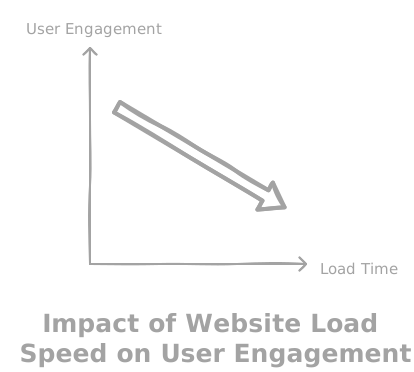
Mobile optimization starts with the technical side: fluid layouts that adapt to any screen, images that scale without losing sharpness, and a properly configured viewport tag. The MDN documentation explains how that tag tells the browser to fit the page to the device’s real width, a small detail that spares the user from pinching to zoom just to read. But speed is also a matter of judgment: on a small screen, every extra click is a chance to abandon. Large buttons, easy to tap with a thumb, and a flow that reaches the CTA with the least effort possible make the difference between a visit that converts and one that gives up in frustration.
Visuals deserve the same care. A well-chosen image communicates in an instant what a paragraph would take to explain, but only if it supports the message instead of competing with it.
- Weight under control: compress images and avoid heavy graphics that drag down load times.
- Test on real devices: emulators help, but nothing replaces checking the page on different phones and browsers.
- Purposeful visuals: use quality images or video that show the product in action, brief and relevant, without crowding the screen.
- Visual hierarchy: guide the eye with size, contrast, and position toward the most important element, which is almost always the CTA.
Speed and visual clarity are not cosmetic details: they are part of the message. A page that loads fast and looks flawless on any device signals, without saying it, that a serious team stands behind it. And that care for performance connects to something deeper: scalability, because a solid technical base is what holds up when a campaign works and traffic multiplies overnight.
Trust that reduces friction and continuous improvement with data
Testimonials, client logos, guarantees, and security signals answer the visitor’s silent question: “can I trust this?” In a world full of options, people look for validation before deciding, and social proof acts as a beacon guiding them toward conversion. Combined with a short form that asks only for what’s necessary, trust removes the doubts that stall action. Every extra field on a form is a small barrier, and sometimes one too many is enough to make the visitor think twice.
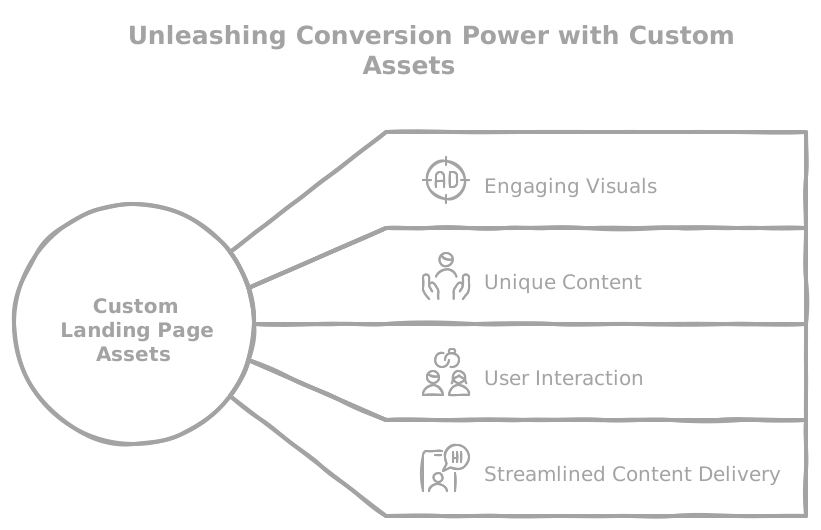
There are several ways to build that trust, and it pays to combine them. Real testimonials lend immediate credibility; case studies let the visitor picture their own result; security badges reassure anyone about to share data. Cybersecurity stops being a purely technical concern and becomes part of conversion: a visible lock and responsible handling of information reduce friction as much as a strong headline does. Showing that you treat data seriously is not a legal formality, it is a promise the visitor senses before typing their email.
- Testimonials and case studies: show short quotes from satisfied customers and before-and-after narratives that make the benefit tangible.
- Security signals: certificates, locks, and clear policies ease the anxiety of sharing information.
- Awards and mentions: industry recognition or press appearances reinforce the sense of credibility.
- Minimal form: ask only for the data you genuinely need at this step and leave the rest for later.
Once trust is built, the part that never ends remains: improving with data. A/B testing is the tool for that. It means showing two versions of the page and letting real behavior decide which one converts better. The key is to change a single element at a time (a headline, a button color, an image) so you can tell with certainty what moved the needle. It also pays to look beyond the conversion rate: time on page and the exact point where people leave tell a story that a single number hides.
“A/B testing is not just about what works; it’s about understanding why it works.” That mindset, more than any isolated trick, is what sustains continuous improvement: every experiment leaves a lesson that makes the page a little more effective than it was yesterday.
In short
A high-converting landing page is clear, fast, and focused on a single action: it knows its audience, proposes an obvious value, guides with a single CTA, respects the visitor’s time and device, builds trust, and improves with data. None of these principles is decorative; all of them push toward the same goal. When they work together, the page stops being a brochure and becomes a growth tool that works for you around the clock.
At LabWeb we design landing pages from strategy and performance, not just aesthetics. We combine custom software, solid UX practices, and attention to speed and security so every visit has the best chance to convert. If you want a page built to grow, we are exactly the kind of partner that builds it.