
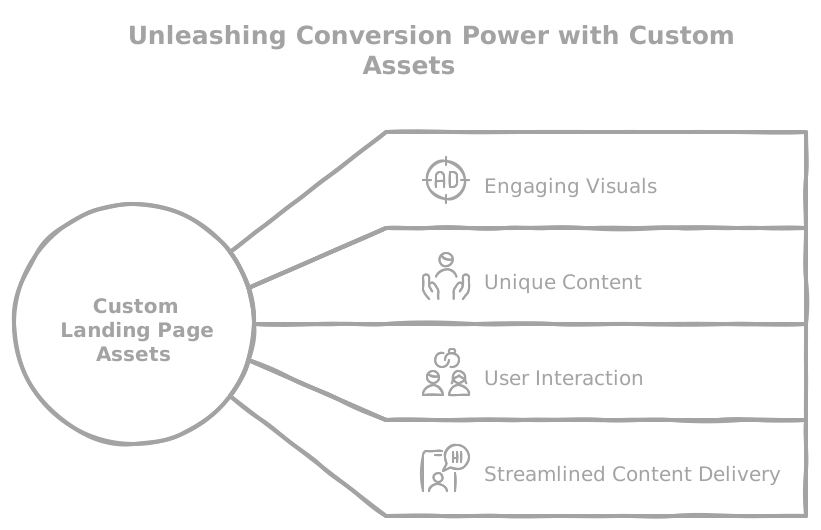
Stock imagery is convenient, but it’s also invisible. The same smiling portrait shows up on hundreds of sites, and the visitor senses it, without quite knowing why, as something generic. Online, first impressions are made within seconds, and in that instant your landing decides whether it conveys a real brand or just another template. Custom visual assets tell a different story: yours. They don’t merely decorate the page, they turn it into a sales argument that guides the eye, reinforces the message, and pushes the visitor toward action.
Before we dig in, it helps to be clear about what you gain when you invest in original visuals instead of stock:
- Trust, because authenticity shows and lowers initial doubt.
- Differentiation, because an original visual system makes you recognizable.
- Guided conversion, because every element steers the user toward the CTA.
- Strategic integration, because coordinated assets reinforce a single message.
- Performance, because customizing well does not mean a slower page.
Trust born from authenticity
An original illustration, a real photo of your team, or an icon designed for your product all signal that there’s a real company behind the page, not an anonymous download. That sense of authenticity reduces the distrust that stalls a visitor before the click. People buy from brands they perceive as real, and visuals are the first proof of that reality. When an asset feels made on purpose for you, the implicit message is clear: someone here took the time to care about the details.
That perception isn’t an aesthetic whim, it carries weight in the buying decision. Usability studies consistently find that a large share of users judge a business’s credibility from its website design before reading a single line of text. If the first glance projects effort and coherence, the visitor lowers their guard and stays to explore. If it projects template, doubt creeps in and the click drifts away. Trust, in practice, is built or lost in that first visual second.

The elements that reinforce that trust most are usually the simplest to get right:
- Coherent identity: colors, typography, and illustrations repeated across the page create a solid, professional sense of brand.
- Real proof: authentic photos of the team, product, or process land harder than any flawless but impersonal stock portrait.
- Intentional detail: an icon designed for your product communicates care, and care translates into credibility.
- Message consistency: when the visual and the copy point to the same place, the whole feels trustworthy and deliberate.
“Design is not just what it looks like and feels like. Design is how it works.” Steve Jobs said it, and it captures why a good custom asset works in favor of conversion, not just aesthetics.
Differentiation in a crowded market
When your competitors pull from the same stock catalog, looking like them is the worst thing that can happen. A custom visual system (colors, shapes, illustrations) makes your landing instantly recognizable and memorable afterward. Differentiation isn’t design vanity, it’s what makes people remember you when the moment to decide arrives. In a market where dozens of options compete for the same attention, looking distinct stops being a luxury and becomes a tool for survival.
Visual consistency also has a measurable effect on the business. Keeping a coherent identity across every touchpoint reinforces brand recognition and, according to several industry analyses, can translate into higher revenue. The logic is simple: a brand that always looks the same is remembered better, and a brand that is remembered better wins the battle for the customer’s mind when the moment to choose arrives. That memory is, in the end, what separates the obvious option from the one lost in the noise.
To build that difference with custom assets, a few fronts are worth tending:
- System, not loose pieces: a palette, an illustration style, and consistent typography are worth more than one brilliant isolated visual.
- A voice of your own: the visual tone should reflect who you are, not imitate the competitor leading the list.
- Instant recognition: the goal is that someone identifies your brand even without seeing the logo.
- Memorability: an original visual lingers in the visitor’s head long after the tab is closed.
Visuals that guide conversion
A good custom asset doesn’t just decorate, it directs the eye. An illustration can point to the CTA, explain a complex benefit at a glance, or reinforce the headline’s message without adding text. Designed with intent, visuals become part of the sales argument, not filler between paragraphs. The brain processes images far faster than text, so a well-placed visual communicates before the user even starts reading, and that head start of milliseconds decides whether they stay or leave.
The key is intent. A custom asset can be designed to create visual hierarchy, carry the eye from the headline to the button, and ease the cognitive load of explaining something abstract. A personalized call to action, well integrated into the design, performs far better than a generic button lost on the page, and the visuals around it are what put it center stage. When every element pushes in the same direction, the page stops being a brochure and becomes a path.

For your visuals to work in favor of conversion, it pays to design them with these criteria:
- Clear hierarchy: the visual should carry the eye toward what matters, not compete with it.
- Explain without text: an illustration can sum up a complex benefit that three paragraphs fail to convey.
- CTA reinforcement: shapes, arrows, and composition can subtly point toward the button.
- Lower mental load: a good graphic reduces the effort of understanding and keeps the visitor moving forward.
“A user interface is like a joke. If you have to explain it, it’s not that good.” The line, popular among designers, is a reminder that the best visual is the one that explains itself.
Strategic integration of your assets
A brilliant visual in isolation does little if it clashes with the rest of the page. The real advantage shows up when custom assets are integrated as a system: colors, typography, illustrations, and composition all work together toward one goal. Thinking of the landing as an orchestra, where each instrument plays its part without drowning out the others, is what separates a page that looks good from one that genuinely converts. Coherence is not a cosmetic detail, it is the structure that holds trust together and guides the decision.
That integration also orders the visitor’s path. When the headline, the main image, and the button share the same visual language, the eye moves without friction from the promise to the action, and each element confirms the previous one instead of contradicting it. A page built this way reduces doubt at every step, because everything the user sees points in the same direction. The result is a clear path, not a collage of pieces competing with each other for attention.

To integrate your assets with strategic intent, a few fronts are worth tending:
- Consistent message: aligned colors, typography, and imagery reinforce a single idea instead of diluting it into mixed signals.
- Accumulated trust: every well-integrated element adds credibility, and credibility is what carries the visitor all the way to the click.
- Frictionless journey: the composition should carry the eye from the headline to the benefit and from the benefit to the button, without jumps or detours.
- Evidence-based iteration: a modular system lets you adjust pieces and measure the effect, refining the page with data instead of hunches.
Adapting the experience to each visitor
Not every visitor arrives the same way, and custom assets let you respond to that diversity. A landing can adjust its message and its visuals based on traffic source, segment, or the campaign that brought the user in, presenting the most relevant argument in each case. That adaptation isn’t a trick: it’s the difference between speaking to everyone in general and speaking to someone in particular, and the latter always converts better.
Personalization done well raises relevance, and relevance raises conversion. When content feels made for the person looking at it, the visitor senses that the brand understands their need, and that perception shortens the road to a decision. Here custom assets are irreplaceable: a coherent, modular visual library lets you assemble variants for different audiences without rebuilding the page from scratch, and without breaking the identity that takes so much effort to build.
Some concrete ways to take advantage of that flexibility:
- Intent-based segmentation: show different visuals and messages depending on what the user came to find.
- Campaign variants: align the landing with the ad that brought the visitor in, so the promise doesn’t break.
- Continuous A/B testing: compare versions with different visuals and keep the one that converts best.
- Data-driven refinement: watch how people interact with each asset and improve from evidence, not intuition.
Performance is non-negotiable
Customizing doesn’t mean adding weight. An optimized SVG, vector illustrations, and modern formats keep the page light and fast, something both visitors and search engines reward. Beauty that takes forever to load doesn’t convert, the balance between visual identity and speed is where the game is won. A well-built custom asset usually weighs less than a high-resolution stock photo, so customization, far from being a burden, can make your landing faster.
Speed matters because user patience is minimal. Every extra second of load time raises abandonment and eats your conversions before the content even appears. That’s why a good custom asset is built with performance in mind from the start: vectors that scale without losing sharpness, clean files, and a controlled weight that doesn’t punish the experience on mobile or on slow connections. The goal isn’t to choose between looking good and loading fast, but to achieve both at once.
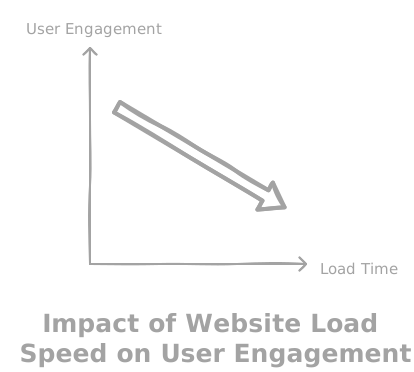
For performance to keep pace with design, these points are worth tending:
- Vector formats: an SVG scales to any size with minimal weight and perfect sharpness.
- Optimized files: cleaning and compressing assets avoids kilobytes no one needs to load.
- Mobile first: what looks and loads well on a phone defines the majority of visits today.
- Conscious balance: every visual should justify its weight with the value it adds to conversion.
According to Google’s web.dev, improvements in load speed have a direct, measurable impact on conversion and user retention.
In short
Custom assets turn a generic landing into an experience that conveys trust, distinguishes your brand, guides the visitor, and loads fast on top of it. They aren’t an ornament: they’re a strategic piece that works in favor of every conversion, from the first visual second to the final click on the button. When design, message, and performance push in the same direction, the page stops competing for attention and starts winning it.
At LabWeb we design every visual with conversion and performance in mind, embedding custom assets inside custom software and landing pages built to scale. If you want your landing not just to look different but to perform better, we’re the kind of partner that turns design into results.