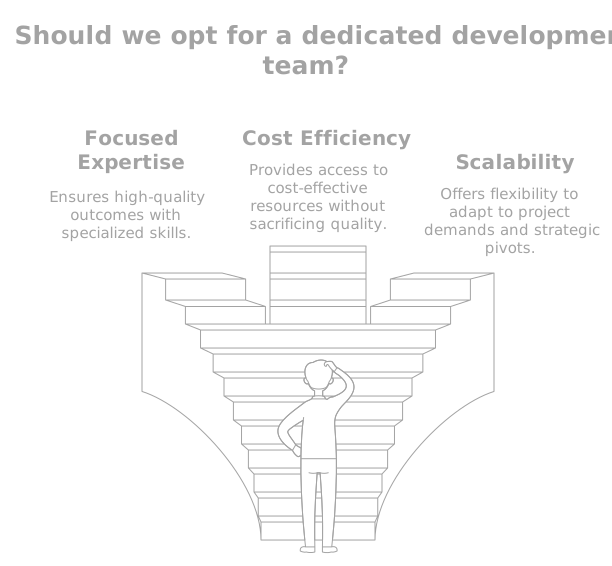
When a digital product stops being an experiment and becomes central to the business, how you build it matters as much as what you build. A dedicated development team makes the difference compared to hiring per project or stitching together loose freelancers because it gives you continuity, focus, and sustained speed. This is not simply about “more hands”: it is about a group of people who know your product deeply, treat your priorities as their own, and stay with you long enough to build it well. Specifically, a dedicated team delivers:
- Knowledge that stays: your product’s context doesn’t leave with every vendor.
- Real focus: it treats your priorities as its own, not split across clients.
- Flexibility to scale: add or refocus roles without starting from scratch.
- Predictable costs: a clear structure, with no renegotiating every change.
Throughout this article we unpack each of these advantages and look at why, for a product that matters, this model tends to beat the more traditional alternatives.
The knowledge stays in-house
A dedicated team accumulates context: it understands your product, your users, and the decisions that got you here. That knowledge, lost every time you rotate project-based vendors, is exactly what lets you iterate fast and avoid rebuilding the same thing over and over. Every line of code carries a history of why that path was chosen, what was tried before, and which business constraints shaped it. When that history lives in the team’s head, the next decisions are faster and sharper.
The difference shows up most in the hard moments. A strange production bug, an integration that breaks, a last-minute regulatory change: in those cases, a team that already knows the terrain responds in hours, while a new vendor needs days just to figure out where to start. That shared memory is a quiet asset that rarely appears in a quote, yet it defines the real speed at which your product evolves.
For that knowledge to be an asset rather than a fragile dependency, a few concrete habits are worth keeping:
- Living documentation: architecture decisions, assumptions, and technical debt recorded, not just stored in one person’s memory.
- Long-term relationship: continuity reduces onboarding time and multiplies the value of every lesson learned.
- Orderly handover: when someone joins or leaves the team, context is passed on deliberately rather than evaporating.
- Closeness to the business: the team understands not just the code, but why the product exists and who it serves.
“Quality is never an accident; it is always the result of intelligent effort.” This idea, attributed to John Ruskin, captures why a stable team tends to produce better software than a succession of interchangeable vendors.
Focus and alignment with your business
Unlike a vendor splitting attention across many clients, a dedicated team treats your priorities as its own. That alignment shows up in communication, in the quality of technical decisions, and in a willingness to optimize for the long term, not just to ship a deliverable. When the team is not racing from one project to another, it can stop to think about architecture, user experience, and the consequences of each choice six months down the line.
Focus also changes the communication dynamic. Instead of intermediaries and interdepartmental email chains, you talk directly to the people building the product. Decisions get made faster, misunderstandings shrink, and feedback flows in both directions. That direct conversation, nearly impossible in fragmented models, is one of the factors that accelerates a product the most without anyone writing a single extra line of code.
Some ways that focus translates into concrete results:
- Faster decisions: with no middle layers, what used to take weeks gets resolved in a single conversation.
- Sustained quality: the team applies good practices (code review, testing, continuous integration) consistently.
- Commitment to the outcome: the success of the product and of the team move together, not in opposite directions.
- Less friction: accumulated trust removes constant renegotiation and frees everyone to focus on progress.
It is worth remembering that focus is not imposed by a contract, it is cultivated through a relationship. A team that feels part of the project proposes, questions, and improves; one that only fulfills a scope limits itself to delivering what was asked, even when it knows there is a better way.
Flexibility to scale without rigidity
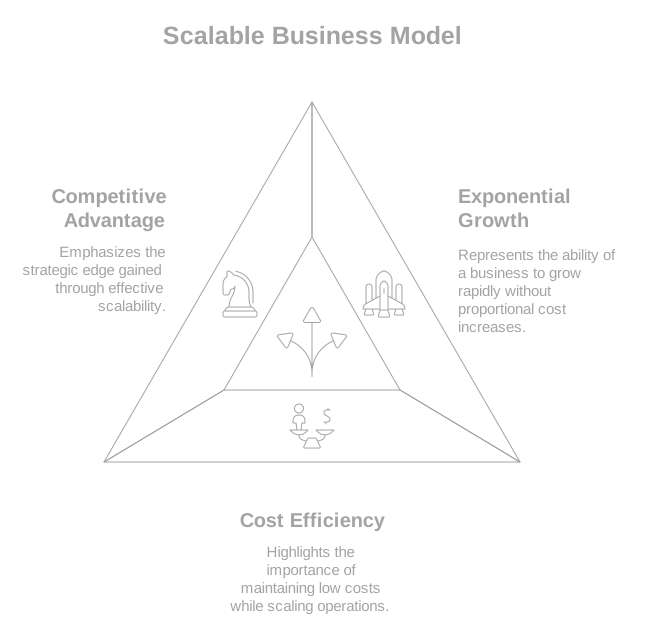
Needs change: sometimes you need to accelerate, sometimes to sustain. A dedicated team adjusts, adding or refocusing roles, without the cost and time of assembling everything from scratch each time. You gain responsiveness without the rigidity of internal hiring, which means long recruitment processes, permanent contracts, and a structure that is hard to reshape when the context shifts.
That elasticity is especially valuable for products that grow in stages. At launch you may need more frontend profiles; as the product matures, the weight moves toward data, infrastructure, or security. A well-managed dedicated team rebalances that mix without losing the context it has accumulated, which is what separates real scalability from simply “hiring more people”. Technical capacity adjusts to business demand, not the other way around.
Flexibility done right rests on a few principles:
- Profiles by stage: the team adds specialists when the product calls for them and reorients them when the priority changes.
- Scaling without losing memory: growing does not mean starting over, but building on a base that already knows the terrain.
- Capacity on demand: you gain muscle when you need to accelerate and release it when it is time to consolidate.
- Less structural risk: you adjust the investment without the weight of permanent commitments that are hard to reverse.
“Great things in business are never done by one person; they are done by a team of people.” The line is Steve Jobs’, and it captures an uncomfortable truth: however brilliant an individual is, the products that last are the work of teams that grow together.
Predictable costs, no surprises
The project-based model tends to hide costs: every change is renegotiated and every surprise is re-quoted. A dedicated team offers a clear, predictable structure, where the budget goes toward making progress rather than managing contracts. You know how much your development capacity costs each month, which makes financial planning far simpler and removes those unexpected invoices that show up like unwelcome guests at a party.
Predictability, however, is not only about spending less, but about spending better. When the cost is stable, conversations stop revolving around “how much is this change worth” and start revolving around “what should we build next”. That shift in focus frees up energy for product strategy and removes a hidden cost that is rarely measured: the wear of negotiating every adjustment.
It pays to look at total cost, not just the hourly rate:
- Stable budget: a clear monthly structure makes it easier to plan and commit resources ahead of time.
- No costly rework: accumulated context avoids redoing what a new vendor would have to relearn.
- Investment, not scattered spend: the money concentrates on building product, not on managing contracts and renegotiations.
- Long-term return: the team’s sustained productivity more than pays back the upfront investment in getting to know and consolidate it.
The well-known management principle warns that what gets measured gets managed; in development, measuring total cost (and not just the visible rate) tends to reveal that continuity is cheaper than it looks.
The nearshore model and Mexican talent
An important part of this conversation is where that dedicated team actually lives. The nearshore model, meaning working with a team in a nearby country with a compatible time zone, has resolved many of the frictions of distant outsourcing. Instead of coordinating across twelve hours of difference, work moves forward in real time, with fewer misunderstandings and faster decisions. For companies in North America, Mexico has become one of the most balanced options across cost, quality, and proximity.
The case is not just geographic. Mexico graduates more than a hundred thousand engineers a year and has a technical community used to collaborating with global clients, under high standards and in English when needed. On top of that base there is a cultural and time-zone affinity that makes collaboration flow: live meetings, same-day answers, and a shared sense of how work gets done. This is precisely the terrain where a dedicated development team finds the right people to build custom software.
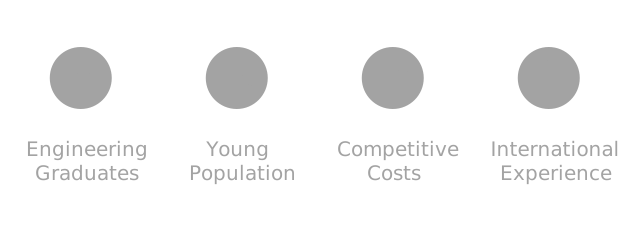
The concrete advantages of building a nearshore dedicated team from Mexico:
- Compatible time zone: collaboration happens in real time, not in offset shifts that slow everything down.
- Cultural closeness: similar business practices and ways of communicating reduce day-to-day friction.
- Abundant talent: a wide base of engineers lets you build solid teams without competing for oversaturated profiles.
- Reasonable cost: operating from Mexico stretches the budget without sacrificing product quality.
With a gross domestic product close to 1.8 trillion dollars, Mexico ranks among the fifteen largest economies in the world, according to the World Bank, a solid base from which to build and export technology.
Agility and the future of development
A dedicated team and agile methodologies reinforce each other. Working in short cycles, delivering value incrementally, and adjusting course with every lesson works better when the same group sustains the product over time. Agility stops being a set of ceremonies and becomes a way of thinking: build, measure, learn, and start again, without losing context between one iteration and the next.
That combination also explains where the industry is heading. The normalization of remote work showed that a distributed team can be as productive as a co-located one, as long as there is continuity, clear communication, and the right tools. More and more companies concentrate their energy on their core business and trust development to dedicated teams that operate as a natural extension of their operation. This is not a passing trend, it is a structural change in how software gets built.
What makes this way of working thrive comes down to a few elements:
- Constant iteration: short cycles that let you correct course before overinvesting in the wrong direction.
- Early feedback: involving the user from the start ensures you build what truly matters.
- Culture of improvement: continuous review, testing, and learning turned into practice, not slogans.
- Focus on the essential: delegating development frees the company to concentrate on its strategy and its customers.
“In an age of accelerating change, the ability to adapt quickly is the only sustainable competitive advantage.” The idea, recurrent in management literature, explains why pairing a stable team with an agile mindset proves so powerful.
In short
A dedicated team isn’t just “more hands”: it’s continuity, focus, and a relationship built to do things well over time. It keeps knowledge in-house, aligns every decision with your business, scales without rigidity, keeps costs predictable, and, when it rests on the right talent and an agile mindset, turns development into a real competitive advantage instead of a recurring expense. For a product that matters, that combination of qualities is hard to match with more fragmented models.
At LabWeb we provide dedicated teams that work as an extension of your operation, committed to your product as if it were their own. If you are building something that deserves real continuity and focus, we are exactly the kind of partner that turns that decision into product.