
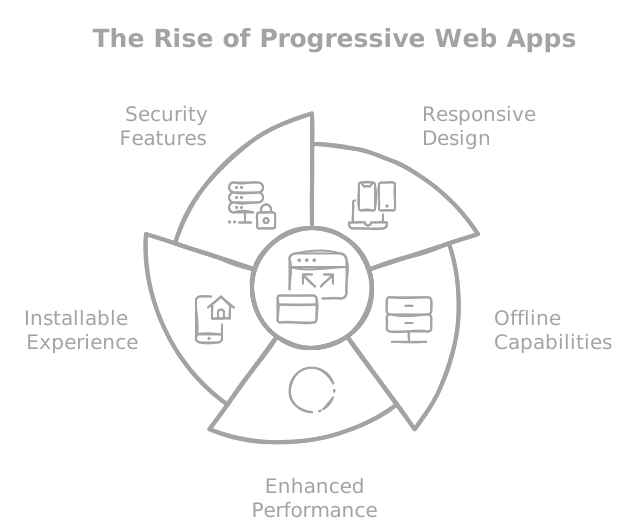
Progressive Web Apps blur the line between a website and a mobile app. They open in the browser, yet they can be installed, work offline, and send notifications, all from a single codebase. For many businesses, they deliver much of a native app’s value without its cost or friction. In a world where users expect instant speed and reliable performance, that promise explains why PWAs moved from a technical curiosity to a central piece of any serious digital strategy.
Before diving into the details, it helps to be clear about what sets a PWA apart from a traditional website:
- Responsive design. It adapts to any screen and delivers a consistent experience on phone, tablet, and desktop.
- Offline capability. Thanks to service workers, it keeps working even when the network falters or disappears.
- High performance. With good caching strategies, it loads in an instant and keeps users engaged.
- Installable experience. It is added to the home screen without going through an app store.
- Security by default. By requiring HTTPS, it offers a safer browsing environment from the very first visit.
The best of web and apps
A PWA combines the universal reach of the web with the experience of an installed application. The user adds it to their home screen with a tap, without going through a store or downloading megabytes. That closeness lowers the barrier to entry and brings your product to the user with far less resistance, exactly at the moment they decide whether it is worth staying or leaving.
The magic comes from a handful of modern web technologies working together. A service worker runs in the background and manages caching and offline availability; a manifest file tells the browser how to install the app and present it like a native one; and push notifications let you reconnect with users even when the app is closed. None of this asks the person to learn anything new: they simply open a link and the experience feels richer than an ordinary page.
That blend shows up clearly in real commerce and content scenarios. Picture an online store: the customer browses the catalog on any device, gets alerts about deals or an abandoned cart, and completes the purchase without installing anything. Those details turn casual visits into conversions.
- No install friction: users enter straight from the browser, with no downloads or waiting at a store.
- Native-like feel: smooth transitions, a dedicated icon, and full screen, without the complexity of publishing to each platform.
- Smart re-engagement: push notifications bring users back to the product at the right moment.

It works even offline
Thanks to service workers, a PWA can load instantly and keep running with intermittent or no connectivity. This is decisive in variable-network contexts, where a traditional website would simply fail. The app caches the essentials and delivers a stable experience even when the connection doesn’t cooperate, which is especially valuable in markets where mobile access dominates and signal quality changes from one neighborhood to the next.
The mechanism is simpler than it sounds. The service worker intercepts network requests and decides what to serve from the cache and what to fetch from the server. With a good strategy, the first load stores the critical assets and later visits feel almost instant. The result is a sense of immediacy that users perceive as quality, even when they have no idea about the technology behind it.
That resilience also protects the business. A momentary network drop no longer means a blank screen or a lost sale: the app keeps showing content and stores actions to sync once the connection returns.
- Instant loading: cached assets are served without waiting for the server, even on slow networks.
- Operational continuity: users keep browsing even if they lose signal for a few seconds or minutes.
- Deferred sync: pending actions are processed automatically once the connection comes back.
- Perceived reliability: an experience that never breaks builds trust and encourages users to return.
According to the MDN Web Docs, service workers let a web application deliver offline and fast-loading experiences comparable to those of a native app.
Speed: the factor that defines retention
Performance is not a luxury, it is the first filter users apply without realizing it. A page that takes too long loses its audience before it can show its value. PWAs tackle that problem at the root with smart caching, progressive loading, and optimized assets, so content appears fast and interaction feels immediate.
The data backs up that urgency. Industry research shows that the probability of abandonment grows dramatically as load time increases: going from one to three seconds raises the bounce rate noticeably. In a competitive market, those seconds are the difference between a conversion and a customer who walks away to a rival.
That is why optimizing a PWA’s performance is not a cosmetic task but a business decision. Every gain in speed translates into more users who stay, more pages viewed, and a higher chance of closing the action that matters.
- Strategic caching: serving the critical parts first speeds up the initial load and improves the perception of speed.
- Progressive loading: showing content in layers avoids empty screens and holds the user’s attention.
- Lightweight assets: optimized images and scripts reduce weight and accelerate every visit.
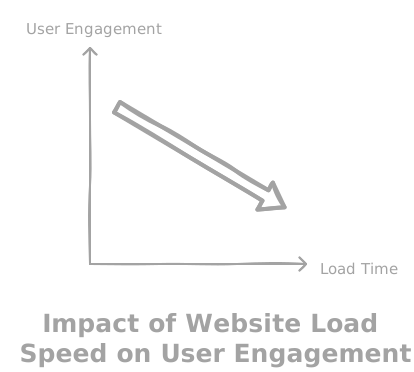
According to Think with Google, as a mobile page’s load time goes from one to three seconds, the probability of a bounce rises considerably.
A single codebase, lower cost
Built with web technologies, a PWA reaches any device with a browser from one codebase. This reduces development and maintenance costs compared to separate native apps for each platform. Updates ship instantly, with no waiting for approvals and no dependence on users downloading a new version, which shortens the cycle between having an idea and seeing it in production.
For a company, that efficiency has a direct effect on the budget. Instead of maintaining separate teams and codebases for iOS and Android, plus the web, a single project covers every front. Those savings free up resources for what truly differentiates the product: better features, better design, and more room to experiment. This is exactly where custom software development pays off most, because every dollar concentrates on one living platform.
The advantage compounds over time. Each fix, each improvement, and each new feature reaches all users at once, with no fragmented versions and no support for endless combinations of systems. For startups and growing companies, that simplicity is an ally of scalability.
- Contained cost: one team and one codebase instead of several parallel projects per platform.
- Immediate updates: changes reach everyone without passing through an app store’s approval.
- Simple maintenance: less technical surface means fewer bugs and less accumulated debt.
- Natural scalability: growing your user base does not force you to multiply the development effort.
Native or PWA: when to choose each
The comparison between native apps and PWAs usually revolves around cost, experience, and performance. Both aim to give the user something excellent, but they start from different philosophies. The native app lives inside the operating system and taps the hardware deeply; the PWA lives on the web and prioritizes reach, deployment speed, and cost. Choosing well is not about following the trend, but about understanding what your experience genuinely needs.
Native keeps clear advantages when the product demands deep device access or extreme performance: heavy games, advanced editing, intimate integrations with sensors. The PWA, in turn, has closed the gap quickly and today comfortably covers most content, commerce, booking, and tool cases, where what matters is reaching more people with less friction.
The good news is that you do not always have to decide in absolute terms. Many teams start with a PWA to validate and grow fast, and reserve native for very specific features later on. The future points toward hybrid solutions where both worlds coexist as needed.
- Cost and time: the PWA wins when launching fast on a tight budget matters most.
- Hardware access: native rules if the product depends on an advanced camera, sensors, or full GPU power.
- Distribution: the PWA avoids store friction; native leverages store visibility and payment channels.
- Updating: the PWA updates itself in the background; native depends on users downloading the new version.
“The best app is the one your users don’t even realize they’re using.” The idea, repeated across the design industry, captures why a smooth experience weighs more than the label of the technology.
The road ahead
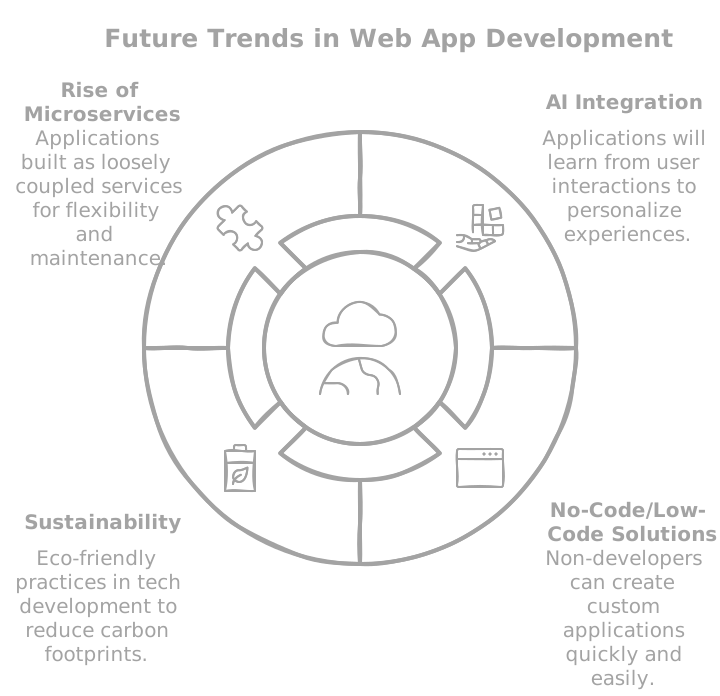
The direction of PWAs is clear and accelerating. As browsers add capabilities, the boundary between web and app grows blurrier, and features that once seemed exclusive to native, like offline work, notifications, or installation, are now common ground. For businesses, this means betting on the modern web no longer implies giving up a great experience.
In markets with high mobile penetration, where most traffic arrives from phones, that evolution is especially relevant. A well-built PWA responds to the reality of variable networks, diverse devices, and demanding users, and it does so without the barrier of a prior download. That accessibility widens reach and opens the door to audiences a traditional app would leave out.
Security comes along with that maturity. By requiring HTTPS to function, PWAs raise the protection standard by default, something increasingly valuable in an environment where cybersecurity weighs on user trust. The combination of reach, performance, and protection positions this technology as one of the soundest bets for the coming years.
- More browser capabilities: each version brings the web closer to what only native achieved before.
- Mobile-first approach: phone-centered design stops being an option and becomes the starting point.
- Baseline security: mandatory HTTPS reinforces trust with no extra effort from the user.
- Growing adoption: more and more companies migrate to PWAs after seeing measurable results in retention and conversion.
In short
PWAs offer speed, reach, and an app-like experience with a contained investment, making them ideal for many products. They blend the best of the web (universality and low cost) with the best of apps (installation, offline work, and notifications), all from a single codebase that grows with you. They are not the answer for absolutely everything, but they are for the vast majority of cases where reach and speed lead.
At LabWeb we assess whether a PWA is the right path for your case and build it with first-class performance and offline support, so you reach more users with less friction. If you want an experience that loads instantly, works on any device, and scales without multiplying costs, we are exactly the kind of partner that turns that idea into a product.
