
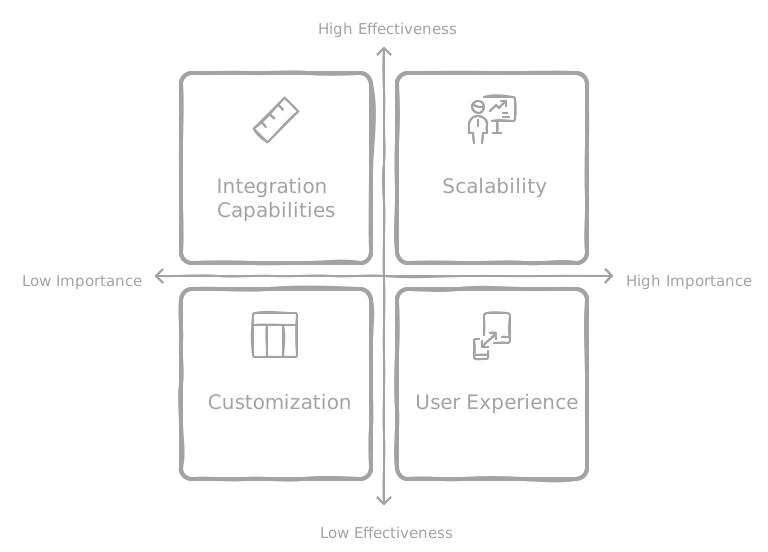
In a startup, every software decision is also a decision about time and money you can’t spare. Choosing badly, too many tools, or the wrong ones, slows you down exactly when you need speed most. The catalog of vendors promising innovative features and the magic touch to propel your business forward is overwhelming, and almost all of them sound equally convincing. The point isn’t to have the best stack on the market, but the one that solves your real problems today without mortgaging tomorrow. This guide walks through the criteria that actually matter when you choose.
Before comparing prices and screens, it helps to keep a few principles in mind that frame the whole decision:
- Understand your real need before looking at the market.
- Prioritize scalability so you don’t migrate every year.
- Care about user experience from day one.
- Demand clean integration with what you already use.
- Tell apart building custom from buying the standard.
Understanding what your startup needs
Understanding your startup’s particular needs is the cornerstone of every good software choice. Just as a ship needs a captain who knows where it’s headed, your company requires clarity about its operational requirements, business objectives, and the concrete problems of the people who will use the tool. Skipping this step is the fastest way to end up paying for features nobody uses and fighting flows that don’t fit.
Before evaluating options, it’s worth answering honestly what problem you’re solving. Looking for custom software that targets a specific operational pain is not the same as looking for a generic suite to get started. A good way to cut through the noise is to write, in a single sentence, the core function the tool must serve, and to discard anything that doesn’t contribute to it.
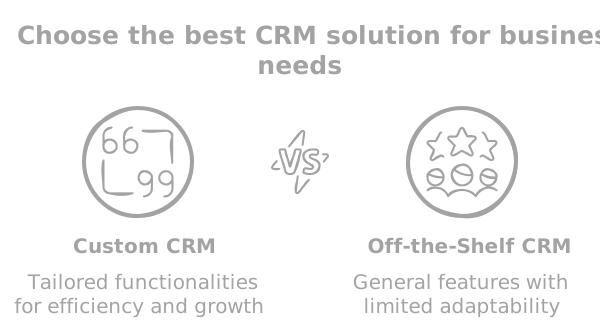
To turn that clarity into a decision, these points help frame the conversation:
- Identify the essential functions. Define what the software absolutely must handle: project management, customer relationships, analytics, billing. That short list is your compass when comparing.
- Know who will use it. An internal team, an end customer, or a supplier don’t need the same thing. Fitting the solution to the real user raises adoption more than any flashy feature.
- Size your budget realistically. More expensive doesn’t mean better. Sometimes a modular piece covers the short term better than a full suite you pay for whole and use halfway.
- Think about growth. Ask whether the tool leaves room to scale, or whether a year from now it will force a painful migration.
“The best way to predict the future is to create it.” The line, attributed to Peter Drucker, captures the point well: understanding your need isn’t ticking a feature list, it’s laying the foundation of your growth strategy.
Build or buy: the first big decision
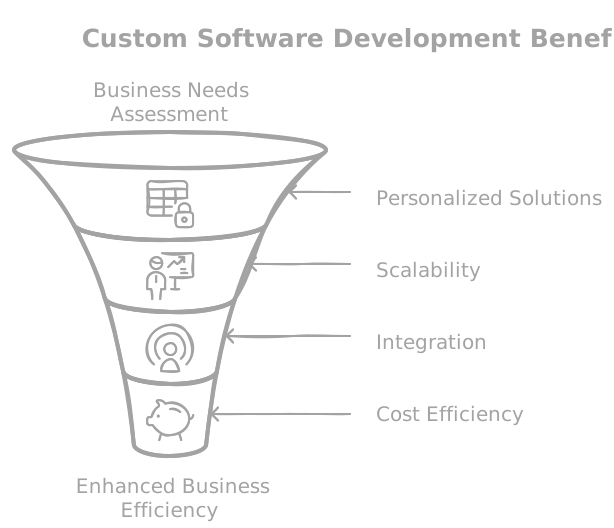
When it comes to choosing software, the debate between custom development and off-the-shelf solutions feels like choosing between a tailored suit and one off the rack. Both work, but the right choice depends on your requirements, your budget, and your need to scale. Not everything deserves to be custom-built, and understanding the pros and cons of each path is what separates an informed decision from an expensive hunch.
Off-the-shelf software usually looks more attractive at first glance: lower upfront cost and setup in days, not months. It brings proven features and spares you from maintaining code. The trade-off is rigidity: it may not cover a specific flow, and you often pay for modules you’ll never use. Custom software flips the equation: it costs more and takes longer, but it’s built around your processes and can grow with you without a complete overhaul.
The practical rule for deciding is simple, and these criteria make it operational:
- Buy the standard. Email, billing, payments, support: functions thousands of companies solve the same way. Reinventing them rarely adds unique value.
- Build the differentiator. When a piece is part of your competitive advantage, custom development gives you control and an asset of your own that’s hard to copy.
- Weigh total cost, not just price. A cheap license that demands constant integrations and patches can end up costing more than a well-thought-out custom solution.
- Consider time to market. If you need to validate an idea now, a minimum viable product built on existing tools gets you to the first real signal faster.
“The best software is the one that solves your problem, not the one everyone else is using.”
Buying the rest gives you speed and frees you from maintaining code that adds no unique value, so you can spend your energy on what truly sets you apart.
It should grow with you, not against you
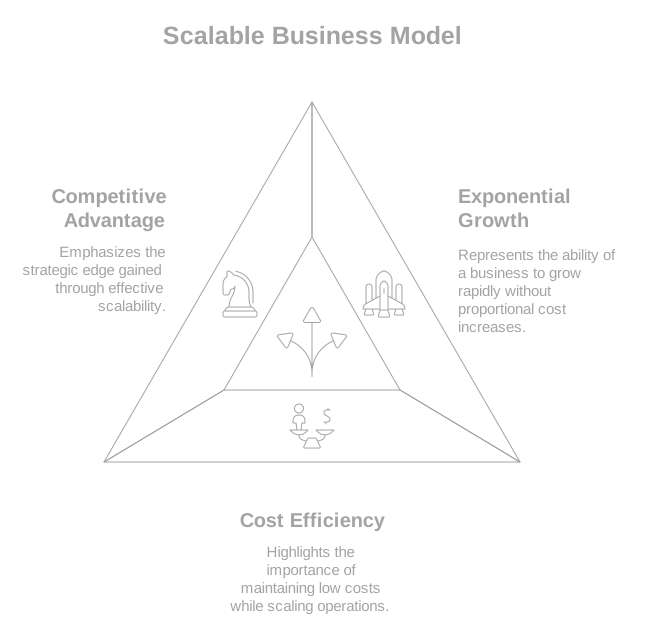
A cheap tool you outgrow in six months ends up being expensive. The cost of switching platforms rarely shows up on the invoice: it lives in the data you have to migrate, the team that retrains, and the weeks the business runs at half speed. That’s why scalability isn’t a luxury for later, but a criterion for today. It’s worth choosing solutions that keep pace with your expected growth, without overpaying for a scale you don’t yet need.
The balance is covering the short term without painting yourself into a corner. An architecture designed to grow lets you add users, data, and features gradually, adding or removing resources as needed, without stalling operations. That usually means paying for what you actually use, which protects cash flow in the early stages and leaves room to invest where it matters.
To anticipate growth without overbuilding, these criteria help:
- Layered growth. Prefer solutions that add capacity incrementally, not ones that demand a platform jump every time you grow.
- Predictable costs. Understand how the price changes when users or data multiply: a surprise on the invoice can weigh more than the feature itself.
- Clear limits. Know in advance where the tool tops out, so you can plan the next step with time instead of in a rush.
- Exit routes. A good solution lets you grow, but also lets you leave: data portability is part of scaling without getting trapped.
“In a world that’s changing really quickly, the only strategy that is guaranteed to fail is not taking risks.” Mark Zuckerberg’s remark applies here: choosing with tomorrow in mind is itself a calculated bet.
User experience and integration
In the startup ecosystem, where innovation is a necessity rather than a slogan, user experience matters more than it seems. The way people interact with your software shapes their perception of the brand and, ultimately, your results. A clear interface turns ordinary tasks into smooth experiences, and that difference shows up in retention. First impressions form in fractions of a second: a confusing tool loses users before it can prove its worth.
Investing in good design from the start also saves money: fixing usability problems after launch costs far more than thinking them through at the beginning. And the experience doesn’t end at the screen: isolated tools create islands of information and manual work, while ones that integrate well multiply their value by talking to each other. It’s also wise to avoid tying yourself so tightly to a vendor that switching later becomes prohibitive; open standards and the ability to export your data are a concrete form of freedom.

To care for both experience and integration at once, these points make the difference:
- Simplicity and clarity. The best interfaces tend to be the simplest; reducing clutter lets people use the tool without friction or endless training.
- Responsive design. With so much usage on mobile, working well on any screen stops being an extra and becomes a requirement.
- Native integration. Favor solutions that talk to what you already use through open interfaces and standards, so you don’t build fragile manual bridges.
- Data portability. Demand clear ways to export your information: if you ever migrate, your data should be able to leave with you without a ransom.
“Design is not just what it looks like and feels like. Design is how it works.” The idea, from Steve Jobs, reminds us that a good experience is functional before it is decorative.
Decide with data, not hunches
In such a fast-moving environment, making decisions with data stops being an option and becomes an advantage. Analytics transforms how you operate: it gives you signals about what works, where money leaks, and how your users behave. Running a startup without data is like sailing through fog without a compass; with good dashboards, decisions stop resting on intuition alone.
The value of analytics isn’t in piling up charts, but in turning information into action. Spotting a consumption trend early lets you adjust strategy ahead of the competition. Analyzing operations reveals where resources are wasted. And understanding your customers better opens the door to more personalized experiences, which usually translate into greater loyalty. The condition is that this data arrives clear, on time, and connected to the rest of your stack.
When choosing an analytics solution, it’s worth reviewing these attributes:
- Ease of use. An intuitive platform gets used; a complex one gets abandoned. If the team doesn’t understand it, the data goes to waste.
- Real time. Access to up-to-date information lets you react quickly, an essential quality for a startup chasing agility.
- Integration with your stack. If the tool doesn’t talk to your other systems, information silos form and slow operations down.
- Metrics that matter. Define indicators tied to your real objectives; measuring everything without focus produces noise, not clarity.
“What gets measured gets managed.” The maxim, attributed to Peter Drucker, captures why analytics used well isn’t an ornament, but the engine of continuous improvement.
Prioritize the essential, ignore the noise
The temptation to adopt every new tool scatters resources and attention. Early on, the sensible move is to solve what hurts first, what blocks sales, delivery, or operations, and defer the nice-to-haves. Fewer tools, well chosen and well used, almost always beat a half-configured arsenal. The discipline of saying no to the shiny but dispensable often separates a focused team from an overwhelmed one.
That same discipline applies to choosing who you partner with. It’s worth asking uncomfortable questions of every vendor: what support they offer, how they protect your data and your cybersecurity, and how easy it is to leave if things don’t work out. In a world where every second counts, investing time in deciding well at the start saves hours and dollars later.
- Solve the pain first. Tackle what blocks revenue or delivery before the nice-to-haves; the rest can wait its turn.
- One tool at a time. Rolling out and mastering a few things well pays off more than starting many halfway.
- Ask the hard questions. Support, security, total cost, and exit route matter as much as the feature list in the brochure.
- Review and prune. Periodically assess which tools still contribute and retire the ones that only add a fee and complexity.
In short
Choosing software for a startup is, above all, an exercise in priorities: understand your real need, buy the standard, build the differentiator, and always keep the freedom to switch. Scalability, user experience, clean integration, and decisions made with data aren’t luxuries for later, but criteria for today. Fewer tools, well chosen, almost always win.
At LabWeb we help you decide what to build and what to integrate, and we develop custom software only where it truly gives you an edge. If you want a stack that solves your real problems without mortgaging tomorrow, we’re exactly the kind of partner that turns those decisions into product.