Few decisions shape a mobile project as much as choosing between a cross-platform and a native approach. There’s no universal winner: each path carries real trade-offs in cost, performance, and user experience. Picking the right one is less like choosing between pizza and tacos (both taste great) and more about understanding what the product in your hands actually needs. The right question isn’t which one is “better,” but which one fits your strategy, your budget, and the people who will use your app every single day.
Before we dig in, it helps to be clear on the two options on the table:
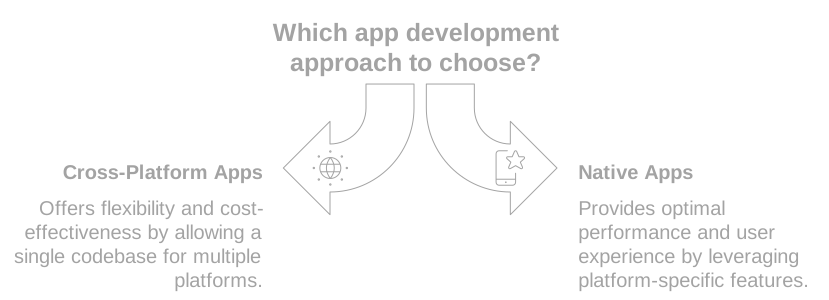
- Cross-platform apps: built with frameworks that let a single codebase deploy to multiple platforms, which makes them cost-effective and faster to develop.
- Native apps: built specifically for one platform (iOS or Android), making full use of its capabilities and generally offering higher performance and a more polished experience.
The appeal of a single codebase
Cross-platform tools like React Native and Flutter let you write once and deploy to both iOS and Android. That cuts costs, speeds up launch, and simplifies maintenance: one team, one codebase, two stores. For many products (an MVP, a content app, an internal tool) that efficiency is exactly what the business needs. The magic of the cross-platform model isn’t only the savings, but the speed at which it lets you reach more users without duplicating effort.
Reach matters, and a lot. More than eighty percent of smartphone users worldwide run either Android or iOS, according to the market-share data from Statista. Betting on a cross-platform approach from the start positions you on both dominant platforms without the cost spiraling. In a market where time-to-market decides who captures a trend first, that agility is a concrete competitive advantage.
These are the reasons so many teams choose the cross-platform path:
- Cost efficiency: you build once and deploy everywhere, maintaining a single codebase instead of two, which lowers both development and maintenance spend.
- Wider market reach: with support for iOS and Android at once, you reach more users without multiplying the team or the budget.
- Easier updates: a change ships to every platform at the same time, with no fragmented experiences across versions.
- Framework flexibility: mature options like React Native, Flutter, and Xamarin let you build polished apps with near-native performance.
- Fast iteration: a single codebase makes it easy to respond quickly to user feedback and keep the product evolving.
“The beauty of cross-platform development is not just about reaching more users; it’s about creating a unified experience that transcends devices.”
That said, let’s not sugarcoat it: the cross-platform approach brings its own challenges. The layer that translates your code to each system can fall short on highly elaborate interfaces, and heavy graphics sometimes demand a level of optimization that only native delivers effortlessly. Recognizing those limits up front avoids surprises and helps you decide with a clear head, not by chasing whatever is trending.
When native earns its price
Native development (Swift for iOS, Kotlin or Java for Android) delivers maximum performance and full access to device capabilities. If your app is like an espresso (intense, demanding, and crafted for a single platform), native offers a smoothness that’s hard to match. By talking directly to the hardware, a native app makes better use of the camera, GPS, sensors, and memory, which translates into smooth animations and instant responses. That closeness to the operating system is exactly what separates a remarkable experience from one that merely works.
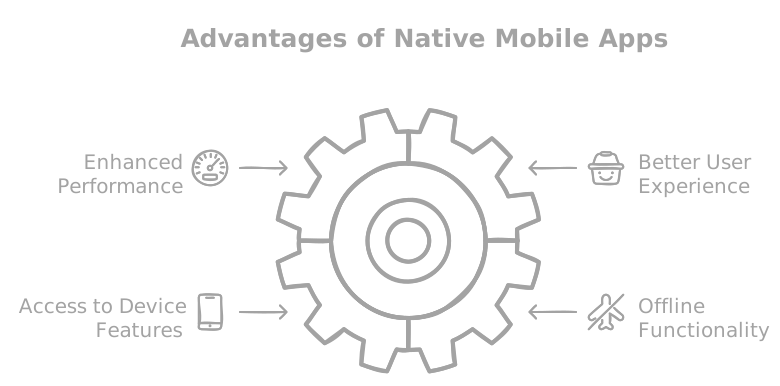
That care shows up in the interface too. By respecting each platform’s design guidelines, a native app feels intuitive and familiar from the very first tap, like walking into your usual coffee shop where they already know your order. That’s why many demanding products (games, editing tools, augmented-reality apps) take this route: the difference in feel comes through, even if the user can’t quite explain why. Instagram, for example, launched as an iOS-only native app in 2010 and perfected its experience there before expanding to Android with the same attention to detail, a move that helped it grow to a hundred million users in just two years.
What you gain (and what you pay) by going native breaks down like this:
- Maximum performance: direct access to the hardware for the most demanding cases in speed and fluidity.
- Tailored experience: natural adherence to each platform’s conventions, which feels more polished to the user.
- Full device access: camera, GPS, sensors, and advanced features with no workarounds or limitations.
- Brand trust: investing in a native experience sends a message of quality and commitment that strengthens loyalty.
- Higher cost: it usually means two codebases and two skill sets, which raises the investment.
- Longer timelines: launching on both platforms at once often requires separate teams and more development time.
“While native apps may require more investment upfront, the long-term benefits in performance and user satisfaction often justify the cost.”
Performance, UX, and long-term maintenance
The performance gap has narrowed considerably, but it still matters in demanding cases. If we think of apps as athletes, native apps are sprinters built for a specific track, while cross-platform apps are triathletes: they adapt to any terrain, even if they don’t always hit the peak performance of a specialized solution. For most products, that peak isn’t even necessary; for heavy graphics or real-time applications, it makes all the difference. The trick is knowing which race you’re signing up for before you pick the runner.
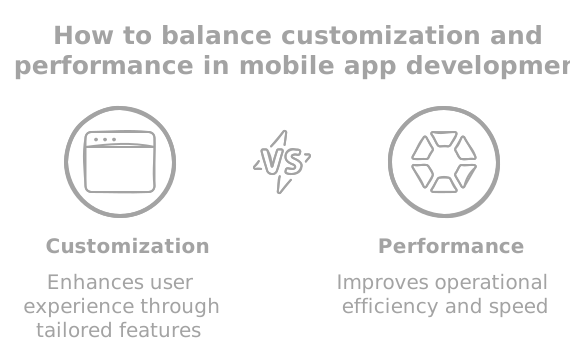
User experience follows a similar logic. Native naturally respects each platform’s conventions; cross-platform can get there, but it takes deliberate design effort to avoid feeling generic. Good design isn’t just about looks: it defines how your product connects with people. Perceived quality weighs on the decision to keep an app or uninstall it, which is why serious teams invest in the experience regardless of the technical approach they choose. The idea of “write once, run anywhere” traces back to open technologies documented by references like MDN Web Docs.
Day to day, the differences concentrate around these points:
- Responsiveness: native leads on complex animations and graphics-heavy interfaces; cross-platform delivers more than enough performance for most cases.
- Cross-platform consistency: a single codebase guarantees a uniform experience; native, by contrast, feels perfectly “at home” on each system.
- Maintenance cost: evolving shared code is cheaper, though framework dependencies bring their own complexity over time.
- Fine optimization: native lets you squeeze every device resource; cross-platform gets there too, but at the cost of extra optimization work.
- Testing across devices: cross-platform demands verifying behavior across many hardware and OS-version combinations to guarantee compatibility.
| Criterion | Cross-platform | Native |
|---|---|---|
| Cost | Lower, a single codebase | Higher, two codebases |
| Performance | Very good for most cases | Maximum, even in demanding ones |
| Time-to-market | Faster | Slower |
| Hardware access | Good, with some limits | Full and first-hand |
| Best for | MVPs, content apps, and internal tools | Demanding apps, heavy graphics, deep integrations |
The real cost, beyond the upfront price
When it comes to development, one of the most sensitive questions is, drumroll please, the cost. And here the difference between the two approaches is tangible. A cross-platform app, leaning on a single codebase, significantly reduces development time and maintenance spend: it’s like ordering a combo meal instead of every dish à la carte. Various industry analyses estimate that building cross-platform can come out up to thirty percent cheaper than developing separate native apps, savings that for a startup can mean several extra months of runway.

Native, by contrast, usually means separate versions for iOS and Android, which often doubles (or triples) the investment and stretches timelines, especially if you need different teams to launch in parallel. That doesn’t make it a bad option: for businesses aiming at premium performance and chasing long-term retention, that extra investment can translate into higher satisfaction and loyalty. The key is to look at total cost of ownership, not just the check on day one, because an app is a living organism you have to feed for years.
When you build the budget, keep these factors in mind:
- Total cost of ownership: add up development, maintenance, updates, and support across the product’s life, not just the initial launch.
- Team and skills: a single codebase needs fewer specialized profiles, while native may demand separate experts on each platform.
- Update cadence: if you plan to iterate often, the simultaneous releases of cross-platform reduce the operational effort.
- Expected return: a mission-critical app can justify the native cost when performance translates directly into revenue or retention.
- Technical-debt risk: today’s shortcuts can become tomorrow’s costs, so it pays to budget for caring for the code too.
“Investing in app development is like planting seeds; choose wisely and watch your project flourish.”
How to make the call
Start with the product, not the technology. Define your budget, your timeline, your critical features, and how much extreme performance matters. An MVP that needs to ship fast weighs differently than an app that will be your flagship for years. The choice between cross-platform and native isn’t about what’s trending: it’s about finding the best fit for your project, your users, and the stage your business is in. There’s rarely a single answer; there’s almost always a right answer for your context.
It also pays to think ahead. Scalability, ease of maintenance, and the ability to add new features without rebuilding everything should weigh as much as the upfront cost. A decision that looks cheap today can turn expensive tomorrow if the product grows in a direction the chosen approach doesn’t support well. That’s why the exercise doesn’t end when you pick a framework: it continues as you plan how the product will evolve, who will keep it running, and how it will stay secure against an increasingly demanding cybersecurity landscape.
To land the decision, ask yourself these questions:
- What does the app need to accomplish? If it depends on extreme performance or deep device integration, native gains ground; if you want wide reach and fast deployment, cross-platform fits better.
- Who is going to use it? Consider whether your audience will value the refined experience of native more, or the accessibility and consistency of cross-platform.
- How fast do you need to launch? In a fast-moving market, shipping sooner can be a decisive edge, and that’s where cross-platform tends to shine.
- How will the product evolve? Think about maintenance, updates, and scalability before committing to a single path.
- How demanding are your users? An audience used to top-tier native apps notices every detail, and that can tip the scale.
“The choice between cross-platform and native isn’t about right or wrong; it’s about finding the best fit for your project.”
In short
Cross-platform wins on cost and speed; native wins on performance and fine control. But neither one is the “right” answer in the abstract: the right one is whatever supports your strategy, respects your budget, and keeps your users happy. The good news is that you don’t have to solve that equation alone. At LabWeb we assess your product, budget, and goals before recommending an approach, whether that’s custom software development, a mobile app, or a dedicated team, so the technical decision works for your business rather than against it.