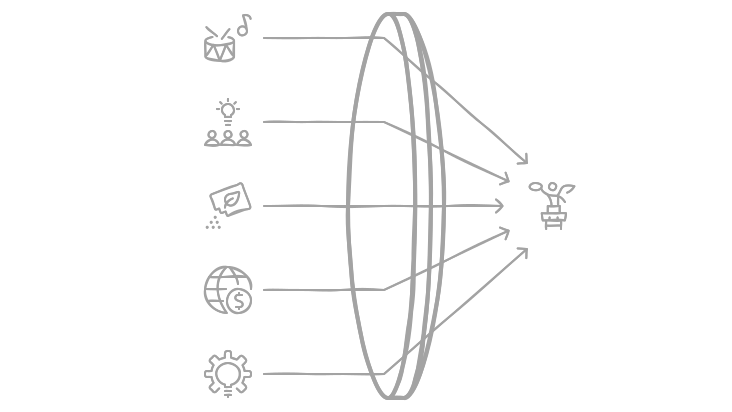
Mexico is shaping up as Latin America’s next great tech hub because it brings together the same ingredients that built Silicon Valley: an expanding startup ecosystem, growing access to capital, abundant technical talent at competitive costs, and a strategic location between two huge markets. Cities like Mexico City, Guadalajara, and Monterrey concentrate that talent and entrepreneurial culture, and each year they add more founders, funds, and communities that professionalize the scene. This isn’t a distant promise, it’s a transformation already underway, and it’s changing how the world looks at the country. Here are the five reasons worth paying attention to:
- A startup ecosystem in full expansion.
- Growing access to capital.
- Technical talent at competitive costs.
- A strategic location between the U.S. and Latin America.
- An environment that drives entrepreneurship.
1. A startup ecosystem in full expansion
The number of tech startups in Mexico has grown steadily over the past decade, driven by a mix of private investment, increasingly connected communities, and a new generation of founders who already think at global scale. The density of talent and relationships, not just capital, is exactly what sets a true innovation hub apart, and it’s what Mexico is building at a good pace.
That expansion doesn’t happen in a single place, but across several hubs that complement each other. Mexico City concentrates capital and operations; Guadalajara earned the nickname “Mexican Silicon Valley” for its hardware and software industry; Monterrey brings a strong industrial and business base. When several cities push at once, the network effect multiplies: talent trained in one finds opportunities in another, and ideas circulate faster.
That maturity also shows in the sectors leading the growth. Financial technology turned Mexico into one of the region’s most dynamic fintech markets; e-commerce and logistics took off alongside digital consumption; and software-as-a-service found fertile ground among companies looking to modernize how they operate. When several industries innovate at once, the ecosystem gains depth and stops depending on a single bet.
What sustains that ecosystem shows up day to day:
- Community and collaboration. Incubators, coworking spaces, and accelerator programs multiply, creating places where founders, engineers, and investors meet and share lessons.
- Events and mentorship. Hackathons, demo days, and industry gatherings connect early-stage ventures with those who have already walked the path.
- Product culture. More and more teams build around real users and metrics, not just an idea: that maturity is what attracts serious capital.
According to Startup Genome’s Global Startup Ecosystem Report, the value of Latin America’s emerging ecosystems grew strongly in recent years, with Mexico among the region’s standouts.
The takeaway is clear: the ecosystem went from a handful of isolated cases to a network that feeds itself. And a self-reinforcing network is, historically, the first symptom of a tech hub in the making.
2. Growing access to capital
For years, funding was the real bottleneck for Mexican startups. That changed. Domestic and international venture capital funds increasingly look toward Mexico, drawn by a large market, digitizing fast and still with plenty left to build.
The turning point came when several Mexican companies reached “unicorn” valuations and proved that regional-scale businesses can be built from here. Those stories worked like a magnet: international funds opened local offices, early-stage investors grew willing to bet sooner, and above all, a new wave of founders understood that raising capital no longer meant relocating to another country.
The shift is felt on several fronts at once:
- More venture capital. In recent years, Mexican startups raised billions of dollars in funding rounds, with several companies reaching top-tier valuations.
- A growing pool of angel investors. The angel investor community expanded, giving oxygen to seed-stage projects that previously couldn’t find their first check.
- Alternative models. Crowdfunding and venture-debt schemes broadened the options beyond traditional capital.
Mexican startups raised more than a billion dollars of venture capital in a single recent year, a sign of investors’ growing confidence in the market.
That access to capital is decisive: a good idea without funding rarely goes far, and Mexico went from having few doors to having more and more paths to fund growth.
3. Technical talent at competitive costs
No tech hub holds up without talent, and here Mexico plays one of its best cards. The country graduates more than a hundred thousand engineers a year, with a young, digitally connected population that adopts new technology naturally.
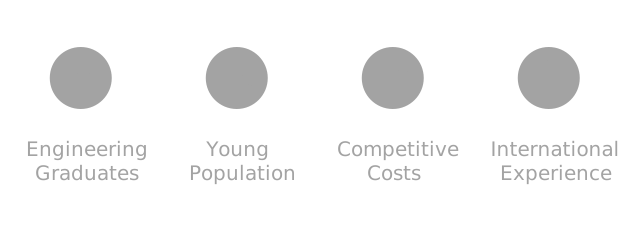
The combination that makes this talent attractive has three parts:
- Solid training. Public and private universities produce technical profiles capable of competing on demanding projects.
- International experience. Much of that talent already works with clients in the U.S. and Europe, so it knows how to operate in global contexts and to high standards.
- Reasonable operating cost. Unlike saturated hubs, the cost of living and operating lets startups stretch their capital and build strong teams without sacrificing quality.
On top of that came a deeper shift in how people work. The normalization of remote work erased much of the geographic friction: today a team in Guadalajara can plug into a San Francisco company without anyone relocating. For Mexican talent, that meant direct access to global projects; for foreign companies, a way to add top-tier engineers without the costs of a saturated market.
For many companies, that talent is precisely the reason to bet on the nearshore model from Mexico: compatible time zone, cultural closeness, and the ability to operate as a single team. The difference from far-off outsourcing is enormous: instead of coordinating twelve hours away, work moves in real time, with fewer misunderstandings and faster decisions. It’s also where custom software development finds the right people to build it. When the conversation turns to assembling a dedicated development team, Mexican talent comes up again and again as one of the most balanced options between cost and quality.
4. A strategic location between two markets
Geography also works in its favor. Sitting between two huge markets, Mexico offers natural access to the United States and to all of Latin America, a position few countries can match.
On top of that physical closeness sits a trade framework that amplifies it. The agreement between Mexico, the United States, and Canada integrates the region into a single value chain, making it easier not just to sell products but to move talent, services, and technology under clear rules. For a startup dreaming of clients up north, starting from Mexico means beginning inside the trade bloc, not knocking from outside.
That location translates into very concrete opportunities:
- Closeness to the largest market. Time-zone and trade proximity to the U.S. makes it easier to sell, collaborate, and raise capital with one of the world’s most active ecosystems.
- A gateway to Latin America. From Mexico it’s natural to scale products into a region whose digital economy keeps growing at double digits.
- A robust domestic market. With more than 126 million consumers, the country is an ideal platform to test and validate products before going international.
Mexico ranks among the world’s fifteen largest economies, according to the World Bank, which makes it a solid base to build and export technology.
In a business where being close to your customers and your capital makes the difference, that geographic position stops being a detail on the map and becomes a real competitive advantage.
5. An environment that drives entrepreneurship
Finally, there’s the culture. The institutional and private environment supports this growth with faster company-formation processes, incentives for innovation projects, and an ever-wider network of events, mentorship, and communities that professionalize the ecosystem.
Beyond the programs, what sets Mexican entrepreneurship apart is a particular blend of creativity and resilience:
- Community support. Networks of founders, mentors, and collaborative spaces act as informal incubators where resources and contacts are shared.
- Diversity as an engine. The country’s cultural richness feeds original products that resonate both locally and internationally.
- Youthful energy. A population with a median age near 30 brings the dynamism and risk tolerance that characterize great startup ecosystems.
One point worth pausing on often goes unnoticed: the growing participation of women founders and of projects born outside the big capitals. That diversity isn’t just about fairness, it’s a source of competitive advantage, because teams with different perspectives solve problems others don’t even see. The wider the pool of people who start companies, the richer the catalog of solutions the country produces.
“An entrepreneur is someone who jumps off a cliff and builds a plane on the way down.” Reid Hoffman, co-founder of LinkedIn, said it, and it captures the spirit of the Mexican ecosystem well: taking calculated risks with an increasingly solid support network behind you.
When talent, capital, and culture push in the same direction, ideas tend to become companies, and companies an industry. That, in essence, is what’s happening in Mexico.
In short
Mexico combines talent, capital, competitive costs, a privileged geographic position, and a rising entrepreneurial culture: the same ingredients that shaped the great tech hubs. It isn’t a future promise, it’s a transformation already happening in plain sight. For anyone looking to build, invest, or scale, ignoring what’s going on in the Mexican ecosystem is becoming an expensive luxury.
At LabWeb we build from here, tapping into that ecosystem to develop world-class software for clients inside and outside the country. If that energy interests you, we’re exactly the kind of partner that turns Mexico’s advantage into product.