Mexican companies generate more data than ever: sales, user behavior, operations, social media. But the real change isn’t in accumulating it, it’s in turning it into decisions. Big data is no longer reserved for large corporations; today it’s within reach for businesses of every size. The country’s digital landscape is going through a deep shift, driven by organizations that figured out that data, used well, is one of the hardest competitive advantages to copy.
That shift is no accident. It mirrors a global move toward evidence-based decision-making, where companies use information to improve operational efficiency and the way they engage with customers. Before we dig in, it helps to name the forces moving the board:
- From intuition to informed decisions.
- Competitive advantage within reach of any company.
- Growing talent and tooling.
- Big data applied to every sector.
- The open challenge: quality, governance, and purpose.
From intuition to informed decisions
For a long time, business decisions were made on experience and gut feeling. Today, data lets you validate those instincts, or challenge them, with concrete evidence. Knowing which products sell together, what time of day your customers buy, or where they get stuck on your site transforms how you operate. The difference between guessing and knowing translates directly into results.
That change in mindset is more radical than it looks. It isn’t about having pretty dashboards, it’s about changing who decides inside the company and how. When a team argues with data on the table, conversations stop revolving around whoever talks loudest and start revolving around what is actually happening. Sustained over time, that discipline separates the organizations that learn fast from the ones that keep repeating the same mistakes.
- Patterns you can’t see at a glance: analysis surfaces correlations between products, time slots, and segments that no manual report would catch in time.
- Speed of reaction: spotting a drop in conversion the same day, instead of at month-end, can be the difference between fixing it and losing revenue.
- Decisions you can defend: a recommendation backed by data is easier to approve, communicate, and audit than a hunch.
- Compounding learning: every measured decision leaves a trail that improves the next one, instead of starting from zero each time.
“Without data, you’re just another person with an opinion.” The line, attributed to engineer and statistician W. Edwards Deming, captures why evidence became the new language of business.
Competitive advantage within reach of any company
Data analysis no longer requires million-dollar infrastructure. Cloud platforms have made it possible for a small business to process and visualize large volumes of information at a reasonable cost. That levels the field: mid-sized companies compete with data used as effectively as that of much larger players. The advantage is defined by smart use, not the size of the budget.
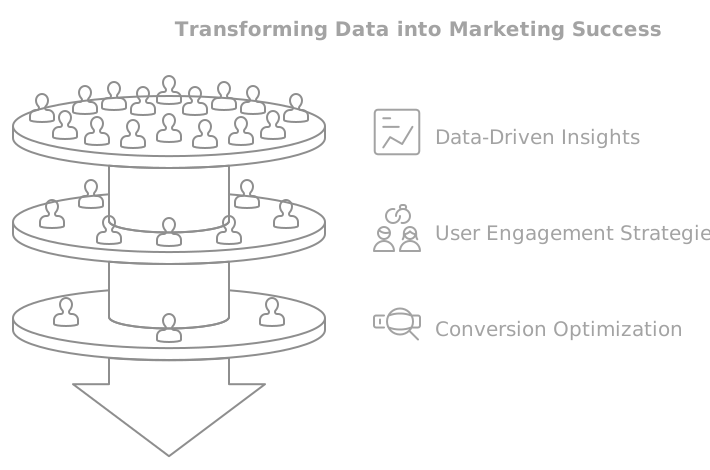
The cloud model changed the rules of the game. Building a serious analytics capability used to mean buying servers, hiring specialists, and waiting months. Today a company can start small, pay for what it uses, and scale as it grows. That flexibility lets teams experiment without risking the capital of the whole operation, which is especially valuable for businesses that are still discovering which questions are worth answering with data.
- Variable, not fixed costs: you pay for storage and processing based on actual demand, which lowers the barrier to entry.
- Scalability on demand: the same platform serves a thousand records or millions, with no need to rebuild the architecture.
- Short time to implement: projects that used to take months now start in weeks with managed services.
- Access to cutting-edge tech: advanced analytics features once exclusive to large enterprises now ship inside standard platforms.
The takeaway is clear: a mid-sized company in Queretaro or Merida can make decisions with the same analytical sophistication as a multinational. What decides the outcome is no longer who has the biggest budget, but who asks the right questions and acts on the answers.
Growing talent and tooling
Mexico has a growing pool of analysts, data engineers, and data scientists, along with a mature, well-documented ecosystem of tools. This means companies have access not just to the technology, but to the people capable of extracting value from it. The combination of local talent and global platforms accelerates projects that used to take months.
That talent doesn’t emerge in a vacuum. Public and private universities turn out solid technical profiles, and many of those professionals already work with international clients, so they are used to high standards and demanding contexts. On top of that sits an active community of meetups, courses, and open-source projects that keeps people current in a field that changes fast.
- Increasingly specialized profiles: it’s no longer just “the data person,” but data engineers, business analysts, and scientists with distinct, complementary focuses.
- Proximity and time zone: the nearshore model lets these teams integrate with U.S. clients in real time, without the friction of operating twelve hours apart.
- Open tooling ecosystem: many of the most-used data platforms are free or low cost, with extensive documentation and large communities.
- A culture of measurement: more teams build around metrics and experiments rather than hunches, which raises the bar for the whole industry.
“The world is now a data economy, and data is the new natural resource of business.” The idea, voiced by former IBM chief executive Ginni Rometty, captures why investing in data talent stopped being optional.
Big data applied to every sector
Big data isn’t an abstract theory: it’s already changing how very different industries operate. Where there used to be monthly reports and slow decisions, there is now analytics feeding the operation day by day. The pattern repeats sector by sector, even if each one puts it to use in its own way.
In retail and commerce, analyzing purchase patterns lets companies adjust inventory, anticipate demand, and personalize promotions. In financial services, models detect fraud and assess risk in real time, which protects both the institution and the customer. In healthcare, analytics helps track patients and anticipate complications. And in manufacturing and telecom, data optimizes processes and reduces failures before they become expensive.
- Retail and e-commerce: recommendations, inventory management, and targeted marketing based on real purchase behavior.
- Financial services: fraud detection, credit risk assessment, and models that react in seconds to suspicious activity.
- Healthcare: tracking clinical outcomes, managing hospital resources, and more personalized care.
- Manufacturing and logistics: predictive maintenance, supply-chain optimization, and fewer unplanned stoppages.
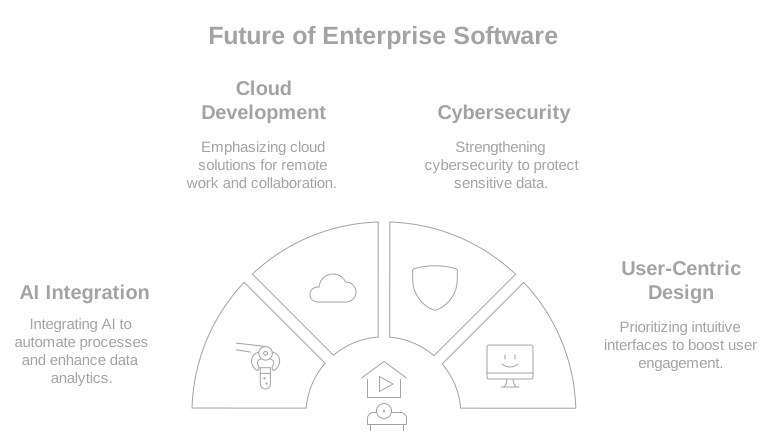
The common thread is the same in every case: turning large volumes of information into concrete operational decisions. Companies that invest in tailor-made data solutions gain a read on their business that competitors simply don’t have, and that advantage compounds over time.
The open challenge: quality, governance, and purpose
Big data only works if the data is reliable and the questions are the right ones. Accumulating information without strategy generates noise, not clarity. That’s why the real value lies in defining clear objectives, keeping data clean, and respecting user privacy. Technology is the means; judgment remains human.
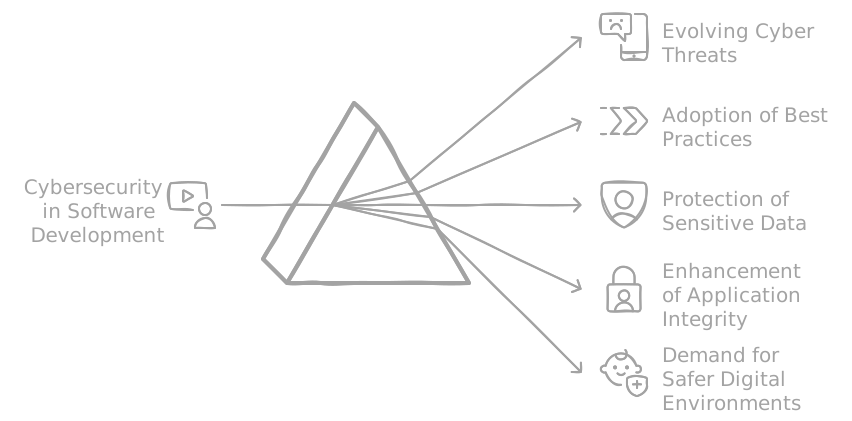
As organizations go deeper into analytics, two challenges become unavoidable: integration and security. Many companies live with legacy systems and data scattered across silos that make a single source of truth hard to reach. And the more data you concentrate, the more attractive it becomes to anyone who wants to attack it, which turns cybersecurity and compliance into a core part of the project, not an afterthought.
- Quality before quantity: dirty or duplicated data produces wrong conclusions; cleaning and validating is the foundation for everything else.
- Data governance: defining who accesses what, under which rules, and for what purpose prevents chaos and makes compliance easier.
- Privacy and compliance: respecting personal-data protection frameworks isn’t just a legal obligation, it also builds trust with the customer.
- Clear purpose: the right question is worth more than the flashiest dashboard; without a business goal behind it, analytics becomes spend with no return.
“The goal is to turn data into information, and information into insight.” Carly Fiorina, former chief executive of Hewlett-Packard, said it, and it describes precisely the path that separates those who hoard data from those who actually put it to work.
In short
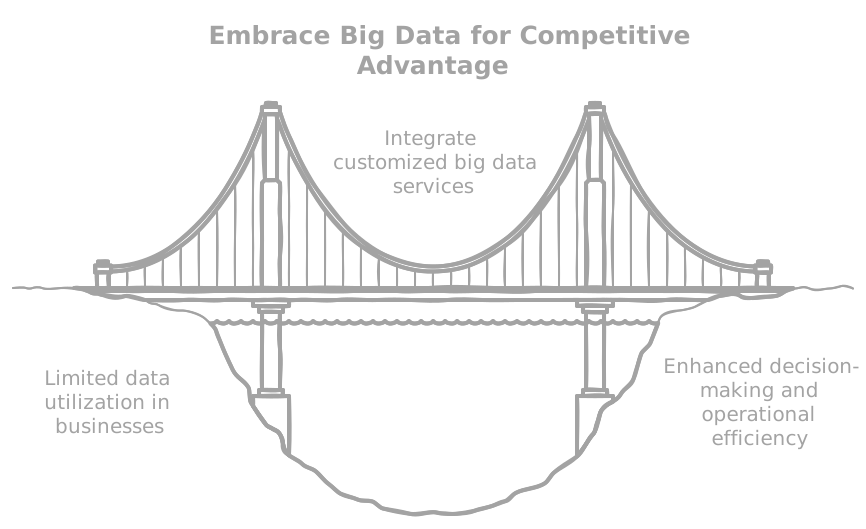
Big data has become a strategic, accessible tool for Mexican companies that want to decide on evidence rather than assumptions. The trends are clear: cloud, analytics applied by sector, growing talent, and a rising demand for quality, governance, and security. Ignoring that wave is starting to be a luxury that costs dearly, because the advantage goes to those who ask the right questions and act on the answers.
At LabWeb we build tailor-made data solutions, from capture to visualization, with scalability and cybersecurity designed in from day one. If you want your information to stop being a forgotten file and start becoming decisions that move the business, we are exactly the kind of partner to help you get there.