Mexico has become one of the most attractive destinations in the world for software development. The mix of technical talent, proximity to the United States, and competitive costs makes it a real alternative to building an in-house team or outsourcing to the other side of the planet. This is not a passing trend or a distant promise: it is a shift that companies of every size are already taking advantage of, from startups that need to build their first product to enterprises that want to scale without ballooning their payroll. Below we go through why the nearshore model from Mexico works so well and what you should keep in mind if you are weighing the option.
Before getting into the detail, these are the pillars behind the country’s appeal:
- Technical talent that grows year after year.
- The same time zone and real-time collaboration.
- Competitive costs without sacrificing quality.
- Cultural and business proximity.
- Increasingly mature compliance frameworks.
Talent that grows year after year
Mexico graduates tens of thousands of engineers every year, and its startup and development ecosystem keeps maturing. That steady talent pipeline means you can build strong teams in modern technologies, web, mobile, data, artificial intelligence, and cybersecurity, without the waiting lists of other saturated markets. Cities like Guadalajara, Mexico City, and Monterrey concentrate much of that talent and compete to attract the best companies in the region.
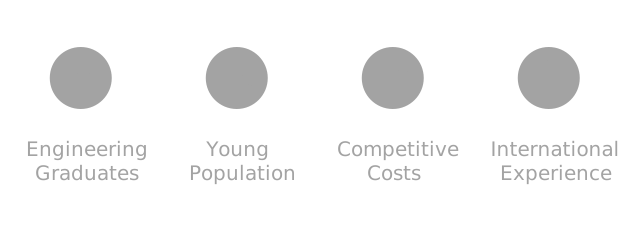
What is interesting is not just the volume, but the quality of the training. Many of these professionals already work with clients in the United States and Europe, so they know global standards and are used to agile methodologies. That international exposure shortens the ramp-up: you do not have to teach them to communicate progress, document decisions, or think about the end user, because they already do.
Looked at closely, Mexican talent stands out for three concrete reasons:
- Solid training: public and private universities produce technical profiles capable of competing on demanding, long-running projects.
- Global experience: a large share of engineers already work with distributed teams, so remote collaboration is the norm rather than an experiment.
- Natural tech adoption: a young, connected population picks up new tools quickly, which keeps teams current without friction.
“Talent is universal, but opportunity is not.” The line, often attributed to former president Barack Obama, captures why so many companies now look toward markets like Mexico: the talent was always there, what changed was the access.
Same time zone, real collaboration
Unlike traditional offshore (Asia or Eastern Europe), a team in Mexico works in your time zone or very close to it. That translates into live standups, same-day answers, and the ability to iterate fast instead of losing a full day on every round trip. The difference looks minor on paper, but in practice it sets the rhythm of the entire project.
Picture a team in San Francisco coordinating with developers who are twelve hours ahead. A question that comes up mid-morning is not resolved until the next day, and a simple blocker can stall progress for 24 hours. With a team in Mexico, that same question gets answered in minutes, on a call or in a message, without anyone waiting for the other side of the world to wake up. Iteration speed is one of the factors with the biggest impact on the quality of the final product.
That time-zone proximity enables a way of working that feels like a single team:
- Live meetings: planning and review sessions happen when everyone is awake and focused, not at awkward hours for one side.
- Same-day response: blockers are cleared in hours, not in full waiting cycles, which keeps the team’s momentum.
- Faster decisions: fewer misunderstandings from asynchronous messages mean less rework and more predictable deliveries.
Competitive costs, without sacrificing quality
The economic case is clear: a nearshore team in Mexico typically costs about half of an equivalent in-house team in the United States. The difference does not come from cutting quality, but from a different cost structure, where the cost of living and operating is lower without lowering the technical level of the engineers.
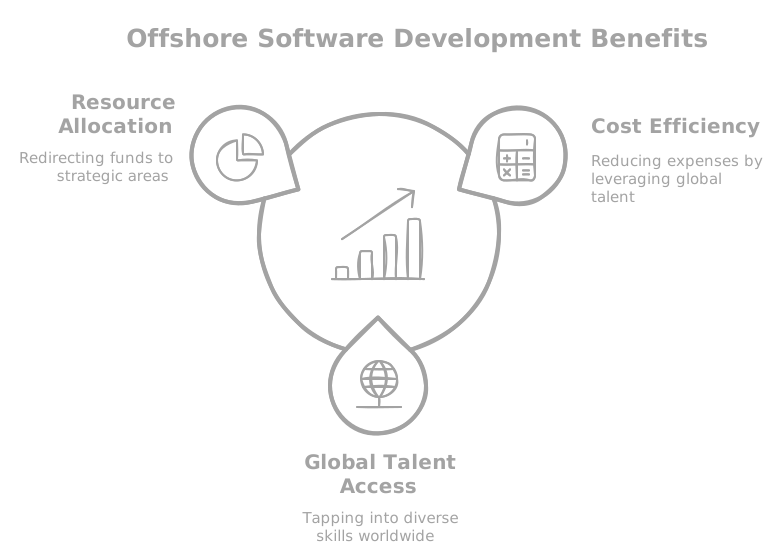
It is worth understanding where those savings come from, because the risk lies in confusing cheap with cost-effective. A team that charges little but ships fragile software ends up being extremely expensive: every bug in production, every delay, and every rewrite costs time and money. The real value of the nearshore model appears when the savings are reinvested into building better, with automated tests, sound architecture, and attention to scalability, rather than simply piling up cheap hours.
For the cost math to be honest, it helps to look beyond the hourly rate:
- Total cost of ownership: what matters is not how much an hour costs, but how much it costs to maintain and grow the product over years.
- Smart reinvestment: putting part of the savings into quality (testing, code review, security) avoids larger expenses down the line.
- Lower hidden turnover: stable, well-integrated teams cut the invisible cost of re-explaining context every few months.
According to World Bank data, Mexico ranks among the fifteen largest economies in the world, which gives it a solid industrial and services base to sustain long-term technology projects.
Cultural and business proximity
Geographic proximity is also cultural. Compatible work habits, communication styles, and business expectations reduce the friction that usually shows up in far-flung collaborations. A team that understands how decisions are made at a U.S. company, what is expected from a meeting, and how priorities are set, integrates much faster than one coming from a completely different cultural context.
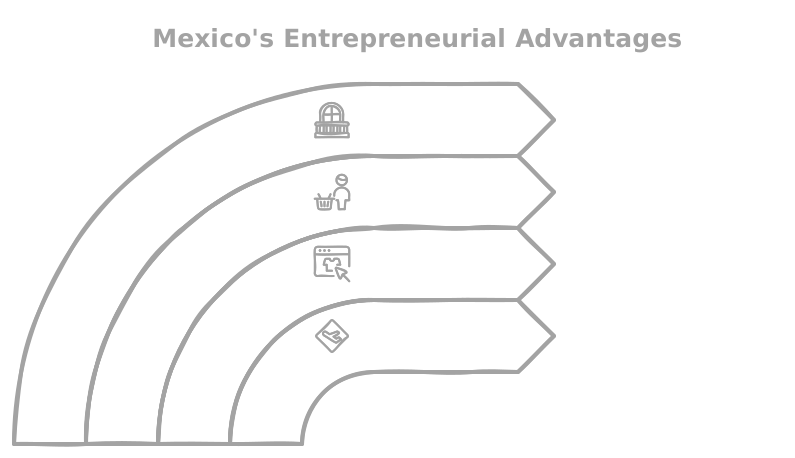
This cultural closeness shows up in everyday details: the way feedback is given and received, the willingness to propose improvements instead of just executing orders, and the ease of building trusting relationships. For many clients, that compatibility is what turns a transactional relationship into a true long-term partnership, where the provider feels like part of the team and not an interchangeable external resource.
When it comes to building a dedicated development team, cultural affinity translates into measurable advantages:
- Smooth communication: a high level of English and shared cultural references reduce the misunderstandings that hold back other remote teams.
- Business alignment: understanding the client’s market helps the team propose custom software solutions, not just code what it is told to.
- Long-term relationships: trust is built faster when both sides share similar values and ways of working.
“No matter who you interview for the job, that person is already part of your team.” The idea, popularized by Reid Hoffman, co-founder of LinkedIn, is a reminder that cultural fit weighs as much as technical skill when building a team that works.
Increasingly mature compliance frameworks
Working with a provider in another country always raises questions about data security, intellectual property, and regulatory compliance. The good news is that Mexico has made notable progress on these fronts, with clearer legal frameworks and an industry that adopted international standards to compete for serious contracts. For a formal project, that means fewer surprises and more legal certainty.

Personal data protection in Mexico is governed by legislation inspired by internationally recognized principles, and a growing number of tech companies are certified in standards like ISO 27001 or work under controls compatible with foreign regulations. On top of that sits the region’s trade framework: the agreement between Mexico, the United States, and Canada integrates the three countries into a single value chain, which makes it easier to move services and technology under predictable rules. For a company that needs guarantees about where its data lives and who owns the code, that context matters as much as the talent.
Before signing with any provider, it is worth reviewing these points:
- Intellectual property: make sure contracts clearly transfer ownership of the code and any assets that get created.
- Security and cybersecurity: ask about concrete controls, access management, encryption, and incident response practices, not just promises.
- Regulatory compliance: verify that the team knows the rules that apply to your industry, especially in sensitive sectors like healthcare or finance.
“There are only two types of companies: those that have been hacked, and those that will be.” Robert Mueller, former FBI director, made the point, and it holds for any country, underscoring why compliance and security belong in the conversation from day one.
In short
Mexico offers a balance of cost, quality, and proximity that is hard to match: technical talent that grows year after year, a time zone that allows real-time collaboration, competitive costs that free up capital to build better, cultural affinity that reduces friction, and increasingly solid compliance frameworks. It is not a single advantage that convinces, but the sum of all of them working at once.
At LabWeb we build from Mexico for clients worldwide, with dedicated teams that integrate into your operation as if they were in the office next door. If you are weighing where to build your next product, we are exactly the kind of partner that turns Mexico’s advantage into software that works.