

The question looks like a budget one, but it rarely comes down to price per word. Deciding between hiring a copywriting service or building an in-house team is deciding how you want your brand to sound, grow, and adapt. It is a bit like choosing between a fine wine and a homemade brew: the former promises craft and sophistication, the latter offers a personal touch at a potentially lower cost. But, just like that wine, the true cost of content reaches well beyond the price tag. The real expense lies in what each option gives and takes beyond the monthly check.
Before you commit to anything, it helps to look at the problem from several angles. These are the factors that weigh most on the decision:
- Quality vs. cost: a professional service charges more, but delivers polished, persuasive content.
- Time efficiency: an outside contributor ramps up fast, without the long hiring process.
- Expertise diversity: agencies and freelancers usually bring insight from many industries.
- Brand consistency: an internal team lives the culture and translates it into a coherent voice.
The cost that isn’t on the payroll
An in-house writer doesn’t cost just their salary: add benefits, taxes, training, tools, workspace, and the management time of whoever directs them. An external service bundles all of that into a fee, with no fixed commitments during slow seasons. The honest comparison isn’t “freelance vs. employee,” but the total cost of each model against the value it produces. Once you add the hidden costs of employment, the headline gap between an hourly freelancer and a full annual salary looks very different.

The temptation is to compare only the big numbers, but opportunity cost matters too. An idle internal team in a quiet month still costs the same; an external service switches off and on with demand.
| Criterion | External services | In-house team |
|---|---|---|
| Cost | Variable fee, no hidden fixed costs | Salary plus benefits, tools, and management |
| Flexibility | Scales with demand | Immediate, constant availability |
| Specialization | Breadth across formats and industries | Depth in your product and your customer |
| Volume | Ideal for peaks and campaigns | Ideal for steady, continuous output |
| Brand voice | Risk of diluting across many hands | Risk of stagnating without fresh perspectives |
It is worth breaking down the variables that actually move the balance:
- Initial investment. A freelancer may charge by the hour or by the project, while an employee means an annual salary plus benefits, on top of onboarding time.
- Long-term value. Quality content tends to pay off over time, because it attracts, converts, and ranks; cheap content ages badly.
- Operational flexibility. Outsourcing lets you scale without the commitment of a permanent hire, valuable in an increasingly flexible labor market.
Understanding what a copywriting service is
Copywriting is the craft of writing persuasive text that drives action, builds loyalty, and strengthens the bond with the customer. It is not writing prettily: it is writing with intent. A good writer doesn’t just write, they strategize: they understand the brand voice, identify the key messages, and tailor content to different audiences. That difference between “putting words down” and “designing a message” is exactly what separates forgettable content from copy that moves the needle.

The field spans many formats, and each plays a different role. Advertising copy chases immediate conversion; SEO copy works for the search algorithms; social copy prioritizes closeness; technical copy explains with precision. Keeping specialists of every profile on staff would be expensive, and that is where an external service shines: it lends you the exact specialization each project needs, when it needs it.
To understand the value of a good service, it helps to see what it really brings:
- Types of copywriting. Advertising, SEO, social media, technical, and narrative, each with its own rules and goals.
- The role of the writer. They don’t just write, they also research, structure, and measure; they treat every text as a piece of strategy.
- Emotional triggers. Good copy stirs the emotions that push people to act, and emotionally connected customers buy and recommend more.
“People don’t buy what you do; they buy why you do it.” Simon Sinek said it, and it captures why narrative, not a feature list, is what turns a brand into a preference.
Brands like Apple have mastered this craft: instead of listing specifications, they tell how their product improves the life of the person using it. Investing in good copywriting, whether through a freelancer or an agency, is not paying for words, it is paying for a strategy that amplifies your message.
The benefits of an in-house team
Having in-house writers offers benefits that go beyond savings. Although the promise of outsourcing is tempting, a dedicated team cultivates brand alignment, shorter turnaround times, and a fine-grained grasp of the company’s culture and goals. Someone who lives the business from the inside writes with a context no external vendor can improvise.
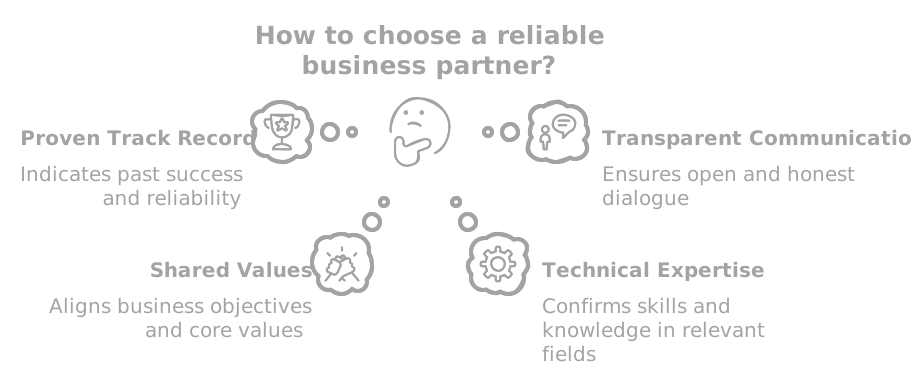
That closeness translates into concrete advantages. Immediate availability lets you react to a market shift the same day, without waiting for a vendor to open a slot in their schedule. And cross-team collaboration (marketing, sales, product) produces richer content, because it grows out of internal conversations an outsider rarely hears.
The strengths of an in-house team usually show up on three fronts:
- Brand consistency. Immersed in the culture, they keep a coherent voice across every channel, something increasingly valued by consumers who prefer brands aligned with their values.
- Immediate accessibility. They are on hand for brainstorming and urgent work, which speeds up adjustments and timely responses.
- Cultural insight. They understand the company’s story and nuances, so they weave in anecdotes and context that make content feel more authentic.
“The only way to do great work is to love what you do.” Steve Jobs’s line explains why a team invested in the mission produces genuine stories that resonate more than generic content made at arm’s length.
Companies like Google lean heavily on their internal teams for creative content, precisely because of that integration between departments that sparks ideas. Cultural closeness can’t be bought by the hour: it is built over time.
Cost analysis: external versus in-house
The cost analysis between a copywriting service and an in-house team is like deciding between a gourmet dinner and home cooking: both have merit, but the long-term impact on your budget and quality can vary a lot. Understanding the financial implications of each option is key to deciding well, and that means looking beyond the price of the first invoice.
The balance depends on your real content needs. If your focus is SEO copy, hiring specialists who understand how the algorithms work usually delivers faster results than relying only on internal generalists without specific training in digital marketing. The choice isn’t ideological, it is practical: which profile best solves your concrete goal?
To compare costs honestly, it helps to separate three layers:
- Initial investment. The freelancer bills by the hour or project; the employee means salary, benefits, and taxes all year round, whether the workload rains or shines.
- Long-term value. Quality content tends to generate better returns over time, because it draws traffic, improves conversions, and builds reputation.
- Cost flexibility. You pay only for what you need, when you need it, avoiding the fixed cost of an underused team during slow seasons.
“Quality is not an act, it is a habit.” The idea attributed to Aristotle reminds us that a sustained result isn’t a stroke of luck, but the fruit of investing consistently in talent, whether it comes from inside or out.
In the end, weighing these factors helps you see not just the immediate cost, but the long-term benefit. A thoughtful strategy, whether with external copywriters or your own team, positions your brand to grow steadily in a market that changes fast.
Scalability and flexibility
On scalability and flexibility, the choice between outsourcing and keeping writing in-house hits your content strategy head-on. Imagine your team suddenly needs a series of articles for an unexpected launch: immediate access to freelancers or an agency lets you respond fast, without the long process of adding new staff.
An in-house team, by contrast, brings a different kind of adaptability: its knowledge of internal processes speeds up decisions and smooths collaboration across areas. The limit is usually team size, unless the company is willing to invest in more hires, which takes time and resources. External flexibility is about volume; internal flexibility is about context.
The advantages of each model are easier to grasp side by side:
- Rapid scaling. External services grow and shrink without friction, ideal for campaigns, demand spikes, or one-off experiments.
- Diverse skill sets. With a wide talent pool, you reach specialized profiles for each project without committing long-term resources.
- Cost flexibility. You pay for what you use, which prevents the overruns typical of fixed headcount, especially when demand drops.
“Flexibility is key in a fast-moving world; businesses must adapt in order to thrive.”
The challenge of the in-house model isn’t quality, it is elasticity. That is why many brands end up combining both: an internal core that guards the voice and the continuity, and an external ring that absorbs the peaks. That mix tends to offer the best of both worlds.
The consistency of brand voice
The biggest risk of outsourcing is that the voice dilutes across different hands; the biggest in-house risk is stagnation from a lack of fresh perspectives. Neither is fatal. A clear style guide and good editorial direction keep things coherent, wherever the copy comes from. Brand voice doesn’t belong to whoever writes, but to whoever defines and protects it.

Consistency is a quiet asset: you rarely notice it when it is there, but you miss it at once when it is gone. A brand that sounds the same in its blog, its emails, and its social posts earns trust, because coherence signals solidity. That is why quality control matters so much: it is not enough for each piece to be good on its own, they all have to sound like the same voice.
To sustain that coherence, three levers matter:
- Quality control. A clear review process ensures every text, internal or external, meets one standard before it goes live.
- Message consistency. A recognizable voice reinforces brand recall and loyalty, because the customer perceives a stable personality.
- Dependability. A team, in-house or external, that meets deadlines and answers on time keeps campaigns from collapsing over a last-minute delay.
“Great content isn’t just about words; it’s about delivering the right message at the right time.”
Brands like Nike combine both worlds: they hire external services for high-impact campaigns and keep an internal team for everyday content. That dual approach lets them build powerful narratives without losing day-to-day cohesion. The lesson is clear: the voice doesn’t depend on the model, it depends on the discipline with which it is cared for.
In short
Outsourcing or keeping writing in-house isn’t a question of which is cheaper, but of which best serves your pace, your specialization, and your voice. The true cost is measured in efficiency, quality, scalability, and strategic priorities, not just in price per word. Weighing those elements against your business goals is what leads you to the right call, and often the answer is a smart combination of both models.
At LabWeb we help you produce strategic, consistent content with whichever model fits your business, guarding the brand voice and measuring what truly matters. That way every word works in your brand’s favor, whoever the hand that writes it.