
We build mobile experiences
Whether you're looking to:
Build mobile experiences
Our team of experts is here to bring your vision to life.
Exceptional Solutions Designed for You
Your audience deserves more than just an app. We design, develop, and launch applications that blend functionality, aesthetics, and user-centered solutions. Each app is crafted to seamlessly address audience challenges, with every feature optimized for an excellent user experience on any platform.

Native Mobile Apps
Our skilled mobile app developers can create native apps for iOS and Android. You will have a fully-functioning, feature-rich app with optimal performance.

Cross-Platform Apps
If you want a mobile app that works on multiple platforms, our mobile app developers can build a near-native app with easy maintenance using a single codebase.

Hybrid Apps
We can combine native and web technologies to build mobile apps that have a web-like feel and are cheaper, faster, and more efficient.

Progressive Web Apps
For an app that's built with web technologies but has an app-like user experience and interface, we offer progressive web app development.
The Benefits of Investing in Native Mobile Apps
Not every app needs to be native, but when the mobile experience is central to your business, native makes a tangible difference. The question is no longer whether your company should invest in mobile applications, but how soon it can make the leap. A native app is built specifically for iOS or Android, gets the most out of the device, and delivers a quality users notice immediately. With most of the world’s web traffic now coming from phones, ignoring that channel means leaving a real chance to connect with your audience on the table. It’s worth understanding exactly what you gain when you invest in native.
Before getting into the detail, these are the pillars that hold up the case for a native app:
- Performance you feel in every interaction.
- Full access to device capabilities.
- A best-in-class user experience.
- Presence and trust in the stores.
- Security and scalability built for the long run.
Performance you feel in every interaction
Native apps run directly on the operating system, with no intermediate layers translating every action. They’re built with each platform’s own languages, Swift on iOS and Kotlin on Android, and that translates into fast launches, fluid animations, and immediate response even under demanding tasks. Where a hybrid approach sometimes trades performance for cross-platform compatibility, native is optimized to run on its home turf.
That difference isn’t a technical detail reserved for developers: it’s something the user notices in the first few seconds. In a market where patience is measured in moments, a transition that stutters or a screen that lags is enough for someone to walk away. Smoothness, by contrast, reads as quality, and quality is what sustains daily use.
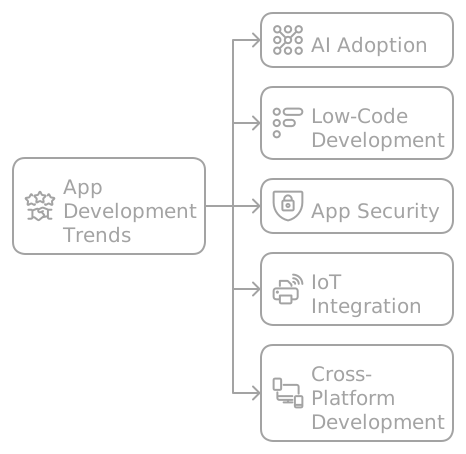
Performance is built across several fronts worth keeping in mind:
- Launch speed. An app that opens instantly invites far more daily uses than one that makes you wait.
- Animations at 60 frames per second. Smooth motion signals solidity and makes the interface feel alive rather than rigid.
- Battery and memory efficiency. Native code manages the phone’s resources better, something users appreciate even when they can’t name it.
- Stability under load. Processing images, maps, or video in real time is exactly where native pulls ahead of the alternatives.
“Design is not just what it looks like and feels like. Design is how it works.” Steve Jobs said it, and it captures why performance isn’t a luxury: it’s an inseparable part of the experience.
Full access to device capabilities
One of native’s biggest advantages is that it taps into all the hardware without restrictions or workarounds. A modern device is a bundle of sensors and capabilities, and a native app can use them in full to create features that would otherwise come out half-finished. If your product depends on deep integrations with the phone, native gives you the full ground to innovate on.
That direct access opens the door to experiences that would be hard or impossible with a purely web-based approach. Think of a commerce app that scans products with the camera, a health app that reads motion sensors, or a logistics app that combines GPS with real-time notifications. Each of those features is born from being able to talk to the hardware without intermediaries.
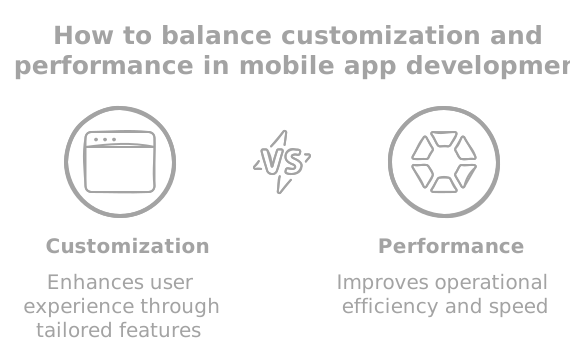
Here are some of the capabilities native uses naturally:
- Camera and sensors for features that depend on the physical environment, from scanning codes to augmented reality.
- GPS and geolocation for maps, deliveries, and experiences based on where the user actually is.
- Push notifications to reopen the conversation at the right moment and keep the relationship alive.
- Biometrics (fingerprint or face recognition) for secure, frictionless access.
- Offline functionality so the app stays useful even on intermittent signal, a deciding factor in many regions.
That last point deserves underlining. A good offline strategy lets the user check information, complete actions, and save progress even when the connection drops, syncing everything once the signal returns. For markets with uneven coverage, that continuity is the difference between a reliable tool and a frustrating one.
A best-in-class user experience
A native app naturally respects each platform’s conventions: the gestures, navigation, and patterns the user already knows without having to learn them. When a button sits where it’s expected and a swipe does what it should, the interface feels familiar and polished. That familiarity flattens the learning curve and builds trust from the very first use.
Mobile experience design isn’t window dressing, it’s what decides whether someone comes back. An interface consistent with the operating system signals care and seriousness, and those details translate into retention. Users spend most of their mobile time inside applications, not in the browser, so competing for their attention demands an experience that holds up against the best they already use every day.
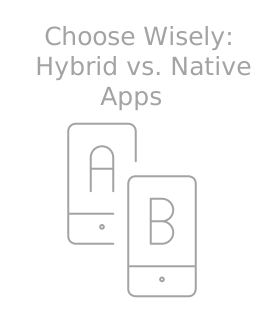
A well-executed native experience rests on a few concrete principles:
- Platform consistency. Following the iOS and Android design guidelines makes the app feel like part of the device, not a foreign body.
- Predictable navigation. When users sense where they are and how to get back, they stop thinking about the interface and focus on the task.
- Accessibility by default. Text sizes, contrast, and screen readers widen your audience and improve the experience for everyone.
- Polished microinteractions. Small visual and haptic responses confirm each action and make the app feel attentive to the user.
“A user interface is like a joke. If you have to explain it, it’s not that good.” The line, popular among designers, captures why clarity beats decoration.
Presence and trust in the stores
Being well positioned on the App Store and Google Play brings visibility, credibility, and a direct discovery channel. Millions of people search for solutions precisely there, and showing up in that storefront, with a polished listing and good reviews, projects a seriousness a website alone can rarely match. That presence is part of the investment’s value, not an extra.
Native apps integrate with each store’s full ecosystem: reviews and ratings that create social proof, updates that keep the product fresh, and metrics that tell you how your real audience behaves. That feedback loop is gold for iterating: every release can answer what users asked for in the last one.
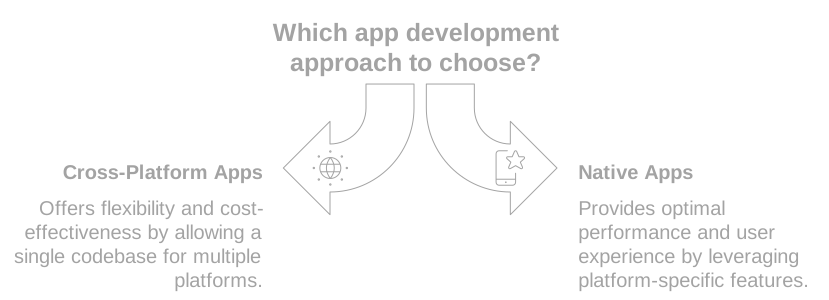
The value of a strong store presence is built with elements worth tending to:
- An optimized listing. Well-chosen screenshots, description, and keywords improve how many people discover and download your app.
- Reviews as social proof. High ratings lower the friction of that first download and reinforce trust in your brand.
- Frequent updates. A track record of steady improvements tells users there’s a committed team behind the product.
- A direct distribution channel. The stores handle payments, installation, and updates for you, simplifying operations.
That recognition becomes a brand asset. An icon on the phone’s home screen is a permanent reminder of your business, far closer than a tab lost among dozens in the browser.
Security and scalability built for the long run
Investing in native doesn’t end at launch: it also prepares you to grow. Data security is a top-tier concern today, and native development offers more robust protection mechanisms than many web or hybrid alternatives, from encrypted storage to using the device’s own biometrics. In a data-driven world, that strength in cybersecurity is a weighty argument.
Scalability is the other side of the coin. A well-planned native architecture lets you add features, support more users, and adapt to new devices without rebuilding from scratch. Combined with agile methodologies and modern backend services, an app can evolve at the pace of the business instead of slowing it down. That’s precisely what sets a product conceived as custom software apart from an improvised one.
Some foundations that support that orderly growth:
- Encrypted data. Protecting information at rest and in transit is the basis of user trust and a requirement in regulated sectors.
- Modular architecture. Splitting the app into clear pieces makes it easier to add features without breaking what already works.
- Controlled updates. Being able to fix and improve without disruption keeps quality high as the user base grows.
- Readiness for new devices. Native adapts sooner to the screens, sensors, and capabilities platforms introduce each year.
“The best way to predict the future is to create it.” The idea, often attributed to Peter Drucker, captures why investing in solid foundations today is the surest way to be ready for tomorrow.
In short
A native app is an investment in performance, capabilities, experience, security, and scalability when mobile is strategic for your business. It isn’t just about building an application, but about crafting an experience that connects with your audience and is ready to grow with it. If your company still relies solely on a traditional website or hybrid solutions, now is a good moment to consider native before competitors get ahead.
At LabWeb we build native apps that harness the device’s full potential, so your product feels fast, reliable, and worthy of what your users expect. If mobile is central to your strategy, we’re exactly the kind of partner that turns that bet into a solid product.
Full-Cycle of Mobile App Development Process
Our comprehensive mobile app development process ensures each phase is meticulously planned and executed for optimal results.
Laying the Foundation for Success
We decide whether your app should be native, cross-platform, hybrid, or a PWA based on your audience and budget. Strategy precedes code.
We map user journeys on iOS and Android, accounting for gestures, notifications, and offline use. Mobile changes the rules.
We agree on measurable adoption and retention goals. An app is justified by its use, not by existing.
Let's Get In Touch!
Send us a message, and we'll promptly discuss your project with you.
What's Next?
- We start by signing an NDA to ensure your ideas are protected.
- Then, our team will analyze your requirements.
- You get a detailed project outline.
- We bring your project to life, so you can focus on growing your business.
© 2019–2026 LabWeb · Laboratorio Internacional Web S.A. de C.V. · All rights reserved.